Photo: Wikipedia
Demographics of Canyon, TX
Affluence Level in Canyon, TX
A middle-class area roughly in line with national averages across income, home values, education, and employment.
People of Canyon, TX
How the city was settled and grew
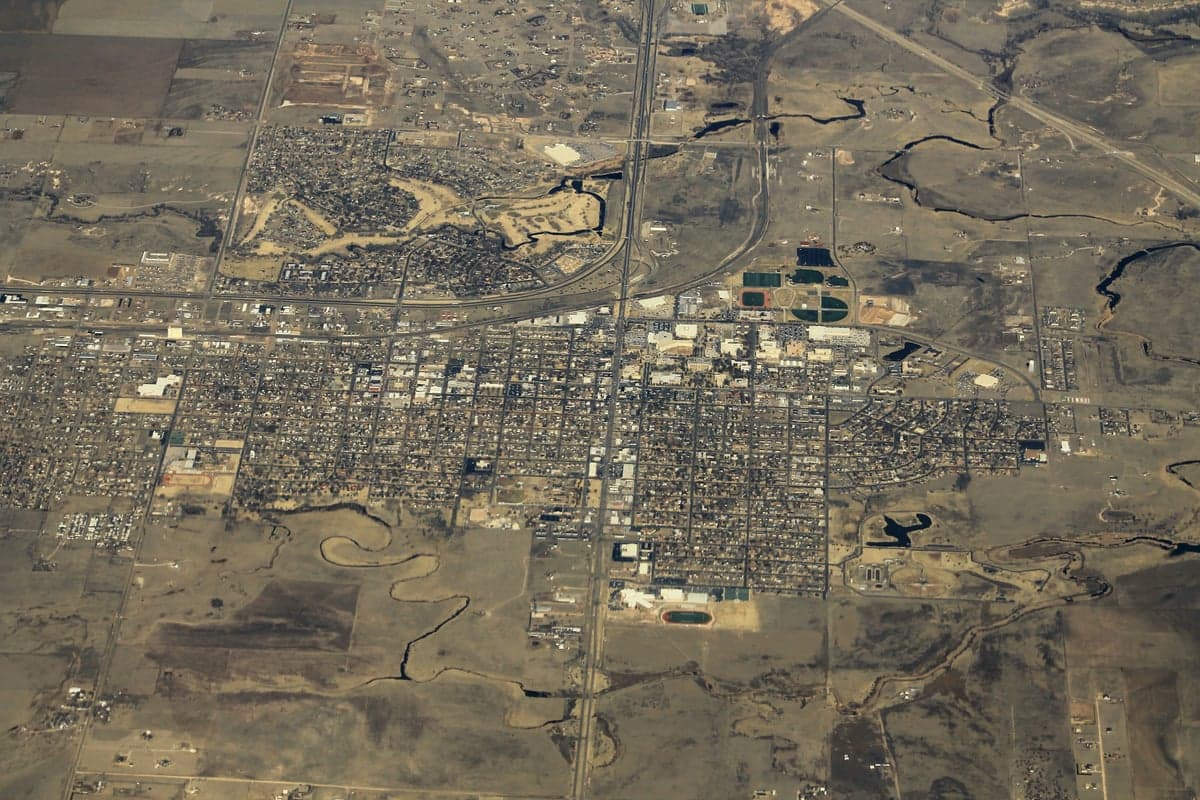
Canyon was founded in 1889 as a stop on the Fort Worth and Denver City Railway, which opened the Texas Panhandle to large-scale cattle ranching and homesteading. The original settlers were predominantly Anglo-American ranchers and farmers drawn by the promise of cheap land and open range, many arriving from the Deep South and Midwest. The town was officially incorporated in 1907, and its early growth centered around the courthouse square and the historic Old Town district, where wooden storefronts and saloons served the surrounding ranch population. A second wave arrived after 1910 when West Texas State Normal College (now West Texas A&M) was established, drawing faculty, staff, and students who settled in the University Heights neighborhood south of campus. The 1920s and 1930s saw modest growth from Dust Bowl refugees, many of whom found work on area ranches and in the newly built Palo Duro Canyon State Park, which opened in 1934 and created a tourism and service sector. These early waves established Canyon's character as a conservative, churchgoing, ranching community with a strong educational anchor.
Modern era (post-1965)
After the 1965 Immigration and Nationality Act, Canyon's demographic change was modest compared to larger Texas cities. The foreign-born population today stands at just 3.8%, indicating limited international immigration. Instead, the city's modern growth has come primarily from domestic in-migration: Amarillo families seeking smaller schools and lower crime, retirees from rural Panhandle counties, and university-related transplants. The Hispanic population grew from roughly 5% in 1980 to 17.8% today, driven largely by families moving from the Rio Grande Valley and West Texas agricultural communities for work in construction, service industries, and the university. These families have concentrated in the Southwest Canyon area near 23rd Street and in the Palo Duro Creek subdivision, where newer, more affordable housing stock attracted younger families. The Black population (3.9%) is small but stable, with many families connected to the university or to the regional medical center. East/Southeast Asian residents (0.9%) and Indian subcontinent residents (0.7%) are almost entirely affiliated with West Texas A&M as faculty, researchers, or graduate students, and they tend to live in the University Park and Canyon Ridge neighborhoods near campus. The overall effect of the modern era has been a gradual diversification of a historically homogeneous town, though the white majority remains dominant and the cultural tone remains distinctly Panhandle conservative.
The future
Canyon's population is projected to grow slowly but steadily, reaching roughly 17,000–18,000 by 2040, driven by continued university enrollment, retirement migration from the wider Panhandle, and spillover from Amarillo's suburban expansion. The Hispanic share is expected to rise to around 22–25% as younger families age into the school system and new arrivals from South Texas continue. The white share will decline proportionally but remain the large majority. The East/Southeast Asian and Indian subcontinent populations will likely grow modestly as West Texas A&M expands its international graduate programs, but they will remain small in absolute terms. New residential development is concentrated in the Timber Creek and Sleepy Hollow subdivisions on the city's north and east sides, which are attracting a mix of young families and retirees. The city's cultural identity is evolving from a purely ranching-and-agriculture town to a hybrid of college town and retirement community, but the conservative, family-oriented, church-centered character is unlikely to shift dramatically. The biggest demographic question is whether Canyon can attract and retain enough young professionals and families to keep its school system and tax base healthy as the population ages.
For someone moving to Canyon now, the city offers a stable, safe, and increasingly educated community where the dominant culture remains traditional and the pace of change is slow. The population is becoming slightly more diverse and more college-connected, but the core identity—rooted in ranching, the university, and conservative family values—remains intact. New arrivals will find a place where neighbors know each other, schools are strong, and the biggest cultural event of the year is still the Tri-State Fair and the Palo Duro Canyon musical "Texas."

* Values derived from national, state, county, city and local statistics and may differ in a specific area. Last updated: 2026-10-23T20:59:54.000Z
Narrative content on this page is AI-generated and may contain mistakes. Verify any details that matter before acting on them.
ReloMaps may earn a commission from affiliate links at no extra cost to you.

