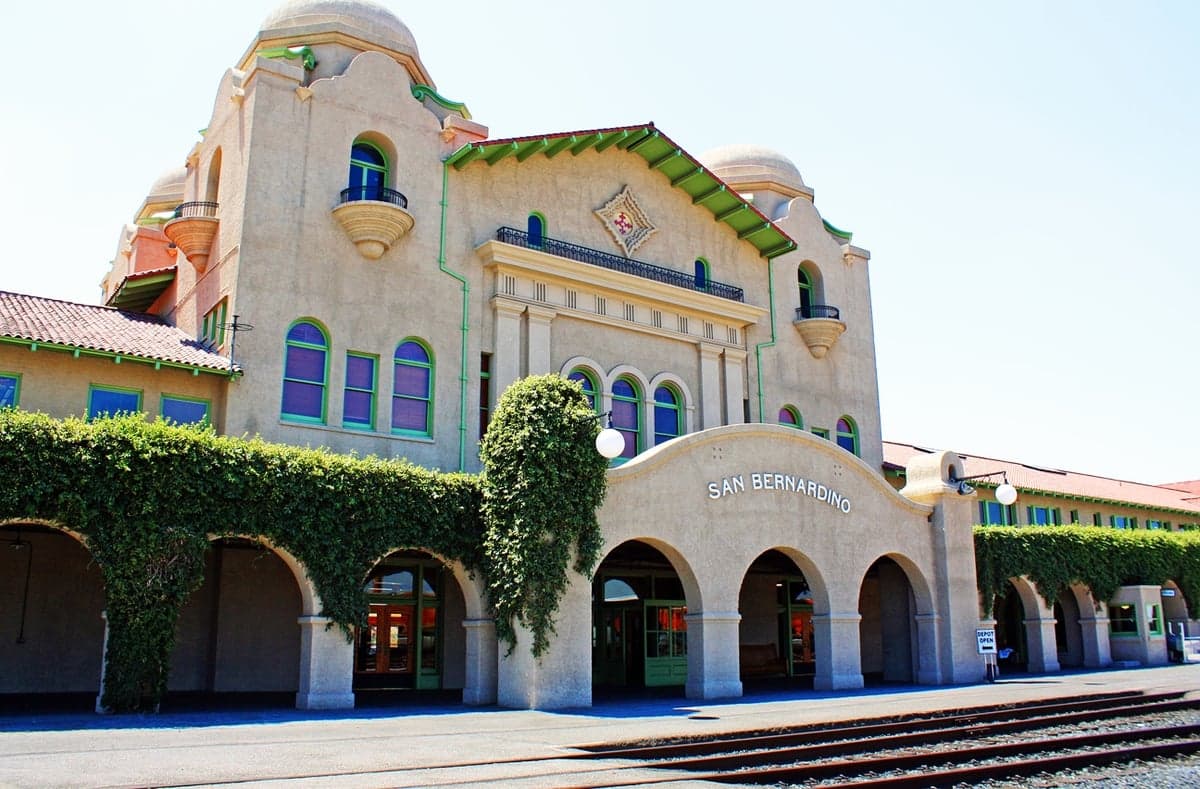
Photo: Wikipedia
Political ClimatePolitical Climate in San Bernardino County
Showing district-level results — no local-only data available.
Local Political AnalysisPolitical Analysis of San Bernardino County
San Bernardino County is a deep red outlier in deep blue California, carrying a Cook Partisan Voting Index of R+8 while the state as a whole sits at D+12. That 20-point gap makes this one of the most politically distinct large counties in the nation — a place where a Republican presidential candidate can win the county by double digits even as the state hands the Democrat a 30-point victory. The county has been trending slightly redder over the past decade, driven by population shifts out of coastal areas and into the Inland Empire, though the fast-growing cities along the I-15 corridor are starting to introduce more purple precincts.
How it compares
California's statewide D+12 lean means Democrats dominate every level of state government, from the legislature to the governor's office to the regulatory agencies that set housing, energy, and water policy. San Bernardino County's R+8 lean means its voters consistently elect a Republican-majority Board of Supervisors and send a mix of conservatives and moderates to Sacramento. The contrast is starkest in presidential elections: in 2020, Joe Biden won California by 29 points but lost San Bernardino County by about 7 points. The county's internal geography matters a lot — the mountain communities of Big Bear Lake and Crestline lean heavily Republican, as do the high desert towns of Hesperia, Victorville, and Apple Valley. Meanwhile, the western cities of Ontario, Rancho Cucamonga, and Fontana are more competitive, with Ontario and Rancho Cucamonga trending blue in recent cycles as commuters from Los Angeles and Orange County move east for cheaper housing. The city of San Bernardino itself is a Democratic stronghold, while the far eastern desert communities like Needles and Twentynine Palms swing unpredictably based on turnout.
What this means for residents
For conservative residents, living in San Bernardino County means your vote carries weight locally — you can elect school board members, city councilors, and county supervisors who share your priorities on taxes, land use, and public safety. But you'll also live under state laws passed by a legislature that doesn't represent your views, from stricter emissions standards to higher minimum wages to tenant protections that landlords in the high desert often find burdensome. For liberal residents, the dynamic is reversed: you may feel politically isolated in your neighborhood or workplace, especially in the high desert towns, but you benefit from statewide policies on healthcare, labor rights, and environmental regulation that the county's elected officials often oppose. The practical result is a county that feels more libertarian than partisan — people tend to leave each other alone, and the political fights that dominate coastal California news cycles often feel distant here.
Culturally, San Bernardino County is defined by its vastness and its frontier mentality. The high desert communities prize self-reliance and are skeptical of government overreach, while the western valley cities are more suburban and service-oriented, with a growing immigrant population that leans Democratic but is often socially moderate. Gun rights are a live issue — the county has a strong concealed-carry culture, and the Board of Supervisors has declared itself a Second Amendment sanctuary. On the other hand, the county's large public employee unions, particularly in law enforcement and education, wield real influence in local elections, creating a pragmatic, deal-making political culture that doesn't map neatly onto the national left-right divide. If you're moving here, expect local politics to be less about ideology and more about who can deliver roads, water, and fire protection in a county the size of West Virginia.

State Political ClimatePolitical Climate in California
State Political AnalysisPolitical Environment in the State
California is a solidly Democratic state with a Cook Partisan Voting Index of D+12, meaning it votes about 12 points more Democratic than the national average in presidential elections. Over the past 20 years, the state has shifted from a competitive purple state—George W. Bush lost it by just 10 points in 2004—to a deep blue stronghold where Democrats now hold every statewide office and supermajorities in both legislative chambers. That said, the political reality on the ground is far more complex than the statewide numbers suggest, with massive regional divides, a growing conservative rural resistance, and a steady stream of moderate and conservative-leaning transplants from other states who are reshaping certain inland communities.
Urban vs. rural divide
The political map of California is essentially a battle between the densely populated coastal metros and the vast interior. The San Francisco Bay Area, Los Angeles County, and the Sacramento metro area drive the state's Democratic lean, with places like San Francisco, Oakland, and Los Angeles routinely delivering 80-90% Democratic margins. In contrast, the Central Valley and far northern counties are deeply Republican: Bakersfield (Kern County) voted +17 for Trump in 2024, while Redding (Shasta County) went +30. The Inland Empire, including Riverside and San Bernardino counties, has become a key swing region—Riverside County voted for Hillary Clinton in 2016 but flipped to Trump in 2020 and 2024, reflecting a broader trend of working-class Latino and white voters moving right. Even within blue metros, there are conservative pockets: Orange County, once a Republican stronghold, has trended purple but still has deep-red suburbs like Yorba Linda and Huntington Beach, the latter of which has become a flashpoint for conservative resistance to state mandates. The Central Coast, including places like Santa Barbara and Monterey, leans Democratic but with a more moderate, business-friendly flavor than the Bay Area.
Policy environment
California's policy environment is defined by high taxes, heavy regulation, and a robust social safety net. The state has a progressive income tax with a top marginal rate of 13.3%—the highest in the nation—and a state sales tax that can exceed 10% in some cities. Property taxes are capped at 1% of assessed value under Proposition 13, but annual increases are limited to 2%, which benefits long-term homeowners but creates disparities for new buyers. The regulatory posture is among the most aggressive in the country, particularly on environmental issues: California has its own vehicle emissions standards, a cap-and-trade program, and some of the strictest building codes and land-use regulations in the nation. Education policy is dominated by the California Teachers Association, one of the most powerful unions in the state, and per-pupil spending has risen significantly but remains uneven across districts. Healthcare is heavily regulated, with the state operating its own insurance exchange (Covered California) and expanding Medi-Cal to cover low-income adults regardless of immigration status. Election laws are among the most accessible in the country: all registered voters receive a mail-in ballot, same-day registration is available, and the state has automatic voter registration through the DMV.
Recent policy direction
Over the past five years, California has moved decisively left on a range of issues that matter to relocators. On gun and self-defense law, the state has passed some of the nation's strictest measures: SB 2 (2023) effectively bans carrying firearms in most public places, including parks, hospitals, and public transit, while the state's assault weapons ban and 10-day waiting period remain in place. Parental and education rights have been a major flashpoint: AB 1955 (2024) prohibits school districts from requiring parental notification when a child changes their gender identity, while the state has also expanded ethnic studies requirements and banned book bans in school libraries. On speech and privacy, California has strengthened consumer privacy protections through the California Privacy Rights Act (CPRA) and passed laws targeting deepfake political ads, but has also faced criticism for allowing public universities to restrict certain speech through "bias response" systems. Medical and bodily autonomy is strongly protected: abortion remains legal and accessible, with the state spending millions to fund travel for out-of-state patients, and gender-affirming care for minors is protected under a 2022 "sanctuary" law. Property rights have been constrained by rent control expansion (AB 1482 caps annual rent increases at 5% plus inflation) and strict tenant protections, while the state's housing crisis has led to controversial laws like SB 9 (2021), which allows duplexes on single-family lots. Taxation remains a major concern for high earners, with no signs of relief: a 2024 ballot measure to raise the corporate tax rate failed, but the state's wealth tax proposals continue to circulate. Voting and ballot access has been expanded through universal mail-in voting and automatic registration, though Republicans have raised concerns about ballot harvesting and signature verification standards.
Civil unrest & political movements
California has been a national epicenter for political activism on both sides. The 2020 George Floyd protests in Los Angeles, Oakland, and San Francisco were among the largest and most destructive in the country, with billions in property damage and a lasting impact on public perceptions of crime and policing. On the right, the state has seen a surge in organized conservative activism, particularly in rural counties: Shasta County's Board of Supervisors has been taken over by a far-right majority that has clashed with state officials over election integrity and public health mandates, while the "California Exodus" movement has gained traction among conservatives who feel the state's policies are hostile to their values. Immigration politics are a constant flashpoint: California is a "sanctuary state" under SB 54 (2017), which limits local law enforcement cooperation with federal immigration authorities, and the state has spent millions on legal defense for undocumented immigrants. Secession and nullification rhetoric has emerged on both ends: the "Calexit" movement, which advocates for California's independence, gained attention after Trump's 2016 win but has little practical traction, while rural counties like Siskiyou and Modoc have passed symbolic "nullification" resolutions against state gun and vaccine mandates. Election integrity controversies have been a persistent issue, with conservative activists challenging the state's universal mail-in voting system and demanding stricter voter ID laws—efforts that have been uniformly rejected by the Democratic-controlled legislature. Visible flashpoints a new resident would notice include the prevalence of homeless encampments in major cities, the presence of armed counter-protesters at LGBTQ+ events, and the ubiquity of political signage in suburban neighborhoods.
Projection
Over the next 5-10 years, California's political trajectory points toward a continuation of its current trends, but with important nuances. The state's Democratic supermajority is likely to hold, but the margin of control may narrow as the Central Valley and Inland Empire continue to shift right. The biggest wild card is demographic change: the state's population has declined for three consecutive years, driven by out-migration to Texas, Arizona, and Nevada, and the people leaving are disproportionately middle-income and conservative-leaning. Meanwhile, the state continues to attract high-skilled immigrants and young progressives to coastal cities, reinforcing the urban-rural divide. Housing affordability will remain the central political issue, and the state's recent push to upzone single-family neighborhoods (SB 9, SB 10) is likely to accelerate, potentially reshaping suburban politics. On the policy front, expect further movement on climate regulation, healthcare expansion, and tenant protections, while gun control and parental rights battles will intensify. The most realistic scenario for a new resident is a state that remains deeply blue at the statewide level but becomes increasingly polarized internally, with conservative enclaves like Huntington Beach, Bakersfield, and Redding becoming more vocal and organized in their resistance.
For a conservative-leaning relocator, the bottom line is that California offers a high-cost, high-regulation environment where your political views will be in the minority at the state level, but where you can find like-minded communities in specific cities and counties. If you're moving to the Bay Area or Los Angeles, expect to navigate a culture where progressive politics are the default in schools, workplaces, and local government. If you're looking at the Central Valley, the Inland Empire, or Orange County, you'll find more political diversity and a stronger conservative infrastructure, but you'll still be subject to state-level policies on taxes, guns, and education that you may find frustrating. The key is to choose your location carefully: Huntington Beach, Bakersfield, and Redding are among the most conservative cities in the state, while San Francisco, Oakland, and Berkeley are among the most progressive. For families, the quality of public schools varies dramatically by district, and the cost of living is a constant pressure. If you value strong property rights, low taxes, and a hands-off regulatory environment, California will be a difficult fit. If you're willing to trade those for access to world-class natural beauty, a diverse economy, and a climate that's hard to beat, it can still work—but you'll need to be strategic about where you land.
* Values derived from national, state, county, city and local statistics and may differ in a specific area. Last updated: 2026-07-12T09:18:14.000Z
Narrative content on this page is AI-generated and may contain mistakes. Verify any details that matter before acting on them.
ReloMaps may earn a commission from affiliate links at no extra cost to you.

