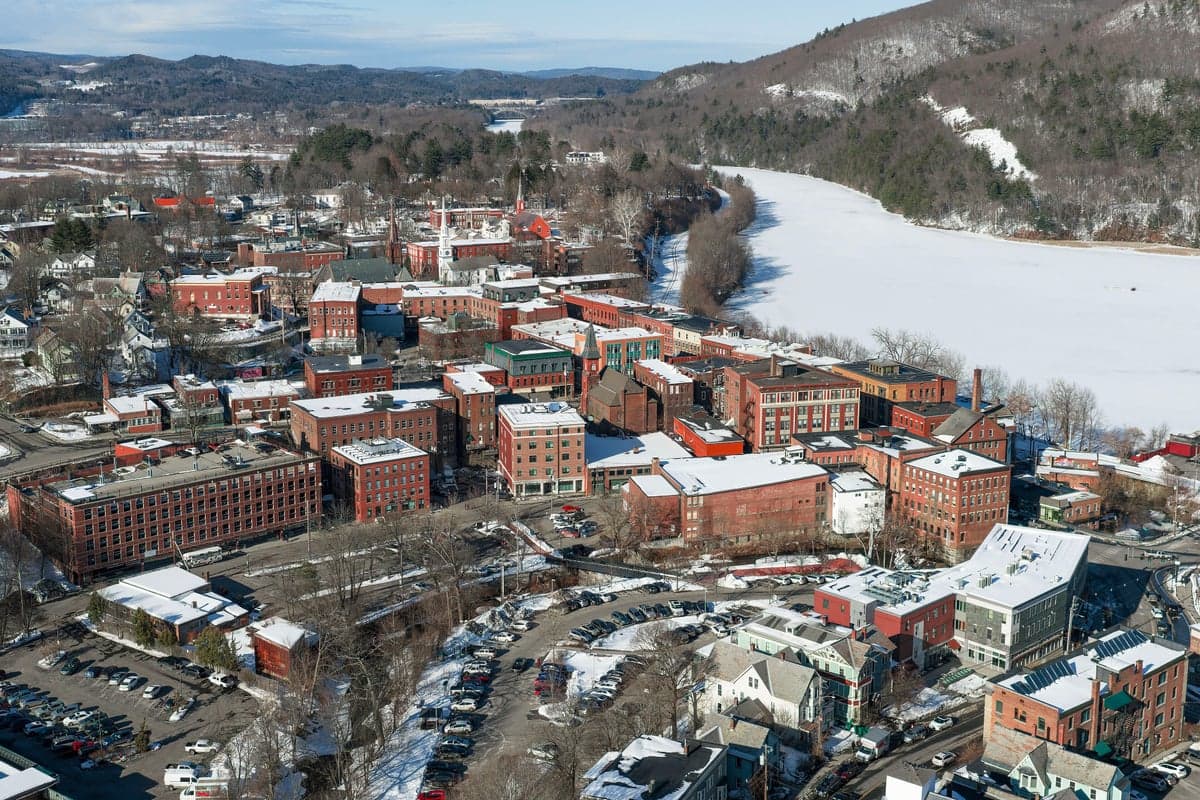
Photo: Wikipedia
Personal Sovereignty in Brattleboro, VT
Moderate friction. Expect trade-offs in some aspect of personal liberty and independence.
What does Personal Sovereignty tell us?
Personal Sovereignty measures your capacity for self-reliance and independence with minimal government friction. Higher scores mean fewer barriers between you and the way you want to live... but it assumes you have the space you need and good neighbors.
What does this tell us?
Personal Sovereignty measures your capacity for self-reliance and independence with minimal government friction. Higher scores mean fewer barriers between you and the way you want to live... but it assumes you have the space you need and good neighbors.
State Policy
Energy independence: Importer (15% of energy produced in-state)
Personal Liberty
Homesteading

Personal Liberty Analysis
Brattleboro offers a complex personal sovereignty environment that reflects Vermont's broader tension between progressive social governance and a deep-rooted libertarian streak. For individuals and families prioritizing autonomy, the town provides meaningful freedoms in areas like self-reliance and land use, but imposes significant constraints through high tax burdens and restrictive gun laws. The net effect is a place where personal sovereignty is highly conditional — strong on lifestyle independence, weak on fiscal and self-defense freedom.
Tax burden and regulatory posture in Brattleboro
Vermont's tax climate ranks among the heaviest in the nation, and Brattleboro sits squarely within that reality. The state levies a progressive income tax with rates from 3.35% to 8.75% on the highest brackets, and the sales tax is 6% — with no local option to reduce it. Property taxes in Brattleboro are notably high, driven by the state's education funding system (Act 60/68) that pools local revenue and redistributes it statewide. For a median-priced home around $300,000, annual property taxes can exceed $6,000, roughly 2% of assessed value. This is a heavy load compared to most of the country. The regulatory environment is similarly hands-on. Vermont has strict land use laws under Act 250, which applies to developments over 10 acres or involving substantial construction — even for single-family homes in some cases. Brattleboro's own zoning adds another layer, with permitting processes that can stretch months for additions or new builds. For a reader accustomed to low-tax, low-regulation states like Texas or Florida, the fiscal posture here will feel like a significant constraint on personal financial autonomy.
Self-defense and gun law specifics in Vermont
Vermont's gun laws have shifted dramatically from its historically permissive reputation. While the state still allows permitless carry (constitutional carry) for handguns and long guns, the legislature has enacted several restrictions since 2018 that directly impact self-defense sovereignty. Magazine capacity is capped at 15 rounds for handguns and 10 for long guns, which limits defensive firearm options. The state also bans "assault weapons" under a 2022 law, defined broadly to include many semi-automatic rifles with features like pistol grips or threaded barrels. Waiting periods of 72 hours apply to all firearm purchases, including private sales, and universal background checks are required. Vermont does not have a "stand your ground" law; instead, it follows a duty-to-retreat standard outside the home, meaning you must attempt to avoid a confrontation before using deadly force in public. For a conservative-leaning reader, these laws represent a significant erosion of the self-defense autonomy that was once a hallmark of Vermont's independent character. Brattleboro itself is a politically progressive town, and local law enforcement generally enforces these statutes without resistance. If carrying a firearm for personal protection is a priority, this is a restrictive environment compared to states like New Hampshire or Maine.
Self-reliance and homesteading viability in Brattleboro
This is where Brattleboro's sovereignty profile shines brightest. The town and surrounding Windham County offer genuine opportunities for self-reliance that are rare in the Northeast. Lot sizes in Brattleboro proper are typically 0.25 to 1 acre, but just outside town in areas like Dummerston or Guilford, 5- to 20-acre parcels are common and affordable relative to southern New England. Zoning is generally permissive for small-scale agriculture: chickens, goats, and even a single cow are allowed on residential lots in most of Brattleboro, though pigs and roosters may require special permits. Off-grid living is legally feasible but not frictionless. Vermont's building code requires a septic system and well for any habitable structure, and solar panels must meet interconnection standards if tied to the grid. However, the state has no law requiring a grid connection, and many residents in the surrounding hills live fully off-grid with solar, wood heat, and rainwater collection. The growing season is short (roughly 120 days) and the soil is rocky, but experienced homesteaders can produce a significant portion of their own food. Wood heat is the norm here — firewood permits on state land cost just $5 per cord — and the town has multiple farm supply stores and a strong network of local farmers. For a family wanting to reduce dependence on supply chains, Brattleboro's rural fringe offers a viable path, though the upfront cost of land and infrastructure is higher than in the Midwest or South.
Personal liberties: parental rights, medical autonomy, speech, and property
Vermont's approach to personal liberties is a mixed bag that requires careful navigation. On parental rights, the state is among the most progressive in the country. Vermont law does not require parental notification for a minor to obtain an abortion or gender-affirming care, and schools are prohibited from notifying parents if a child changes their name or pronouns without the child's consent. This is a significant concern for conservative families who prioritize parental authority in medical and educational decisions. Medical autonomy more broadly is constrained by Vermont's vaccine mandates: the state requires all schoolchildren to be vaccinated against a standard set of diseases, with only medical exemptions allowed (no religious or philosophical exemptions). During COVID-19, Vermont had some of the strictest mandates in the nation, including a healthcare worker vaccine requirement that remains in effect. Free speech is generally protected under the First Amendment, but Brattleboro's social climate can be intolerant of dissenting views on hot-button issues like COVID-19 policies or gender ideology — a de facto constraint that may affect comfort level. Property rights are relatively strong: Vermont has no statewide rent control, and Brattleboro does not impose rent stabilization. However, the Act 250 permitting process can limit what you can do with your land, and the state's strong environmental regulations restrict activities like logging or stream alteration without permits. For a reader who values maximum control over their children's upbringing and medical choices, these policies will feel intrusive.
Overall, Brattleboro's personal sovereignty environment is a study in trade-offs. It offers genuine freedom for self-reliant living — land access, homesteading viability, and a culture that respects individual lifestyle choices — but demands high taxes, accepts restrictive gun laws, and imposes progressive social policies that limit parental and medical autonomy. Compared to a state like New Hampshire (lower taxes, constitutional carry, no vaccine mandates, parental notification laws), Brattleboro is clearly more interventionist. Compared to Massachusetts or New York, it is notably more permissive on land use and self-reliance. For a conservative-leaning individual or family, the decision hinges on which freedoms matter most: if self-sufficiency and rural independence are paramount, Brattleboro can work with careful planning; if fiscal freedom, self-defense rights, and parental control are non-negotiable, the town will feel like a net loss of sovereignty.

* Values derived from national, state, county, city and local statistics and may differ in a specific area. Last updated: 2026-10-17T00:31:53.000Z
Narrative content on this page is AI-generated and may contain mistakes. Verify any details that matter before acting on them.
ReloMaps may earn a commission from affiliate links at no extra cost to you.

