Photo: Wikipedia
Demographics of Brattleboro, VT
Affluence Level in Brattleboro, VT
A below-average socioeconomic profile. Incomes, home values, and educational attainment trail the U.S., with higher poverty and unemployment.
People of Brattleboro, VT
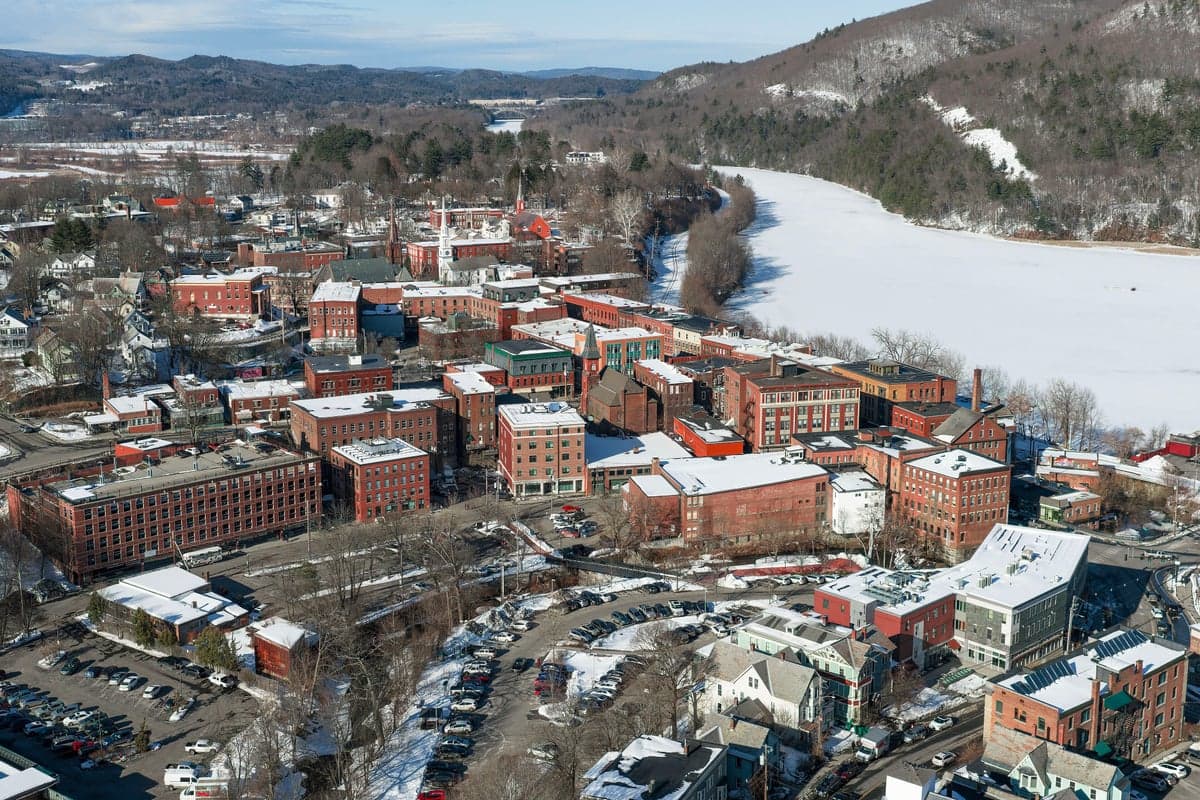
The people of Brattleboro, Vermont, today number 7,793, forming a tight-knit, predominantly white community with a notably high education level—51.0% of adults hold a college degree. The population is overwhelmingly native-born, with only 0.2% foreign-born, and the racial makeup is 91.7% white, 3.3% Hispanic, 1.0% Black, 0.7% East/Southeast Asian, and 0.1% Indian (subcontinent). This is a community shaped by waves of Yankee settlers, industrial workers, and countercultural migrants, resulting in a distinctive blend of progressive activism and traditional New England independence.
How the city was settled and grew
Brattleboro’s human history begins with the original inhabitants, the Abenaki people, who used the confluence of the West River and Connecticut River as a seasonal fishing and trading site. European settlement began in 1724 with the construction of Fort Dummer, a British colonial outpost, but permanent Yankee settlers—primarily of English descent—arrived in the 1760s after land grants were issued. These early families, drawn by fertile river valleys and timber, established the West Brattleboro neighborhood, where many of their descendants still live in historic farmhouses and village centers. The town’s growth accelerated in the 19th century with the arrival of the railroad and the rise of manufacturing—especially the Estey Organ Company, which by the 1880s was the world’s largest organ manufacturer. This industry drew a wave of French-Canadian and Irish immigrants, who settled in the South Main Street and Putney Road corridors, building working-class neighborhoods with dense tenements and Catholic churches. A smaller wave of German and Italian craftsmen arrived later, concentrating in the West River Road area near the factories. By 1900, Brattleboro was a bustling industrial town of about 6,000, overwhelmingly white and native-born, with a strong Yankee-Protestant elite and a growing Catholic working class.
Modern era (post-1965)
The post-1965 period brought significant demographic shifts, though Brattleboro remained overwhelmingly white. The 1965 Immigration and Nationality Act had little direct effect here—the foreign-born population today is just 0.2%—but domestic in-migration reshaped the town. Starting in the 1970s, a wave of countercultural migrants, artists, and back-to-the-landers from the Northeast moved to Brattleboro, drawn by its scenic beauty, affordable housing, and reputation for tolerance. These newcomers, often college-educated and politically progressive, settled in the West Brattleboro and Algiers Village neighborhoods, converting old farmhouses into communal homes and opening natural food stores and craft businesses. This influx drove the college-educated share from roughly 20% in 1970 to 51% today. The Hispanic population grew from near zero to 3.3%, concentrated in the Flat Street area near downtown, where seasonal agricultural and service jobs attracted a small but stable Latino workforce. The Black population remains at 1.0%, with families historically concentrated in the South Main Street corridor, near the former railroad and industrial zones. The East/Southeast Asian population (0.7%) is largely composed of professionals and academics associated with the nearby School for International Training, living dispersed across the Western Avenue and Cedar Street neighborhoods. The Indian subcontinent population (0.1%) is negligible, with a handful of families in the West Brattleboro area. Suburbanization has been minimal—Brattleboro’s compact, walkable layout and strict land-use regulations have kept new development infill rather than sprawl.
The future
Brattleboro’s population is aging and slowly declining—down from 8,000 in 2000—and is projected to remain predominantly white and native-born for the foreseeable future. The Hispanic share is expected to grow modestly, possibly reaching 5-6% by 2040, driven by service-sector employment in hospitality and healthcare, with new arrivals likely settling in the Flat Street and Putney Road areas. The East/Southeast Asian population may increase slightly as the School for International Training continues to attract international students and faculty, but most will not settle permanently. The Black and Indian subcontinent populations are likely to remain below 2% each. The most significant demographic trend is the continued in-migration of educated, progressive retirees and remote workers from Boston, New York, and other expensive Northeast cities, drawn by Brattleboro’s cultural amenities and lower cost of living. These newcomers are concentrating in West Brattleboro and Algiers Village, driving up home prices and accelerating the displacement of long-term working-class residents. The cultural identity is becoming more polarized: a highly educated, activist-leaning majority coexists with a smaller, more traditional working-class population, creating a town that is both politically progressive and socially insular.
For someone moving in now, Brattleboro offers a stable, safe, and highly educated community with a strong sense of place, but it is not a diverse or growing population center. The town is becoming more expensive, more progressive, and more oriented toward retirees and remote workers, while the working-class and younger family demographics shrink. New residents should expect a welcoming but close-knit environment where fitting in requires active participation in local civic and cultural life.

* Values derived from national, state, county, city and local statistics and may differ in a specific area. Last updated: 2026-10-17T00:31:53.000Z
Narrative content on this page is AI-generated and may contain mistakes. Verify any details that matter before acting on them.
ReloMaps may earn a commission from affiliate links at no extra cost to you.

