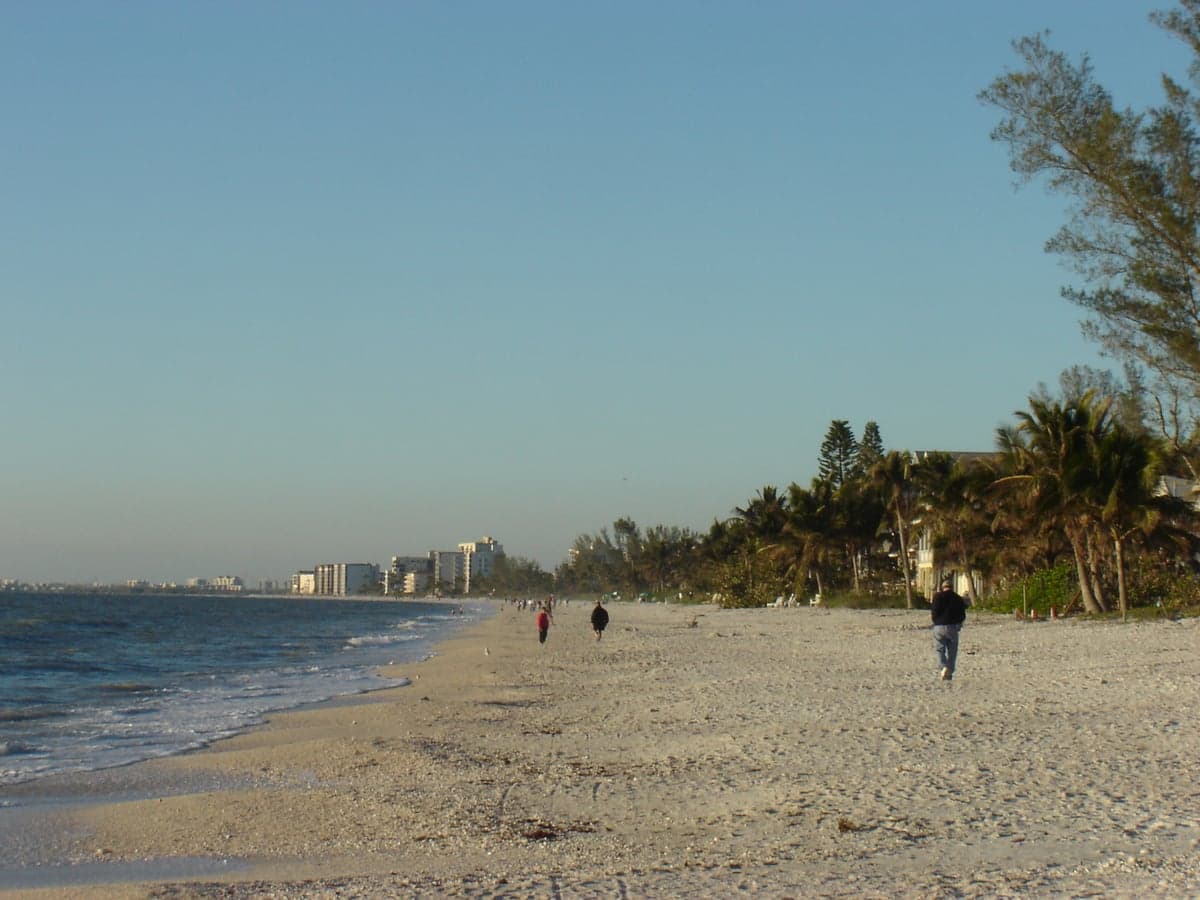
Photo: Wikipedia
Political ClimatePolitical Climate in Bonita Springs, FL
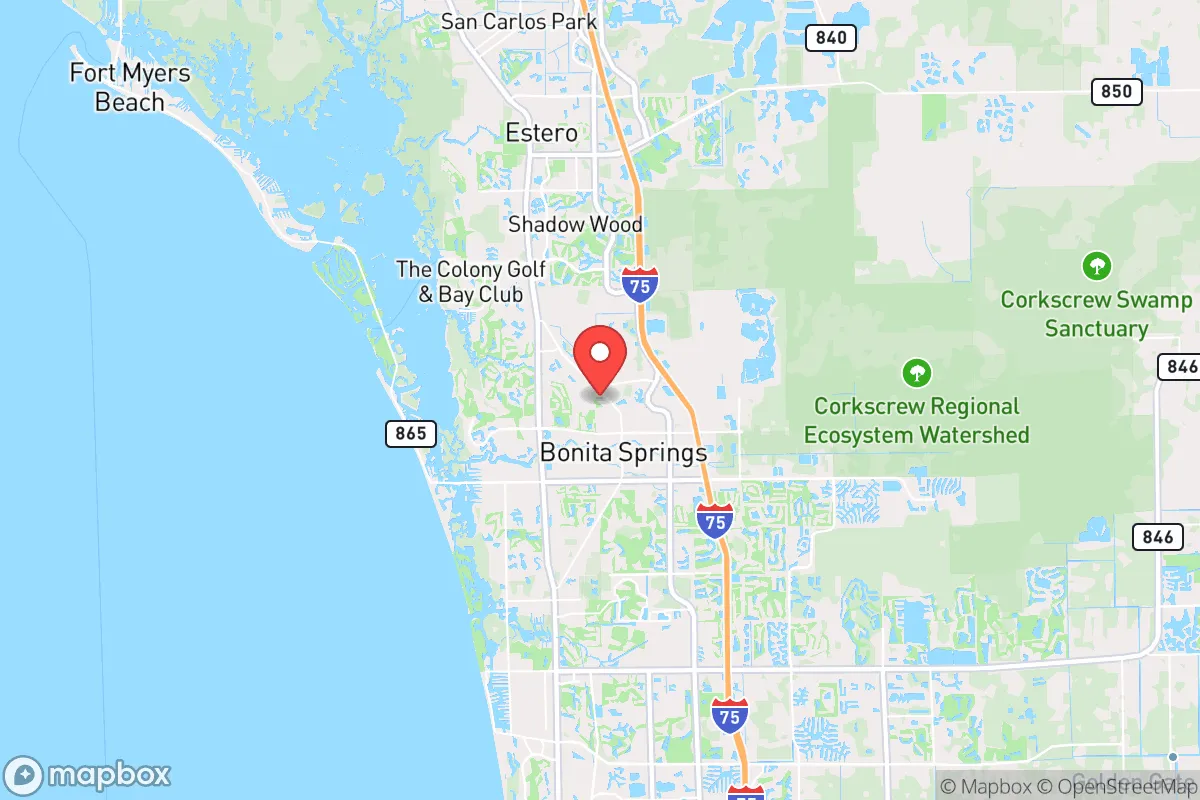
District shown is the primary district for this city’s centroid. Cities may span multiple districts.
Local Political AnalysisPolitical Analysis of Bonita Springs, FL
Bonita Springs leans solidly Republican, with a Cook Partisan Voting Index (PVI) of R+14, making it significantly more conservative than the national average and somewhat more so than the state of Florida as a whole, which has a PVI of R+3. Over the past decade, the area has deepened its red hue, driven largely by an influx of retirees from the Midwest and Northeast who tend to vote Republican, as well as a growing population of families seeking lower taxes and a more traditional lifestyle. While the city itself is reliably conservative, its immediate neighbors—like the more affluent and slightly more moderate Naples to the south, or the historically Democratic-leaning agricultural communities in Immokalee to the east—offer a reminder that Southwest Florida is not a monolith.
How it compares
Compared to Florida as a whole, Bonita Springs is roughly 11 points more Republican on the PVI scale, which is a meaningful gap. Statewide, Florida is a competitive swing state where elections are often decided by margins of 1-3 points, but in Bonita Springs, Republican candidates typically win by 20-30 points in local races. For context, nearby Fort Myers (about 20 minutes north) has a PVI of R+8, while Cape Coral (just across the Caloosahatchee River) sits at R+13—both similar but slightly less conservative. The real contrast comes when you look east to Lee County’s inland areas, like Lehigh Acres, which has a PVI of R+5 and a more diverse, working-class electorate. In Bonita Springs, the political conversation is dominated by growth management, water quality (especially red tide and algae blooms), and property taxes—issues that unite most residents across party lines, even if the solutions proposed tend to lean conservative.
What this means for residents
For conservative residents, Bonita Springs feels like a natural fit: local government is generally pro-business, zoning laws favor development, and there’s little pushback on Second Amendment rights or school choice. The city council and Lee County Commission are reliably Republican, so conservative priorities—like keeping taxes low and limiting regulations—tend to move forward without much drama. For liberal residents, life here is more about finding your niche. There’s a small but active Democratic club, and many progressives find common ground with conservatives on environmental issues like protecting the Everglades and limiting overdevelopment. Socially, the area is polite but not particularly diverse in political opinion; you’re unlikely to hear heated political debates at the grocery store, but you also won’t see many yard signs for Democratic candidates. The practical effect is that liberal residents often feel they need to be selective about where they voice their views, especially in more insular neighborhoods or homeowner associations.
Culturally, Bonita Springs is defined by its rapid growth and its status as a retirement and second-home destination. The local policy debates revolve around managing that growth—how many new homes can be built, how to fund road expansions, and how to keep the beaches clean. Unlike some parts of Florida where cultural wars over education or LGBTQ rights dominate headlines, Bonita Springs tends to focus on bread-and-butter issues. That said, the area’s conservative lean means that school board and library board elections often see candidates running on platforms of parental rights and limited government. Looking ahead, the trajectory seems clear: Bonita Springs will likely stay R+14 or even shift a point or two rightward as more conservative retirees arrive from blue states. But the real story is how the city balances its growth with its natural environment—a challenge that will test whether its political unity can hold when the costs of development start to outweigh the benefits.

State Political ClimatePolitical Climate in Florida
State Political AnalysisPolitical Environment in the State
Florida has transformed from a quintessential swing state into a solidly Republican-leaning powerhouse over the past decade, driven by a massive influx of conservative-leaning migrants from the Northeast and Midwest. The state’s overall partisan lean now sits roughly R+6 to R+8 in statewide elections, a dramatic shift from the 2000 and 2004 nail-biters where a few hundred votes decided the presidency. This realignment is anchored by a dominant Republican trifecta in Tallahassee—control of the governorship, state House, and Senate—that has been in place since 1999, with only brief interruptions. For a relocator, this means the state’s political culture is increasingly defined by conservative policy priorities, though the coastal metros remain vibrant Democratic strongholds.
Urban vs. rural divide
The political map of Florida is a study in stark contrasts. The state’s three major Democratic engines are Miami-Dade County (Miami, Hialeah), Broward County (Fort Lauderdale), and Palm Beach County (West Palm Beach), which together deliver roughly 1.5 million vote margins for Democratic candidates. However, even this bastion is cracking: Miami-Dade, once reliably blue, has shifted rightward by about 10 points since 2016, with Cuban-American and Venezuelan-American voters increasingly backing Republicans over concerns about socialism and economic freedom. The I-4 corridor—stretching from Tampa through Orlando to Daytona Beach—remains the true battleground, with fast-growing suburbs like Lakeland and Clermont trending red as new arrivals from blue states settle in. Meanwhile, the Panhandle and rural interior—places like Panama City, Ocala, and Gainesville (the latter a blue island in a red sea)—vote Republican by margins of 30-40 points. The result is a state where a Democrat can win statewide only by running up massive margins in the southeast while keeping losses manageable in the Tampa-Orlando corridor—a formula that has failed in every statewide race since 2012.
Policy environment
Florida’s policy environment is defined by a low-tax, low-regulation posture that has become a national model for conservative governance. There is no state income tax, a fact that drives much of the in-migration from high-tax states like New York and California. Property taxes are moderate, with a 3% annual cap on assessment increases for homesteaded properties (Save Our Homes amendment). The regulatory climate is business-friendly: Florida is a right-to-work state, and permitting processes for construction and development are streamlined compared to the Northeast. Education policy has been a flashpoint: the state has the nation’s largest school voucher program (the Family Empowerment Scholarship), and Governor Ron DeSantis signed the Parental Rights in Education Act (HB 1557, often called the “Don’t Say Gay” law) in 2022, which restricts classroom instruction on sexual orientation and gender identity through third grade. Healthcare policy is mixed: Florida did not expand Medicaid under the Affordable Care Act, leaving roughly 800,000 low-income adults without coverage, but the state has a robust private insurance market and a growing telehealth sector. Election laws have been tightened: the 2021 SB 90 law added voter ID requirements, limited drop boxes, and restricted third-party ballot collection, while the 2023 SB 7050 law increased penalties for ballot harvesting and required stricter signature verification.
Recent policy direction
The last three years have seen an aggressive push on cultural and liberty-related issues that directly affect daily life. On gun and self-defense law, Florida became a permitless carry state in 2023 (HB 543), allowing any adult legally allowed to own a firearm to carry it concealed without a permit. The “Stand Your Ground” law remains in full effect, with no duty to retreat in any place where a person has a right to be. On parental and education rights, the 2022 “Don’t Say Gay” law was expanded in 2023 to cover all grades (HB 1069), and the state now requires schools to teach that “the United States is a constitutional republic” and that “the history of the United States is the history of a nation of people who have struggled to form a more perfect union.” On speech and privacy, the state passed the “Stop WOKE Act” (HB 7) in 2022, which restricts workplace and educational training that promotes certain concepts about race and sex—a law that has been partially blocked by federal courts. On medical and bodily autonomy, Florida banned abortion after six weeks of pregnancy in 2023 (HB 5), with exceptions for rape, incest, and the life of the mother. The state has also restricted gender-affirming care for minors (SB 254, 2023). On property rights, the state has strengthened protections against eminent domain and passed laws limiting homeowners’ association (HOA) fines and foreclosure powers. On taxation, the 2023 budget included a permanent reduction in the corporate income tax rate from 5.5% to 5.0%, and the state has repeatedly suspended the gas tax. On voting and ballot access, the 2023 SB 7050 law requires all mail-in ballot requests to be renewed every two years and prohibits private funding of election administration.
Civil unrest & political movements
Florida has seen its share of political flashpoints, though large-scale civil unrest has been less common than in some other states. The 2020 George Floyd protests were significant in Miami, Orlando, and Tampa, with several nights of demonstrations and some property damage, but the state did not see the prolonged unrest of Portland or Seattle. The “Don’t Say Gay” law sparked protests outside the state capitol and school board meetings across the state, particularly in liberal enclaves like Tallahassee and Gainesville. Immigration politics are a constant undercurrent: Florida passed the nation’s toughest anti-sanctuary city law (SB 1718) in 2023, which requires businesses with 25+ employees to use E-Verify, makes it a felony to transport undocumented immigrants into the state, and invalidates out-of-state driver’s licenses for undocumented residents. This has led to protests from immigrant rights groups, particularly in Miami and Immokalee. Election integrity controversies have been muted compared to 2020, but the state’s 2022 gubernatorial election saw no major irregularities. A new resident would notice the ubiquity of political yard signs and bumper stickers, especially in suburban areas, and the presence of active local Republican and Democratic clubs in most mid-sized towns.
Projection
Over the next 5-10 years, Florida is likely to become more Republican at the state level, driven by continued in-migration from blue states and the naturalization of conservative-leaning Hispanic voters. The state’s population is projected to grow by roughly 3 million people by 2030, with most new arrivals settling in the I-4 corridor and Southwest Florida (Naples, Fort Myers, Sarasota). These migrants tend to be older, wealthier, and more conservative than the national average. However, the Democratic base in the southeast is not disappearing—it’s just becoming a smaller share of a growing pie. The wild card is the youth vote: Florida’s under-30 population is more liberal than the state as a whole, but they vote at lower rates. If the state’s abortion ban and education policies drive younger voters to the polls in higher numbers, the partisan balance could tighten again. For now, the trajectory points to continued Republican dominance, with the state likely to remain a safe red state for presidential elections through at least 2032. A relocator moving in now should expect a political environment where conservative policies on taxes, education, and immigration are the norm, but where coastal cities remain vibrant Democratic strongholds with their own local political cultures.
For a new resident, the bottom line is this: Florida offers a political environment that is predictably conservative at the state level, with low taxes, strong gun rights, and a business-friendly regulatory climate. If you lean right, you’ll find a state government that largely shares your values and is actively shaping policy to match them. If you lean left, you’ll find that your vote carries less weight in statewide elections, but you’ll still have plenty of company in the cities and suburbs of the southeast and I-4 corridor. The practical takeaway is that Florida is a state where your political identity will be shaped more by your local community than by the state as a whole—and where the cost of living and tax advantages may outweigh any policy disagreements you have with Tallahassee.
* Values derived from national, state, county, city and local statistics and may differ in a specific area. Last updated: 2026-09-17T20:18:06.000Z
Narrative content on this page is AI-generated and may contain mistakes. Verify any details that matter before acting on them.
ReloMaps may earn a commission from affiliate links at no extra cost to you.

