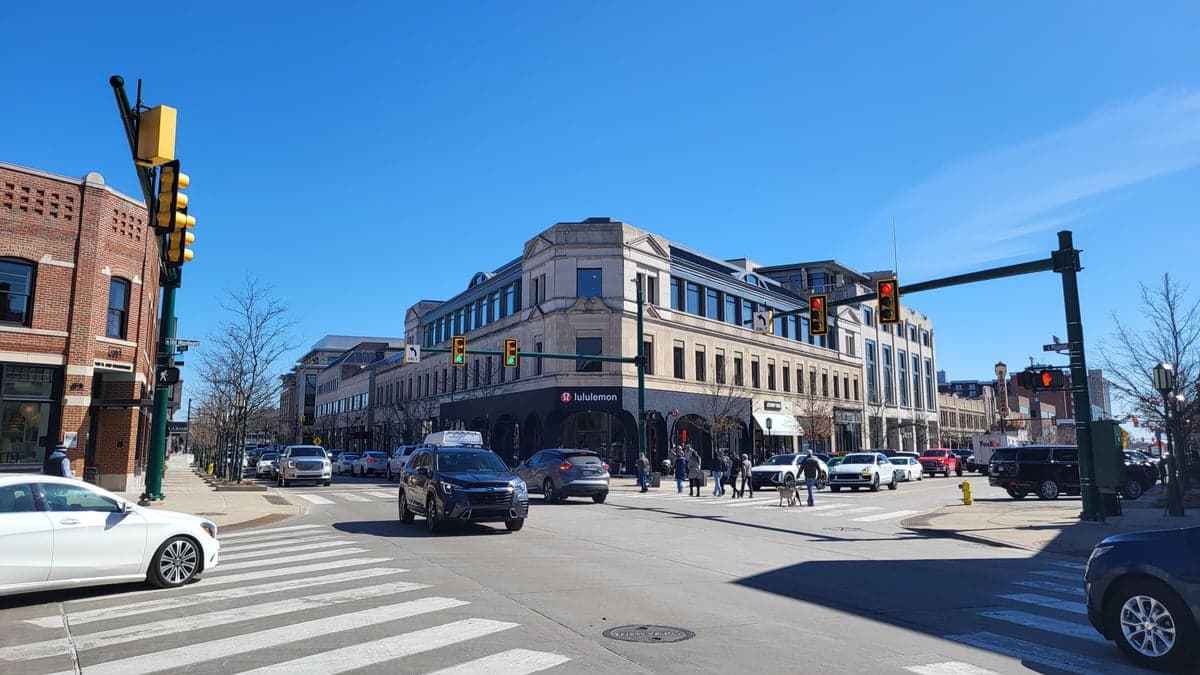
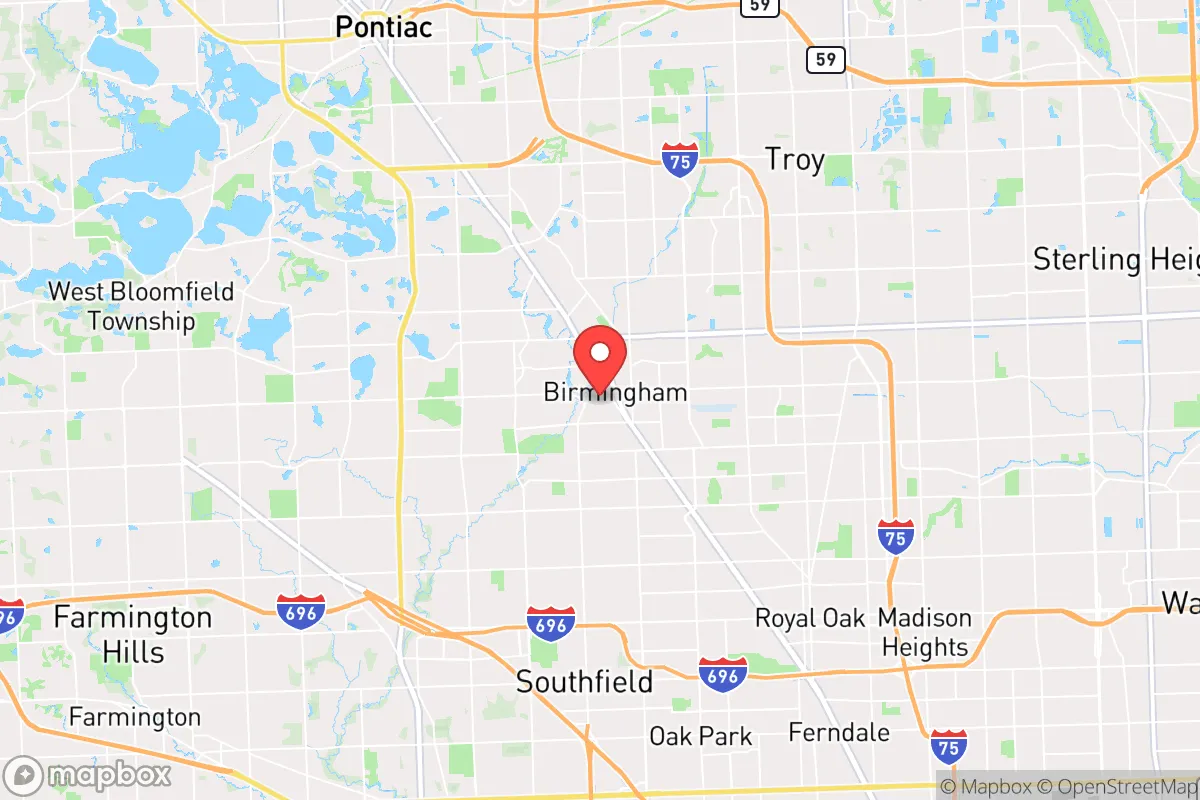
Photo: Wikipedia
Demographics of Birmingham, MI
Affluence Level in Birmingham, MI
An upper-middle-class area. Household wealth, education levels, and homeownership run ahead of national benchmarks.
People of Birmingham, MI
The people of Birmingham, Michigan today form a highly educated, predominantly white population of 21,612, with a distinctive blend of old-money legacy families and new professional arrivals drawn by the city’s top-ranked schools and walkable downtown. The city’s character is defined by its 76.9% college-educated rate, a low 3.3% foreign-born share, and a modest but growing diversity that includes 3.8% Hispanic, 3.6% Black, 2.6% Indian (subcontinent), and 2.4% East/Southeast Asian residents. Birmingham is not a melting pot but a curated, high-cost suburb where stability and affluence are the dominant notes, and where demographic change is slow and concentrated in specific enclaves.
How the city was settled and grew
Birmingham’s population story begins with the 1817 Treaty of Fort Meigs, which opened the area to Yankee settlers from New York and New England. The first permanent settler, John W. Hunter, arrived in 1818, followed by Elijah Willets and others who dammed the River Rouge to power a sawmill and gristmill. The village was platted in 1828 and named after Birmingham, England, reflecting the founders’ industrial ambitions. The original population was entirely white, Protestant, and of British or German stock, clustering around what is now the Old Woodward Avenue corridor and the Shain Park area. The arrival of the Detroit and Birmingham Railway in 1870 turned the village into a commuter suburb for Detroit’s elite, and grand homes went up in the Quarton Lake and Booth Park neighborhoods. By 1900, Birmingham’s population was about 1,000, still overwhelmingly white and native-born, with a small enclave of Irish and German Catholic families near St. James Church on Maple Road. The city’s growth remained steady but exclusive through the mid-20th century, with no major immigrant waves — the foreign-born share in 1950 was under 5%, and the Black population was virtually zero due to restrictive covenants that were enforced until the 1960s.
Modern era (post-1965)
The post-1965 era brought the first meaningful demographic shifts, though Birmingham remained far more homogeneous than neighboring Detroit or Pontiac. The 1968 Fair Housing Act ended overt racial discrimination, but high property values and a lack of rental housing kept the city largely white. The 1970 census recorded a Black population of just 0.4%. The real change began in the 1990s and accelerated after 2000, driven by two forces: the expansion of the nearby Bloomfield Hills corporate corridor (home to companies like Taubman Centers and PulteGroup) and the rise of Birmingham’s downtown as a regional dining and retail destination. The Downtown Birmingham district and the Rail District (along South Old Woodward) attracted young professionals and empty-nesters willing to pay a premium for walkability. The Indian-subcontinent population — now 2.6% — began settling in the East of Woodward neighborhoods, particularly around Lincoln Avenue and the Adams Avenue area, drawn by the Birmingham Public Schools system. East/Southeast Asian families (2.4%) concentrated in the West of Woodward sections near Quarton Lake and Eton Street. The Hispanic population (3.8%) is more dispersed, with a small cluster of Mexican-American families in the Southfield Road corridor near the city’s southern border. The Black population (3.6%) is the most scattered, with no single majority-Black neighborhood; most Black residents live in the North Old Woodward area or in newer condominium developments near Birmingham Theatre. The foreign-born share remains low at 3.3%, reflecting the city’s high cost of entry — the median home price in 2025 was over $650,000 — which filters for affluent, English-proficient immigrants rather than refugee or labor-migrant populations.
The future
Birmingham’s population is slowly becoming more diverse, but the pace is glacial. The white share has declined from 90.1% in 2010 to 83.8% today, with the Indian-subcontinent and East/Southeast Asian populations each growing by about 0.5 percentage points per decade. The Hispanic and Black shares are rising at similar rates. The Rail District and Downtown Birmingham are absorbing most of the new diversity, as younger, more diverse professionals replace retiring white empty-nesters in condos and apartments. The Quarton Lake and Booth Park neighborhoods remain overwhelmingly white and older, with little turnover. The city’s population is projected to remain stable at around 21,500–22,000 through 2040, as infill development replaces single-family homes with townhouses but does not add net units. The cultural identity is evolving from a purely old-money WASP enclave to a more cosmopolitan, but still exclusive, professional hub — think less Grosse Pointe, more Palo Alto. For a mover considering Birmingham, the bottom line is this: you are joining a community that values education, order, and tradition, where diversity is present but not dominant, and where the population is stable enough that your neighbors will likely still be there a decade from now.

* Values derived from national, state, county, city and local statistics and may differ in a specific area. Last updated: 2026-10-05T03:56:01.000Z
Narrative content on this page is AI-generated and may contain mistakes. Verify any details that matter before acting on them.
ReloMaps may earn a commission from affiliate links at no extra cost to you.

