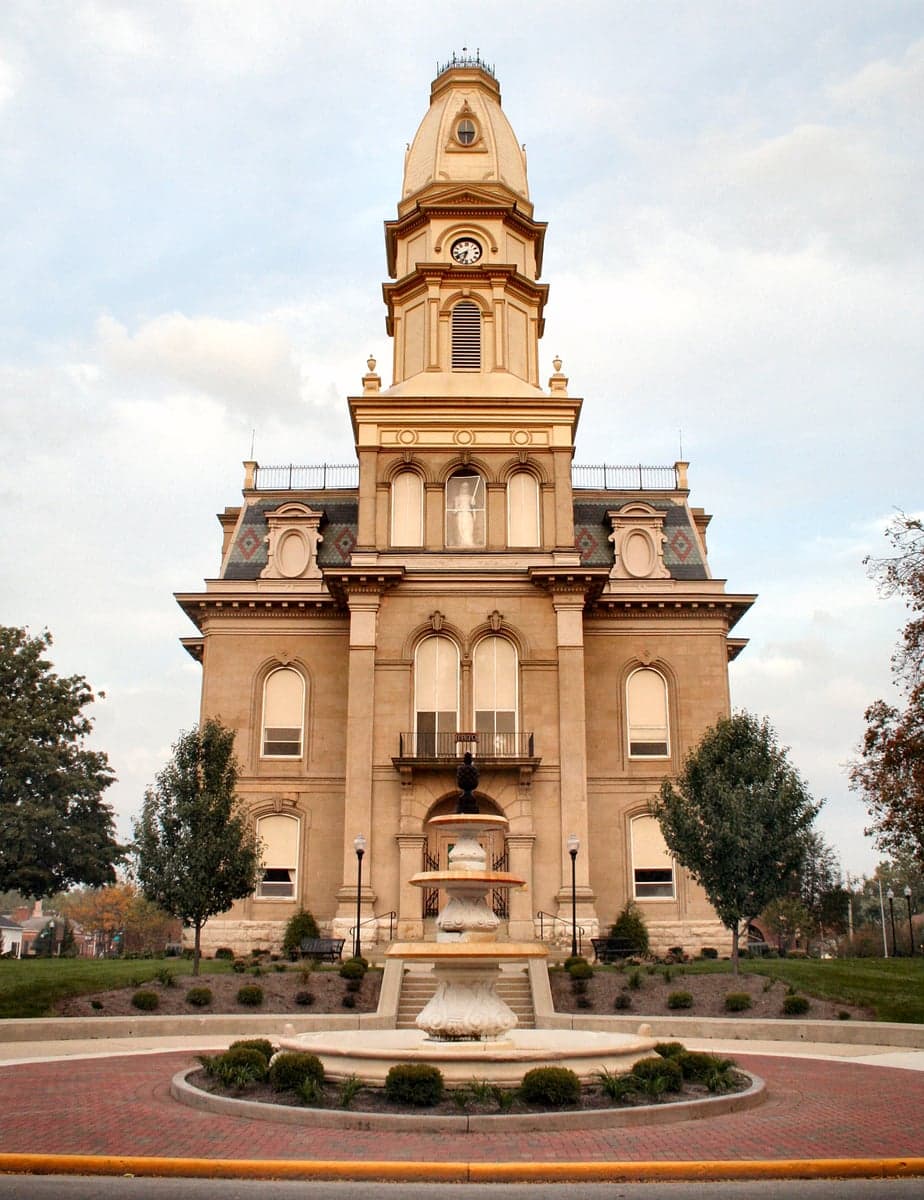
Photo: Wikipedia
Political ClimatePolitical Climate in Bellefontaine, OH
District shown is the primary district for this city’s centroid. Cities may span multiple districts.
Inherited from parent state — no local data available.
Local Political AnalysisPolitical Analysis of Bellefontaine, OH
Bellefontaine sits in a reliably Republican corner of Ohio, and that’s been true for as long as anyone around here can remember. The county seat of Logan County, it anchors a region that routinely votes 70% or more for GOP statewide candidates, a margin that runs well ahead of Ohio’s overall R+5 Cook PVI. The political trajectory isn’t shifting so much as it is solidifying — the rural-urban divide that defines Ohio politics has only grown sharper since 2016, and Bellefontaine is firmly on the rural side of that line.
How it compares
To understand Bellefontaine’s politics, you have to look at the state map. Ohio as a whole is a purple state that leans red — Donald Trump won it by 8 points in 2020 and by double digits in 2024, and the R+5 PVI reflects that baseline. But that statewide number is a blend of deep-blue urban islands like Columbus, Cleveland, and Cincinnati and vast red expanses like Logan County. Bellefontaine itself is closer in voting behavior to nearby rural counties like Champaign and Union than it is to the state’s metropolitan cores. The contrast is stark if you drive 45 minutes east to Marysville, which is growing fast with Honda jobs and trending more moderate, or an hour south to Columbus’s Franklin County, which votes Democratic by 30-point margins. Within Logan County, Bellefontaine is the largest town, but it’s still a small city of about 14,000 — and its politics mirror the surrounding farmland more than any suburban shift.
What this means for residents
For conservatives, living in Bellefontaine means your values are the default. Local offices — county commissioners, sheriff, school board — are almost always held by Republicans, and contested races are often decided in the primary rather than the general election. Gun rights, low taxes, and local control are not debated positions; they’re the baseline assumptions of civic life. For liberals, the reality is different but not hostile. You’ll find like-minded people, but you’ll have to seek them out — there’s no organized progressive infrastructure, and Democratic candidates rarely campaign here. That said, the practical impact is muted. Property taxes are low, the schools are well-funded by rural standards, and the city government focuses on infrastructure and downtown revitalization rather than culture-war issues. Most residents, regardless of party, care about the same things: the Holland Theatre renovation, the new YMCA, and whether the snow gets plowed on County Road 11.
The cultural distinctions here are subtle but real. Bellefontaine is proud of its quirky history — it’s home to the world’s first concrete street, poured in 1891 — and that sense of place translates into a cautious, self-reliant political culture. There’s little appetite for national political drama; people vote Republican because it aligns with their views on taxes and agriculture policy, not because they’re tuned into cable news. Looking ahead, the trajectory is likely to hold. Logan County isn’t attracting the kind of migration that’s flipping other Ohio counties, and the local economy — anchored by manufacturing, agriculture, and the nearby Honda transmission plant — doesn’t show signs of reshaping the electorate. For better or worse, Bellefontaine will probably keep voting the same way it has for generations, and both its conservative majority and its liberal minority will keep finding ways to coexist in a town that values neighborliness over partisanship.

State Political ClimatePolitical Climate in Ohio
State Political AnalysisPolitical Environment in the State
Ohio sits at R+5 on the Cook Partisan Voting Index, making it a solidly Republican state in presidential elections, but the story is more layered than that number suggests. Over the last 15 years, the state has shifted from a premier battleground—where Barack Obama won twice—to a state where Donald Trump carried it by 8 points in 2020 and by roughly 11 points in 2024. The dominant coalition is a mix of Appalachian and rural conservatives, working-class voters in the Mahoning Valley and along the I-77 corridor, and suburban families in places like Delaware County who have drifted right on cultural issues even as they’ve stayed moderate on economics.
Urban vs. rural divide
The political map of Ohio is a tale of three distinct regions. The urban cores—Cleveland, Columbus, and Cincinnati—are Democratic strongholds, with Cuyahoga County alone delivering about 200,000-vote margins for Democrats. Columbus, anchored by Ohio State University and a booming tech and financial sector, has become the state’s blue anchor, with Franklin County voting 66% for Biden in 2020. Cincinnati’s Hamilton County is more competitive but has trended Democratic in recent cycles, driven by the city’s growing professional class.
Outside those metros, the state is overwhelmingly red. Butler County (north of Cincinnati) and Warren County are among the most Republican large counties in the nation, routinely delivering 70%+ margins. The rural southeast, including counties like Meigs and Monroe, votes 75-80% Republican, reflecting a deep cultural alignment with the national GOP on guns, abortion, and religious liberty. The real political action is in the suburbs: Delaware County (north of Columbus) flipped from a swing county to a reliably red one, while Licking County (east of Columbus) has become a bellwether—Trump won it by 20 points in 2024 after it went for Obama in 2012. The Toledo area’s Lucas County remains blue, but the surrounding northwest Ohio counties are deeply red, creating a stark urban-rural split that defines every statewide race.
Policy environment
Ohio’s policy environment is defined by a low-tax, light-regulation posture that has made it attractive to businesses and families alike. The state has a flat income tax of 3.5% (down from a top marginal rate of 7.5% a decade ago), and the sales tax is 5.75% at the state level, with local add-ons pushing it to around 7.25% in most metros. Property taxes are moderate, though school levies are common and can add significant burden in affluent suburbs. The regulatory climate is business-friendly, with no state-level minimum wage above the federal $7.25 (though many employers pay more), and a right-to-work law was repealed by referendum in 2011—a rare defeat for conservatives that still stings.
Education policy is a mixed bag. The state funds private school vouchers (the EdChoice program) and has expanded them significantly since 2023, making Ohio one of the most voucher-friendly states in the nation. Charter schools are plentiful, especially in Columbus and Cleveland. Healthcare is more complicated: Ohio expanded Medicaid under the Affordable Care Act in 2014, and roughly 3 million residents are on the program, but the state has also imposed work requirements for able-bodied adults (currently tied up in litigation). Election laws are moderately restrictive—voter ID is required, early voting is available for 28 days, and absentee voting is easy—but the state purges voter rolls aggressively, which has drawn criticism from voting rights groups.
Recent policy direction
The last few years have seen Ohio move decisively right on several fronts. In 2023, the state passed a constitutional amendment protecting abortion access (Issue 1), which was a significant defeat for the GOP legislature—but lawmakers have since worked to limit its practical impact through clinic regulations and parental consent requirements. Gun laws have loosened: Ohio became a permitless carry state in 2022, and "stand your ground" language was strengthened in 2021. The legislature also passed a law in 2023 banning gender-affirming care for minors, overriding a veto from Governor Mike DeWine—a rare rebuke of a popular Republican governor.
On education, the state passed the Parental Rights in Education Act in 2024, requiring schools to notify parents of any changes to a student’s gender identity or pronoun usage. Property rights have been bolstered with a 2023 law limiting municipal authority to regulate oil and gas drilling, and the state has preempted local gun ordinances, meaning cities like Columbus cannot enact their own restrictions. On taxation, the trend is toward further cuts: the 2025 budget included a phased reduction of the income tax to 3.0% by 2027. Voting access has tightened slightly—the 2023 law shortened the post-election curing period for provisional ballots from 10 days to 7—but early voting remains robust.
Civil unrest & political movements
Ohio has seen its share of political flashpoints. The 2020 George Floyd protests in Columbus and Cincinnati were large but largely peaceful, though property damage in downtown Columbus led to a heavy National Guard presence. More recently, the 2023 East Palestine train derailment became a national story, with residents and activists—both left and right—criticizing the federal response and demanding accountability from Norfolk Southern. Immigration politics have heated up: the 2024 Springfield, Ohio, controversy over Haitian migrants (amplified by national figures) put the state in the spotlight, and the legislature has since passed a law requiring local law enforcement to cooperate with federal immigration authorities. There is no sanctuary city in Ohio, and several municipalities have passed resolutions affirming their cooperation with ICE.
On the right, the state has seen a strong "election integrity" movement, with Republican county parties pushing for hand-counting ballots and stricter chain-of-custody rules. On the left, the abortion rights coalition that won Issue 1 has remained organized and is now pushing for a constitutional amendment to protect reproductive privacy more broadly. The state’s marijuana legalization (passed in 2023) was a bipartisan effort, and the rollout has been messy—a reminder that Ohio’s politics are not purely tribal.
Projection
Over the next 5-10 years, Ohio is likely to stay Republican at the statewide level, but the margin may narrow slightly. In-migration is concentrated in the Columbus and Cincinnati suburbs, which are becoming more diverse and more moderate. The Delaware County and Licking County growth corridors are attracting young families who are fiscally conservative but socially moderate—they like low taxes and school choice, but they don’t want abortion bans or book bans. The rural population is aging and shrinking, which will slowly erode the GOP’s rural base. The wildcard is the Mahoning Valley (Youngstown area), which has trended Republican but could flip back if Democrats nominate a populist. Expect the state to remain R+3 to R+5 for the next decade, with the legislature staying firmly Republican due to district maps that favor the GOP.
Bottom line for new residents
If you’re moving to Ohio, here’s what you should know. You’ll find a state where your vote matters less in presidential races than it did a decade ago, but where local politics are still hotly contested—especially in the suburbs. Property taxes and school levies are the biggest local issue you’ll vote on, and they vary wildly by district. Gun laws are permissive, abortion access is protected by the constitution but practically limited, and the cost of living is low enough that you can afford a house in a good school district on a single income. The political culture is pragmatic: Ohioans are less ideological than their national reputation suggests, and most people just want good schools, safe streets, and reasonable taxes. You’ll find both MAGA flags and Black Lives Matter signs in the same county—sometimes on the same street—and for the most part, people get along. If you’re conservative, you’ll feel at home in most of the state; if you’re liberal, you’ll want to stick to the urban cores or the college towns like Athens or Yellow Springs, where you’ll find like-minded neighbors and a lively local scene.
* Values derived from national, state, county, city and local statistics and may differ in a specific area. Last updated: 2026-10-29T02:10:18.000Z
Narrative content on this page is AI-generated and may contain mistakes. Verify any details that matter before acting on them.
ReloMaps may earn a commission from affiliate links at no extra cost to you.

