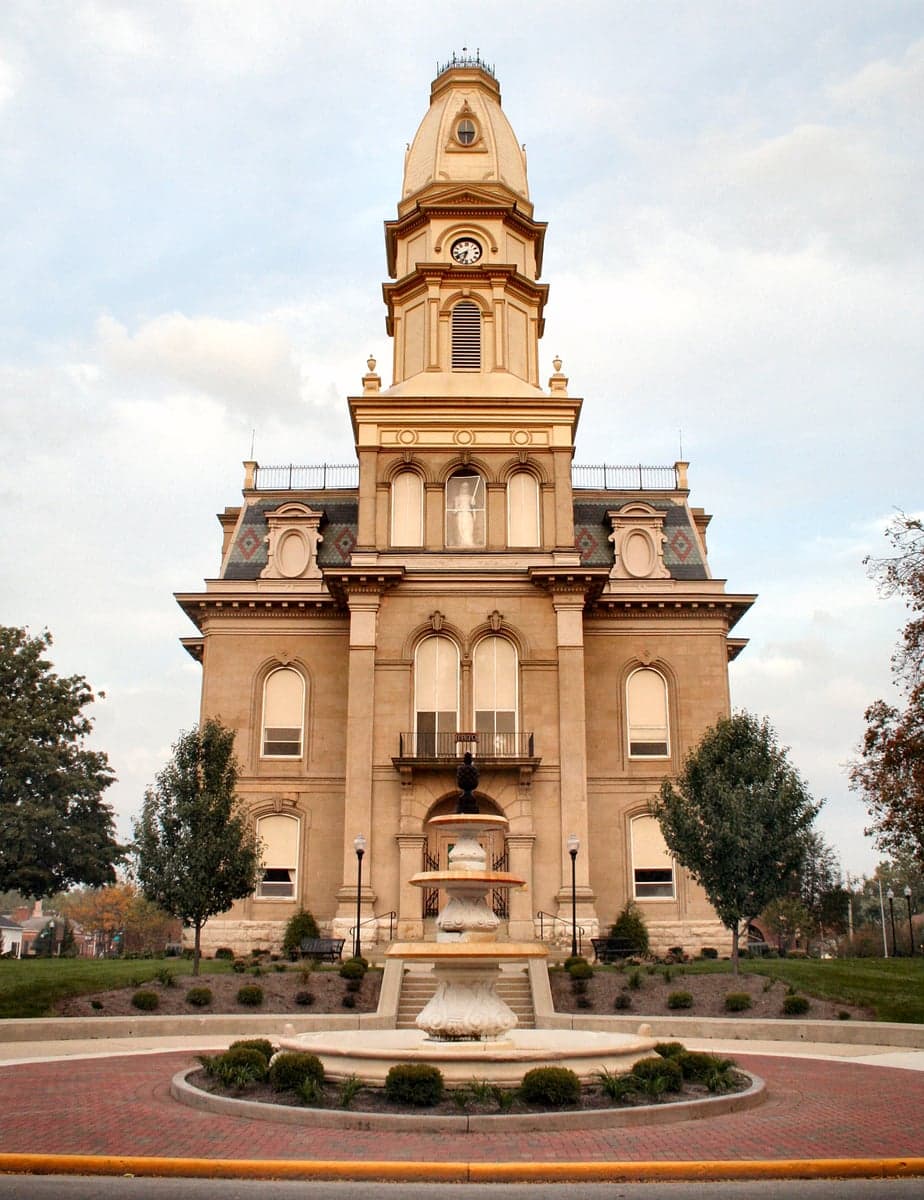
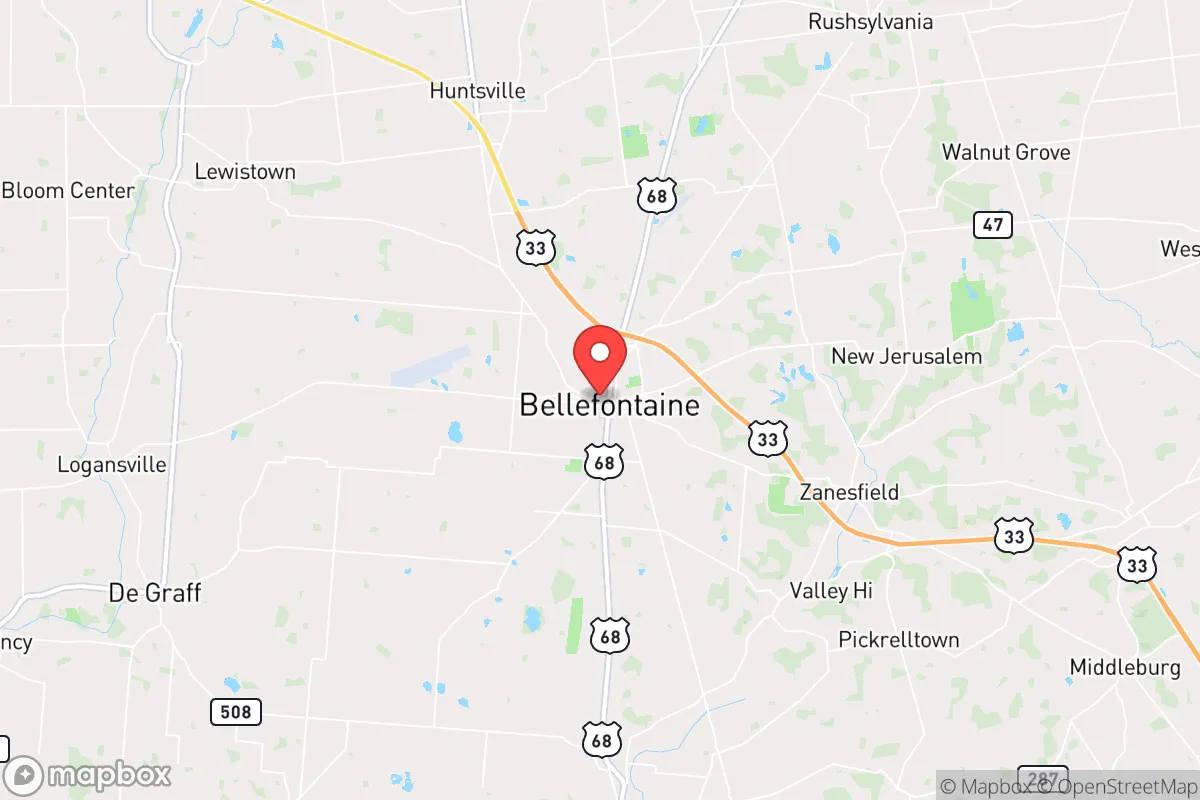
Photo: Wikipedia
Demographics of Bellefontaine, OH
Affluence Level in Bellefontaine, OH
A below-average socioeconomic profile. Incomes, home values, and educational attainment trail the U.S., with higher poverty and unemployment.
People of Bellefontaine, OH
The people of Bellefontaine, Ohio today number roughly 14,051, a population that is 86.5% white and overwhelmingly native-born, with just 1.1% of residents born outside the United States. This is a working-class, family-oriented community with a 14.5% college-educated rate, reflecting a manufacturing and logistics heritage rather than a white-collar professional base. The city’s identity is rooted in its role as the county seat of Logan County and its claim to fame as the birthplace of the first concrete street in America, a fact locals still point to with pride. Demographically, it is a stable, predominantly white Midwestern town with small Hispanic (3.2%) and Black (4.2%) communities and a negligible East/Southeast Asian presence (0.4%).
How the city was settled and grew
Bellefontaine was founded in 1820 as the county seat of Logan County, named for the natural springs ("beautiful fountain" in French) that attracted early settlers. The original population was almost entirely of English, Scottish, and German stock, arriving from Pennsylvania, Virginia, and New England via the National Road and later the canal system. The city’s first major growth spurt came with the arrival of the railroad in the 1850s, which turned Bellefontaine into a regional shipping hub for agricultural goods. The historic Downtown Bellefontaine district, centered on the courthouse square, was built by these early merchants and remains the city’s civic and commercial heart today.
The second major wave came in the late 19th and early 20th centuries, driven by the discovery of limestone deposits and the rise of the cement industry. The East Side neighborhood, along Sandusky Avenue, absorbed many of the German and Irish laborers who came to work in the quarries and kilns. A third wave arrived during the World War II era, when the city’s manufacturing base expanded to support the war effort. This period brought a small but notable influx of Appalachian migrants from eastern Kentucky and West Virginia, who settled primarily in the West Side and North Park areas, seeking steady factory work. These families, drawn by the promise of union wages at plants like the Bellefontaine Foundry and the Ohio Steel Tube Company, established a cultural character that still defines the city’s blue-collar ethos.
Modern era (post-1965)
Following the 1965 Hart-Cellar Act, Bellefontaine did not experience the large-scale immigration that transformed many larger Ohio cities. The foreign-born population remains minuscule at 1.1%, and the city’s racial composition has shifted only modestly over the past six decades. The Black population, now 4.2%, has deep roots in the area, with many families tracing their arrival to the post-war industrial boom and the subsequent migration of African Americans from the South during the 1950s and 1960s. These residents have historically concentrated in the South Side, near the former rail yards and industrial corridors, and in the East Side, where older housing stock offered affordable entry points.
The Hispanic population, at 3.2%, is the city’s fastest-growing demographic segment, a trend that began in the 1990s and accelerated in the 2010s. This growth is tied to agricultural and food-processing work in the surrounding Logan County countryside, as well as light manufacturing jobs within the city limits. Hispanic families have dispersed across the city rather than forming a single ethnic enclave, though a visible cluster has emerged along the South Detroit Street corridor, where a handful of Latino-owned businesses and a Catholic parish serve as community anchors. The East/Southeast Asian population (0.4%) is tiny and consists almost entirely of professionals employed at Mary Rutan Hospital or the Honda transmission plant in nearby Russells Point, with no distinct ethnic neighborhood.
The future
Bellefontaine’s population is aging and slowly shrinking, a trajectory shared by much of rural Ohio. The city has lost roughly 1,000 residents since its 1980 peak of just over 15,000, and projections suggest continued modest decline over the next decade. The Hispanic share is expected to grow gradually, potentially reaching 5-6% by 2035, driven by younger families and higher birth rates, while the white population will continue to age in place. The Black population is likely to remain stable, with younger residents often leaving for larger cities like Columbus or Dayton for educational and employment opportunities.
The most significant demographic wildcard is the potential for new in-migration tied to the region’s logistics boom. The completion of the U.S. 33 bypass and the expansion of distribution centers in the Bellefontaine area have created demand for warehouse and trucking workers, a draw that could attract younger, more diverse families from outside Logan County. If this materializes, new residential development is most likely to occur on the northwest edge near the new industrial parks and along the East Sandusky corridor, where land is available for subdivision housing. Culturally, the city remains deeply conservative and church-oriented, with a strong emphasis on local schools, high school football, and county fair traditions.
For someone moving to Bellefontaine today, the city offers a predictable, safe, and affordable environment where neighbors know each other and the cost of living is well below the national average. It is not a diverse or cosmopolitan place, and those seeking ethnic variety or a highly educated peer group will find it limited. But for families and individuals who value stability, a slower pace, and a genuine sense of community rooted in a long industrial and agricultural history, Bellefontaine remains a solid, if modest, choice in west-central Ohio.

* Values derived from national, state, county, city and local statistics and may differ in a specific area. Last updated: 2026-10-29T02:10:18.000Z
Narrative content on this page is AI-generated and may contain mistakes. Verify any details that matter before acting on them.
ReloMaps may earn a commission from affiliate links at no extra cost to you.

