
Photo: Wikipedia
Strategic Assessment of Bellefontaine, OH
Meaningful friction. Expect exposure to either population pressure, blast zones, or natural disaster risk. Consider buying a retreat property.
What does the Strategic Assessment tell us?
Our Strategic Assessment grades tactical survivability of an area. Major population centers, military targets, fallout zones, natural disasters, and border exposure all drive risk — lower exposure means a more defensible position in a crisis.
This is heavily inspired by Joel Skousen's Strategic Relocation book. Highly recommended you checkout the book ($)What does this tell us?
Our Strategic Assessment grades tactical survivability of an area. Major population centers, military targets, fallout zones, natural disasters, and border exposure all drive risk — lower exposure means a more defensible position in a crisis.
This is heavily inspired by Joel Skousen's Strategic Relocation book. Highly recommended you checkout the book ($)Strategic Pillars
Key Distances
Regional Safe Places
Below is our recommended "safe zones" in Ohio and the surrounding area based on our strategic heuristics. For most people, it's unrealistic to live in a “safe zone” full-time due to work, family or other personal reasons. They tend to be more rural. However, many of these areas are perfect for second homes and retreat properties that double as a vacation home or even a short-term rental.

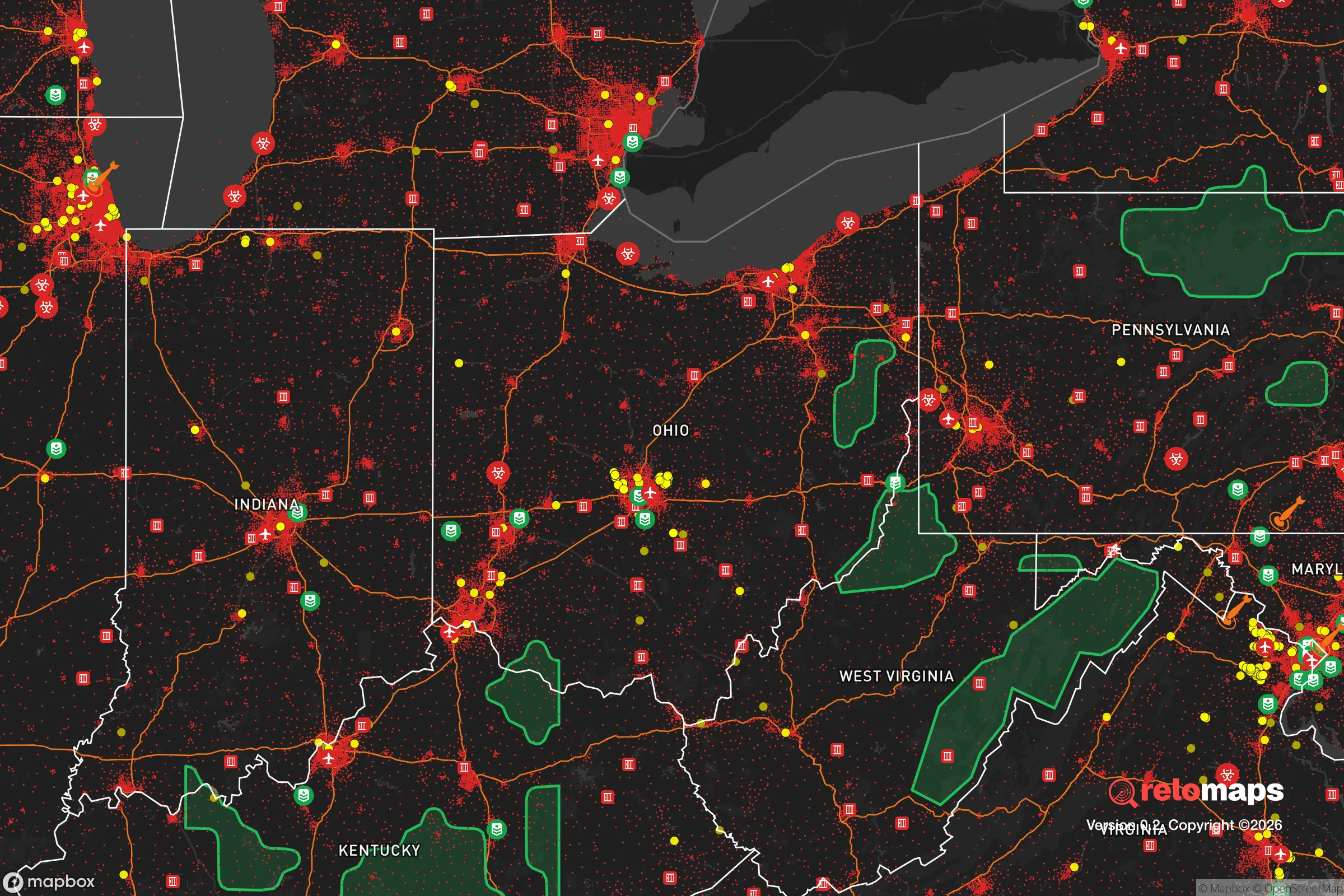


Important Note: For informational purposes only. This does not mean nothing bad ever happens in the green zones. Please use common sense. This is based on public data and modeled with AI. We tried to take a conservative approach but mistakes happen. We update this regularly as new information becomes available.
Solar Generator Recommendations
Backup power matters more here than in safer locations. We've picked three solar generators across budgets and capacity tiers — start with the budget unit if you only need a few essentials, or step up if you want to run a fridge and HVAC for days at a time.
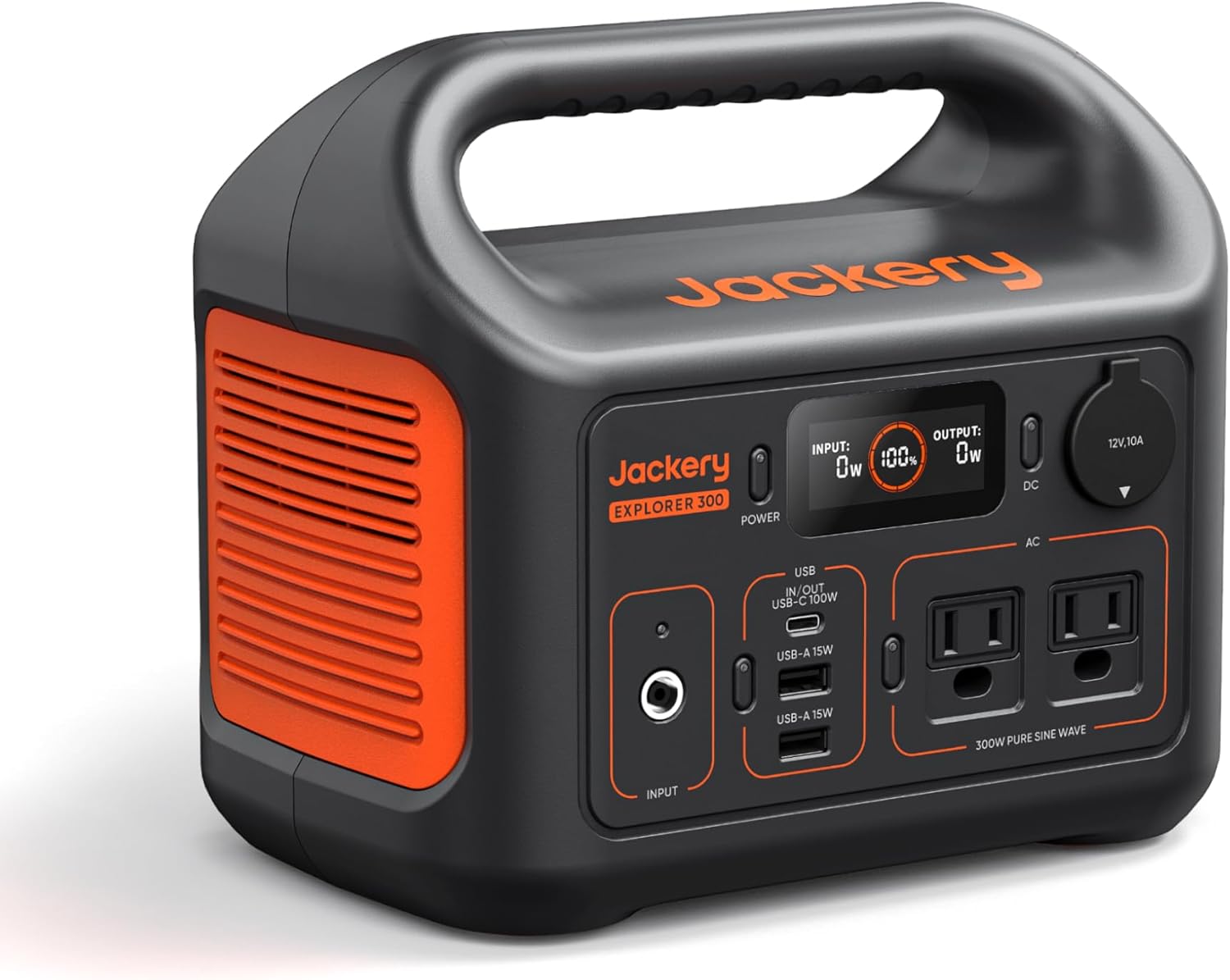
Jackery Portable Power Station Explorer 300
Budget OptionPower on the Go: Weighing only 11 lbs, it's convenient to set up and store with book-sized foldable solar panels

BLUETTI Portable Power Station AC180
Designed for both indoor and outdoor scenarios, AC180 is highly capable as it has a robost capacity and continuous output power.

EF ECOFLOW DELTA Pro Ultra Power Station
Upgraded PickEcoFlow DELTA Pro Ultra is a whole-home energy system designed to grow with your family. Integrated with the Smart Home Panel 2, it scales to meet your evolving energy needs — keeping your home powered, intelligent, and secure through every stage of life.
We earn a commission, at no additional cost to you.
Strategic Assessment Analysis
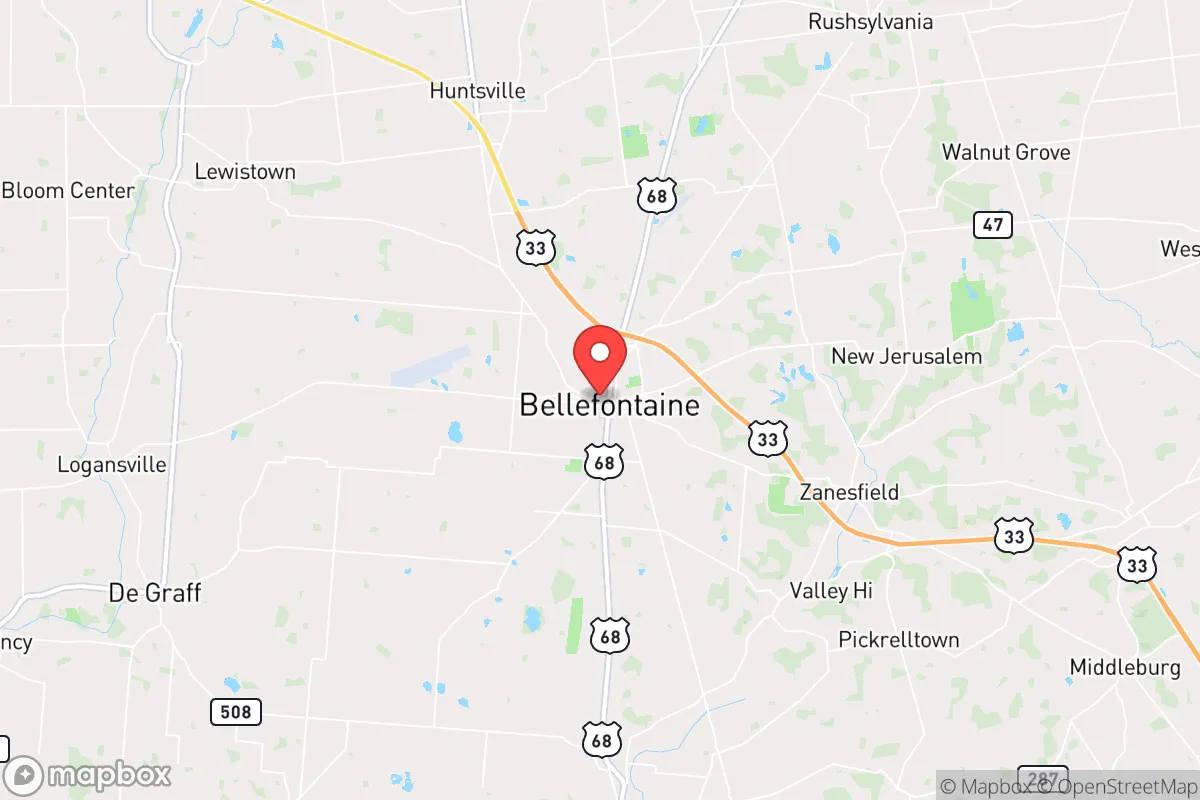
Bellefontaine, Ohio, sits in a sweet spot for resilience-minded relocators: it’s far enough from major metros to dodge their worst-case scenarios, yet close enough to maintain supply lines and employment options. The city anchors Logan County in west-central Ohio, roughly 50 miles northwest of Columbus and 45 miles east of the Indiana border, giving it a strategic position that balances isolation with access. For a single person or family weighing disaster readiness, self-sufficiency, and long-term stability, Bellefontaine offers a genuinely defensible base—provided you understand its specific exposures and plan accordingly.
Geographic position and natural advantages for long-term stability
Bellefontaine’s most underrated asset is its elevation. At roughly 1,240 feet above sea level, it’s the highest point in Ohio—a fact that matters more than trivia buffs realize. The city sits on a glacial moraine, which means well-drained, sandy-loam soils that handle heavy rain better than the clay-heavy flatlands to the west. Flood risk is minimal compared to river towns like Dayton or Cincinnati; the Great Miami River’s headwaters are nearby, but Bellefontaine itself is not in a floodplain. That elevation also translates to slightly cooler summer temperatures and faster snowmelt in winter, which reduces the severity of ice-storm impacts on roads and power lines.
The surrounding Logan County landscape is rolling farmland interspersed with wooded tracts, offering natural cover and multiple egress routes. Unlike suburban sprawl with cul-de-sacs and single choke points, the road network here is a grid of county roads and state routes—US-33, US-68, and SR-47—that provide redundant ways in and out. If one corridor is blocked by weather, accident, or worse, you have options. The city’s position equidistant from Columbus, Dayton, and Lima means you’re outside the immediate blast-and-fallout radius of any single major target, while still being close enough to reach specialized medical care at OhioHealth’s Bellefontaine hospital or, for major trauma, the Level I centers in Columbus within an hour.
Risks, exposures, and proximity to fallout-relevant landmarks
No location is risk-free, and Bellefontaine has its own set of vulnerabilities. The most significant is its proximity to Wright-Patterson Air Force Base near Dayton, roughly 45 miles southwest. Wright-Patt is a major Air Force research and logistics hub—a legitimate strategic target in a conflict scenario. Fallout patterns are wind-dependent, and prevailing westerlies mean a strike on Wright-Patt could push contamination toward the Springfield/Columbus corridor rather than directly at Bellefontaine, but that’s a probabilistic judgment, not a guarantee. Similarly, Columbus’s defense-industrial footprint, including the Ohio National Guard headquarters and various logistics centers, sits about 50 miles east—close enough to matter in a worst-case regional event, far enough to avoid immediate ground-zero effects.
Natural risks are comparatively mild. Tornadoes are the primary weather threat; Logan County sits on the northern fringe of Ohio’s traditional tornado alley, with an average of one to two touchdowns per year, typically EF-0 to EF-2. The 2020 Memorial Day storms that hit nearby Dayton are a reminder that the region can produce violent weather, but Bellefontaine’s topography and lack of dense urban heat-island effects make it less prone to the worst microbursts. Winter storms are a routine hazard—lake-effect snow from Lake Erie occasionally reaches the area, and ice storms can knock out power for days. Seismic risk is negligible, and the nearest nuclear power plant, Davis-Besse on Lake Erie, is over 100 miles north—outside any realistic evacuation or fallout zone for a Bellefontaine resident.
One underappreciated risk is economic rather than physical: the area’s reliance on a few large employers, including the Honda transmission plant in nearby Russells Point and the Mary Rutan Hospital system. A major disruption to either would ripple through the local economy. For a relocator, that argues for maintaining skills or income streams not tied to the local job market—remote work, e-commerce, or portable trades—rather than assuming the local economy is bulletproof.
Practical resilience for a relocator: food, water, energy, and defensibility
Bellefontaine’s practical resilience is where it genuinely shines. The city is surrounded by working farmland—corn, soybeans, and livestock operations—which means local food production is not a theoretical concept but a daily reality. The Logan County Farmers Market operates seasonally, and within a 15-minute drive you can find roadside stands, u-pick orchards, and direct-from-farm meat sellers. For a family serious about food security, this is a major advantage: you can build relationships with producers before a crisis, rather than scrambling during one. The soil also supports substantial home gardening; the growing season runs roughly April through October, and the aforementioned sandy loam is forgiving for beginners.
Water is a mixed picture. Bellefontaine’s municipal supply comes from the Mad River Valley aquifer, which is reliable and well-managed, but a household truly preparing for disruption should plan for private water. The water table in Logan County is accessible—most rural properties can drill a well at 50 to 150 feet, with good yields—and the county’s agricultural extension office provides free well-water testing. Rainwater catchment is legal and practical; the region averages 38 inches of precipitation annually, spread fairly evenly across the year. For a relocator, the key question is whether you’re buying a property with existing well access or planning to retrofit a home on municipal water with storage and filtration.
Energy resilience is achievable but requires deliberate investment. The grid in west-central Ohio is moderately reliable, with outages typically lasting hours rather than days, but winter ice storms are the exception. Solar potential is decent—the area gets about 4.2 peak sun hours per day, comparable to much of the Midwest—and net metering is available through the local utility, Logan County Electric Cooperative. Wood heat is a practical supplement; the surrounding woodlands provide ample fuel, and many rural homes already have wood stoves or outdoor boilers. Propane is widely available and reasonably priced, making dual-fuel generators or propane standby systems a common sight on rural properties. For defensibility, the terrain itself helps: the moraine’s rolling hills provide natural sightlines, and the low-density rural character means neighbors are close enough to form a community but far enough to avoid the chaos of suburban panic.
Overall, Bellefontaine presents a strong strategic picture for the resilience-minded relocator. It’s not a remote mountain redoubt, and it shouldn’t be treated as one—its strength lies in being a well-connected, moderately isolated, resource-rich hub that can sustain a household through most disruptions while remaining close enough to civilization for the things you can’t produce yourself. The realistic threat matrix is dominated by weather events and economic shocks, not catastrophic scenarios, and the area’s agricultural base, accessible water table, and redundant road network give you the raw materials to build genuine self-sufficiency. The trade-off is that you’re not fully off-grid, and you’re not fully safe from regional fallout patterns—but for a family or individual who wants a defensible, productive base within a day’s drive of major infrastructure, Bellefontaine is a quietly excellent choice. The work is yours to do: secure the well, size the solar array, and get to know your neighbors before you need them.

* Values derived from national, state, county, city and local statistics and may differ in a specific area. Last updated: 2026-10-29T02:10:18.000Z
Narrative content on this page is AI-generated and may contain mistakes. Verify any details that matter before acting on them.
ReloMaps may earn a commission from affiliate links at no extra cost to you.

