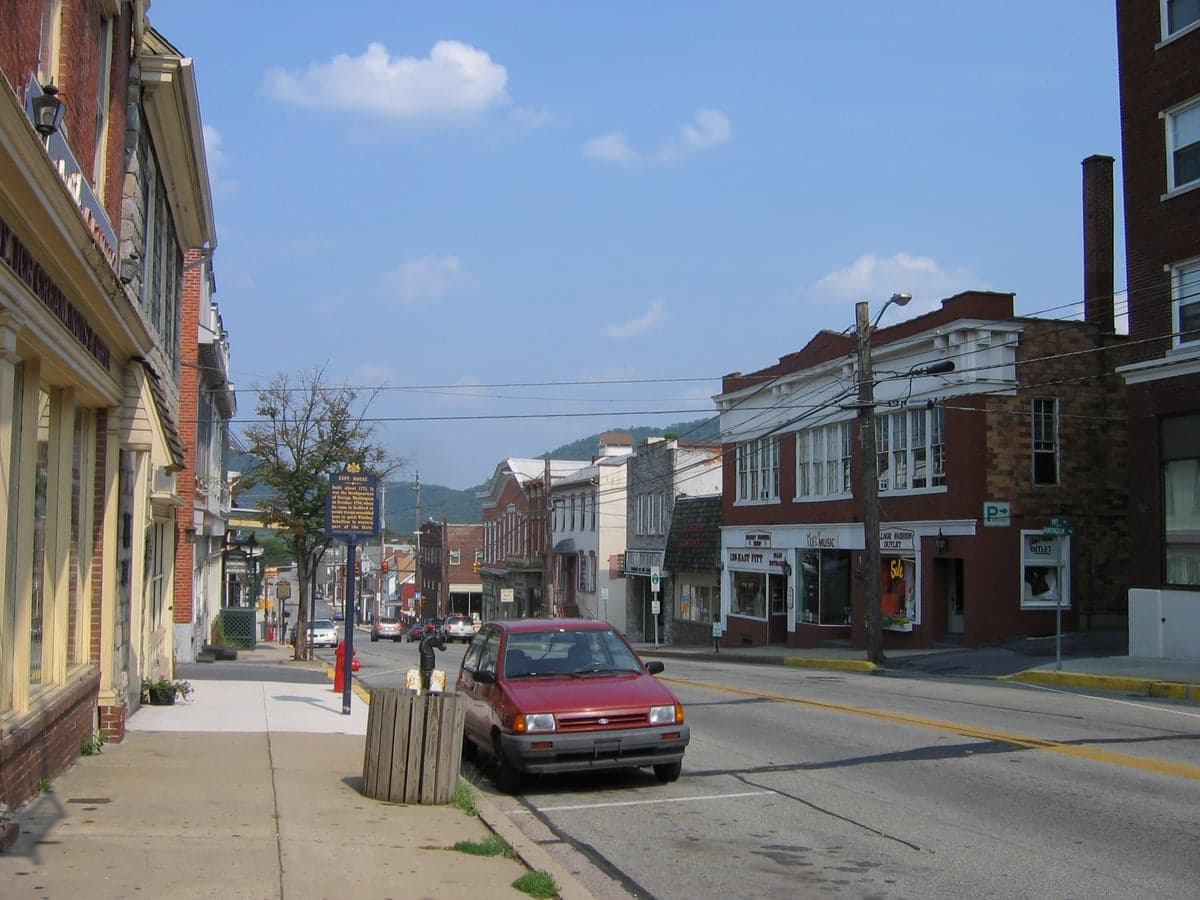
Photo: Wikipedia
Political ClimatePolitical Climate in Bedford, PA
District shown is the primary district for this city’s centroid. Cities may span multiple districts.
Inherited from parent county — no local data available.
* Lean and PVI are calculated from Bedford, PA’s own 2020 presidential results (precinct returns summed to the city), with 2024 estimated from the surrounding county’s 2020–2024 shift, Cook-style. Sources: state election offices; VEST 2020 precinct results (CC BY 4.0).
Political rankings in Pennsylvania
- Most Conservative Cities in Pennsylvania
- Most Liberal Cities in Pennsylvania
- Best Conservative-Leaning Towns in the Northeast
- Best Conservative-Leaning Towns in the Mid-Atlantic
- Most Affordable Liberal-Leaning Small Towns in the U.S.
- Safest Liberal-Leaning Cities in the U.S.
- Most Conservative Counties in Pennsylvania
- Most Liberal Counties in Pennsylvania
Local Political AnalysisPolitical Analysis of Bedford, PA
Bedford, Pennsylvania, sits in a deeply conservative pocket of the state, with a Cook Partisan Voting Index (PVI) of R+35 — one of the most Republican-leaning areas in the entire commonwealth. That number isn't just a statistic; it reflects a community where registered Republicans outnumber Democrats by roughly four to one, and where national Republican candidates routinely win by 60-70 point margins. The trajectory here has been steadily redder over the past two decades, mirroring the broader rural shift away from the Democratic Party, but with a local intensity that feels almost baked into the landscape. If you're looking for a place where "Pennsylvania is a swing state" doesn't apply, this is it.
How it compares
The contrast between Bedford and the rest of Pennsylvania is stark. The state as a whole carries a Cook PVI of EVEN, meaning it's a pure toss-up in national elections — think Philadelphia and its suburbs pulling left, while places like Bedford pull hard right. Bedford County's R+35 is a full 35 points more conservative than the state average, a gap you can feel driving just 30 miles east to Altoona (R+18) or 40 miles north to State College (D+5). Even nearby Somerset (R+28) and Huntingdon (R+24) are less conservative. The real political shock comes if you head southeast toward Gettysburg (R+11) or, further, into the Philadelphia suburbs like Bucks County (D+2). Bedford is essentially the anchor of the state's deep-red rural southwest, a world away from the purple battleground that defines Pennsylvania's national reputation.
What this means for residents
For conservative residents, Bedford offers a rare sense of political alignment. Local government, school boards, and county offices are overwhelmingly Republican, meaning policy debates tend to be about how conservative to be, not whether to lean left. Gun rights are broadly supported, taxes are low, and the local culture — from church attendance to hunting seasons — reinforces a traditional worldview. For liberal residents, the reality is more isolating. There's no active Democratic Party infrastructure to speak of; finding like-minded neighbors can feel like a scavenger hunt. Socially, it's not hostile — people are polite — but political conversations are often avoided, and progressive views on issues like climate policy or LGBTQ+ rights are rarely voiced in public. Both sides, however, share a deep appreciation for the area's natural beauty and slow pace of life, which tends to mute overt political friction day-to-day.
One cultural distinction worth noting: Bedford's conservatism isn't the firebrand, protest-heavy kind you see in some suburban counties. It's quieter, more rooted in tradition and self-reliance. There's no local chapter of a national activist group; instead, politics shows up in the local paper's letters to the editor, the VFW hall's annual dinner, and the near-universal display of American flags on Main Street. The area's trajectory suggests this will only deepen — younger residents who stay tend to hold the same values, while out-migration of more liberal-leaning young adults to cities like Pittsburgh or Harrisburg reinforces the status quo. For anyone moving here, the takeaway is simple: Bedford is a place where the political climate is stable, predictable, and deeply conservative, and that's unlikely to change in the near or long term.

State Political ClimatePolitical Climate in Pennsylvania
State Political AnalysisPolitical Environment in the State
Pennsylvania is the ultimate swing state, with a Cook PVI of EVEN that perfectly captures its 50/50 split. Over the past 20 years, it has shifted from a reliably blue-leaning state in presidential elections (voting Democratic from 1992 to 2012) to a true battleground that flipped for Trump in 2016, then flipped back for Biden in 2020 by just over 80,000 votes. The dominant coalitions are the urban-suburban crescent from Philadelphia through the Lehigh Valley and the Pittsburgh metro area, which vote heavily Democratic, versus the vast rural and exurban interior—the "T" of the state—that votes overwhelmingly Republican. This split has only hardened since 2016, with the Philadelphia suburbs moving further left while the small towns and farm country of central and northern Pennsylvania have moved further right.
Urban vs. rural divide
The political map of Pennsylvania is a tale of two states. The southeastern corner, anchored by Philadelphia and its collar counties (Montgomery, Delaware, Chester, Bucks), is the Democratic engine, delivering margins of 300,000+ votes that often decide statewide races. Pittsburgh and its Allegheny County base are also reliably blue, though the surrounding southwestern counties (Washington, Greene, Fayette) have trended hard red. The "T" of the state—the vast rural expanse stretching from the New York border down through the center and west to Ohio—is deeply Republican. Lycoming County (Williamsport), Franklin County (Chambersburg), and Butler County north of Pittsburgh routinely vote 65-70% Republican. The key swing areas are the Lehigh Valley (Allentown, Bethlehem, Easton) and Erie County in the northwest—both are working-class, union-heavy regions that have oscillated between the two parties. Lancaster County, once a Republican stronghold, has seen its suburban areas drift toward Democrats while its Amish and rural precincts remain deeply conservative.
Policy environment
Pennsylvania’s policy landscape reflects its divided government. The state has a flat income tax of 3.07% and a sales tax of 6% (8% in Philadelphia and Pittsburgh), which is relatively low compared to neighboring New York and New Jersey. Property taxes are high, averaging about 1.5% of home value, and are the primary funding mechanism for schools—a perennial source of tension. The regulatory posture is moderate: Pennsylvania is not a "right-to-work" state, and unions (especially public-sector and building trades) remain politically powerful. Education policy is locally controlled, with school districts setting their own curricula, though the state Department of Education mandates standardized testing. Healthcare is a mixed bag: the state expanded Medicaid under the ACA, but private insurance markets are competitive. Election laws are moderately restrictive: voters must show ID (non-photo) at the polls, and mail-in voting was expanded in 2019 under Act 77, though it has become a flashpoint. There is no voter ID law requiring a photo, but the state has a voter registration deadline of 15 days before an election.
Recent policy direction
In the last five years, Pennsylvania has moved in a moderately progressive direction on several fronts, but with significant conservative pushback. On gun and self-defense law, the state is a "shall-issue" concealed carry state, and preemption laws prevent local municipalities from enacting their own gun restrictions—a major win for gun rights advocates. However, Philadelphia and Pittsburgh have sued the state to allow local ordinances, and the issue remains in court. On parental and education rights, the state has not passed a "Parents' Bill of Rights" like Florida, but school boards in conservative counties like York and Cumberland have adopted policies requiring parental notification for curriculum changes. On speech and privacy, Pennsylvania has no state-level equivalent of a "bathroom bill," and transgender students are protected under the state's anti-discrimination laws. On medical and bodily autonomy, abortion remains legal up to 24 weeks, and Governor Josh Shapiro has pledged to veto any further restrictions—a sharp contrast to neighboring Ohio and West Virginia. On property rights, the state has strong eminent domain protections, but fracking (natural gas drilling) is a major issue in the Marcellus Shale region, with local zoning battles in places like Washington County over well placement. On taxation, the state has not passed a broad-based tax cut, but the flat income tax rate has remained stable. On voting and ballot access, Act 77 (2019) expanded mail-in voting, but the state Supreme Court has ruled that ballots must be received by Election Day—a compromise that has satisfied neither side fully.
Civil unrest & political movements
Pennsylvania has seen its share of political flashpoints. The 2020 election aftermath was particularly intense: Trump’s campaign filed numerous lawsuits in the state, and the "Stop the Steal" movement held rallies at the state capitol in Harrisburg. Election integrity remains a live issue, with Republican-led counties like Berks and Luzerne conducting audits of voting machines. On the left, the Black Lives Matter protests in Philadelphia in 2020 were among the largest in the country, and the city has since seen ongoing debates over police reform and defunding. Immigration politics are less heated than in border states, but Philadelphia is a self-declared "sanctuary city," and the state has a law (Act 30) that prohibits local law enforcement from asking about immigration status—a source of tension with conservative counties. There is no serious secession or nullification movement, but rural counties have passed "Second Amendment Sanctuary" resolutions, and some have discussed withholding tax revenue to protest state gun laws. The most visible flashpoint for a new resident would be the constant political advertising: Pennsylvania is the most expensive media market in the country for political ads, and residents in the Harrisburg and Scranton markets are bombarded with campaign spots for months before every election.
Projection
Over the next 5-10 years, Pennsylvania is likely to remain a toss-up, but the demographic trends favor Democrats slightly. The Philadelphia suburbs are growing and diversifying, while the rural "T" is aging and shrinking. In-migration from New York and New Jersey is accelerating, particularly in the Lehigh Valley and the Poconos, and these newcomers tend to vote Democratic. However, the state’s electoral college votes (19) and its status as a swing state mean that both parties will continue to pour resources into it. The wild card is the working-class vote in places like Erie and Beaver County: if Democrats can hold onto these voters, they will remain competitive; if Republicans can flip them back, the state could shift right. A new resident moving in now should expect a decade of close elections, divided government, and constant political noise—but also a state that, for all its divisions, has a tradition of pragmatic compromise on issues like infrastructure and economic development.
For a new resident, the bottom line is that Pennsylvania offers a genuine swing-state experience. If you lean conservative, you’ll find deep red counties with strong gun rights, low taxes, and a culture of self-reliance—but you’ll also live under a state government that is often controlled by Democrats. If you lean liberal, you’ll find blue cities and suburbs with progressive policies on abortion and LGBTQ rights—but you’ll also have to contend with a state legislature that is often gerrymandered to favor Republicans. The practical takeaway is that your daily life will be shaped more by your county and municipality than by the state as a whole. Choose your location carefully: Bucks County is a swing county within a swing state, while Centre County (State College) is a blue island in a red sea. Pennsylvania rewards the politically engaged and punishes the indifferent—it’s a state where your vote truly matters, every single time.
* Values derived from national, state, county, city and local statistics and may differ in a specific area. Last updated: 2026-11-21T15:27:20.000Z
Narrative content on this page is AI-generated and may contain mistakes. Verify any details that matter before acting on them.
ReloMaps may earn a commission from affiliate links at no extra cost to you.

