Photo: Wikipedia
Demographics of Bedford, PA
Affluence Level in Bedford, PA
A middle-class area roughly in line with national averages across income, home values, education, and employment.
People of Bedford, PA
The people of Bedford, Pennsylvania, today form a small, tightly-knit community of 2,851 residents, characterized by its strong white majority (93.5%) and a notably low foreign-born population of just 1.5%. The city’s identity is rooted in its historic role as a county seat and transportation hub, with a population that is older and less diverse than the national average, though a small but distinct Indian-subcontinent community (2.4%) represents the most significant non-white group. With a college attainment rate of 21.9%, Bedford’s workforce is heavily tied to local government, healthcare, and manufacturing, creating a stable but slowly shrinking population base.
How the city was settled and grew
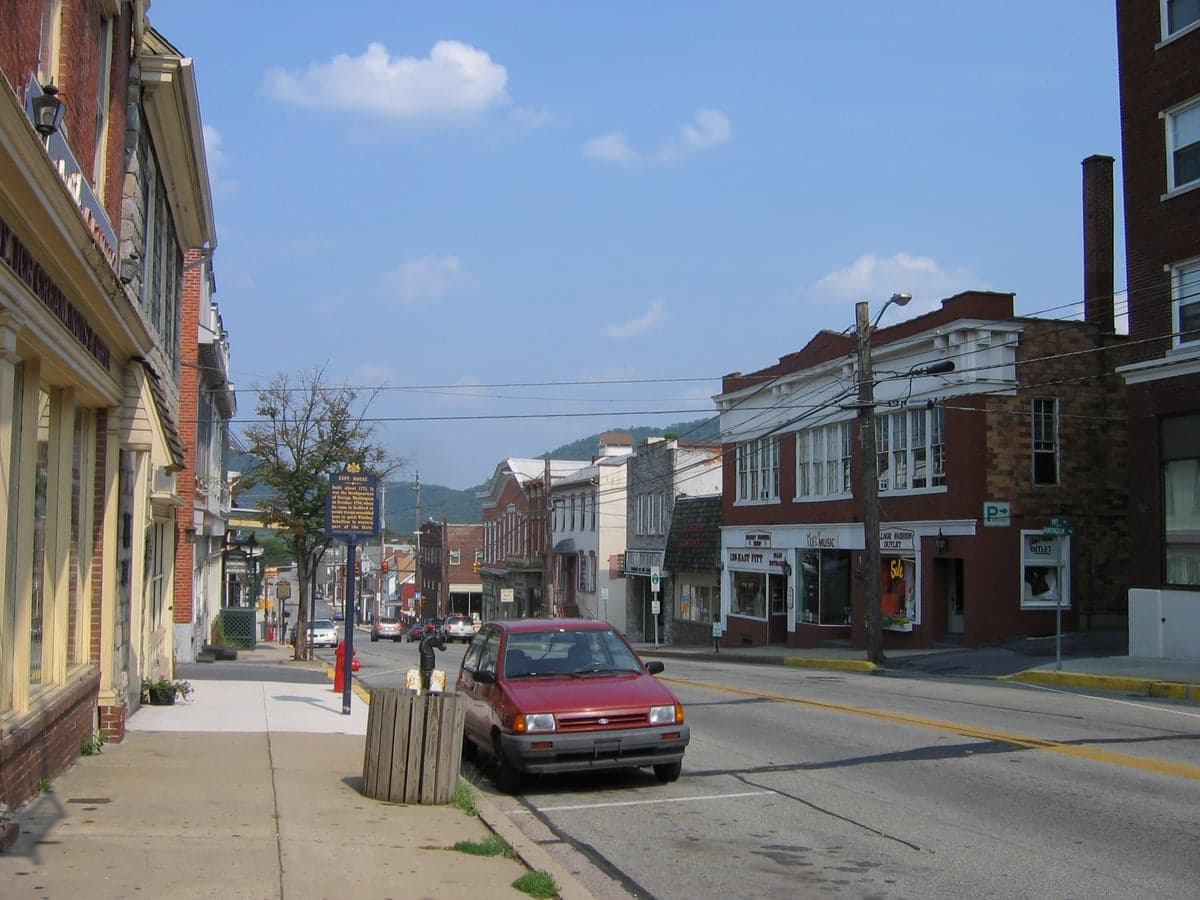
Bedford’s human history begins with its strategic location along the Raystown Path, a Native American trail that became the Forbes Road during the French and Indian War. The town was formally laid out in 1766 by Dr. John Campbell, with the first wave of settlers being Scotch-Irish and German farmers drawn by the fertile lands of the Bedford Valley. These early residents built their homes in what is now the Historic District, centered around the courthouse square, where stone and brick structures from the late 1700s still stand. The arrival of the Pennsylvania Railroad in the 1850s spurred a second wave of Irish and German laborers, who settled in the West End neighborhood, near the rail yards and the Bedford Springs Hotel. By the early 20th century, the town’s economy diversified with the rise of the silk and shirt manufacturing industries, attracting a small number of Italian and Eastern European families to the South Side area, along Quaker Valley Road. The population peaked around 3,500 in the 1950s, supported by the nearby Bedford Army Air Field (now the Bedford County Airport) and the growing tourism trade around the springs.
Modern era (post-1965)
Following the 1965 Immigration and Nationality Act, Bedford experienced minimal international immigration, with the foreign-born share remaining below 2% through 2026. The most notable demographic shift has been the arrival of a small Indian-subcontinent community, primarily professionals in healthcare and engineering, who began settling in the Colonial Hills subdivision in the 1990s and 2000s. This group, now at 2.4% of the population, is concentrated in newer single-family homes on the eastern edge of town. The East/Southeast Asian population (0.6%) and Black population (1.3%) remain very small, with most families living in the Northwood area near the hospital. Domestic in-migration has been limited, with most new residents coming from other parts of Pennsylvania, drawn by lower housing costs and the quiet, rural lifestyle. The Hispanic population is negligible at 0.3%, reflecting the area’s lack of agricultural or service-sector jobs that attract such workers in other parts of the state. Suburbanization has been minimal; the city’s boundaries have not expanded significantly, and most growth has occurred in the surrounding township, leaving Bedford’s core population stable but aging.
The future
Bedford’s population is projected to continue a slow decline, mirroring trends across rural Pennsylvania, with the 2020 census showing a drop from 2,841 to 2,851 (a negligible change) after decades of gradual loss. The population is becoming slightly more diverse, driven by the Indian-subcontinent community, which is expected to grow as healthcare professionals are recruited to the local hospital and regional medical centers. However, the overall foreign-born share is unlikely to rise above 3% in the next decade, as the area lacks the economic magnets—large universities, tech hubs, or major immigrant gateway cities—that drive diversity elsewhere. The white population, while dominant, is aging, with a median age likely above 45, and younger residents are leaving for college and jobs in State College, Harrisburg, or Pittsburgh. New housing developments are concentrated in the Bedford Heights area, a small subdivision of ranch homes and townhouses that attracts retirees and a few remote workers, but the city’s cultural identity remains firmly rooted in its Pennsylvania Dutch and Appalachian heritage, with little pressure to change.
For someone moving in now, Bedford offers a stable, low-cost, and safe environment with a strong sense of local history, but it is not a place of rapid demographic change or growth. The population is becoming slightly more diverse through targeted professional recruitment, but the city remains overwhelmingly white and native-born, with a culture that values tradition, self-reliance, and community ties. New residents should expect a quiet, slow-paced life where integration requires active participation in local churches, civic groups, and events like the annual Bedford County Fair.

* Values derived from national, state, county, city and local statistics and may differ in a specific area. Last updated: 2026-11-21T15:27:20.000Z
Narrative content on this page is AI-generated and may contain mistakes. Verify any details that matter before acting on them.
ReloMaps may earn a commission from affiliate links at no extra cost to you.

