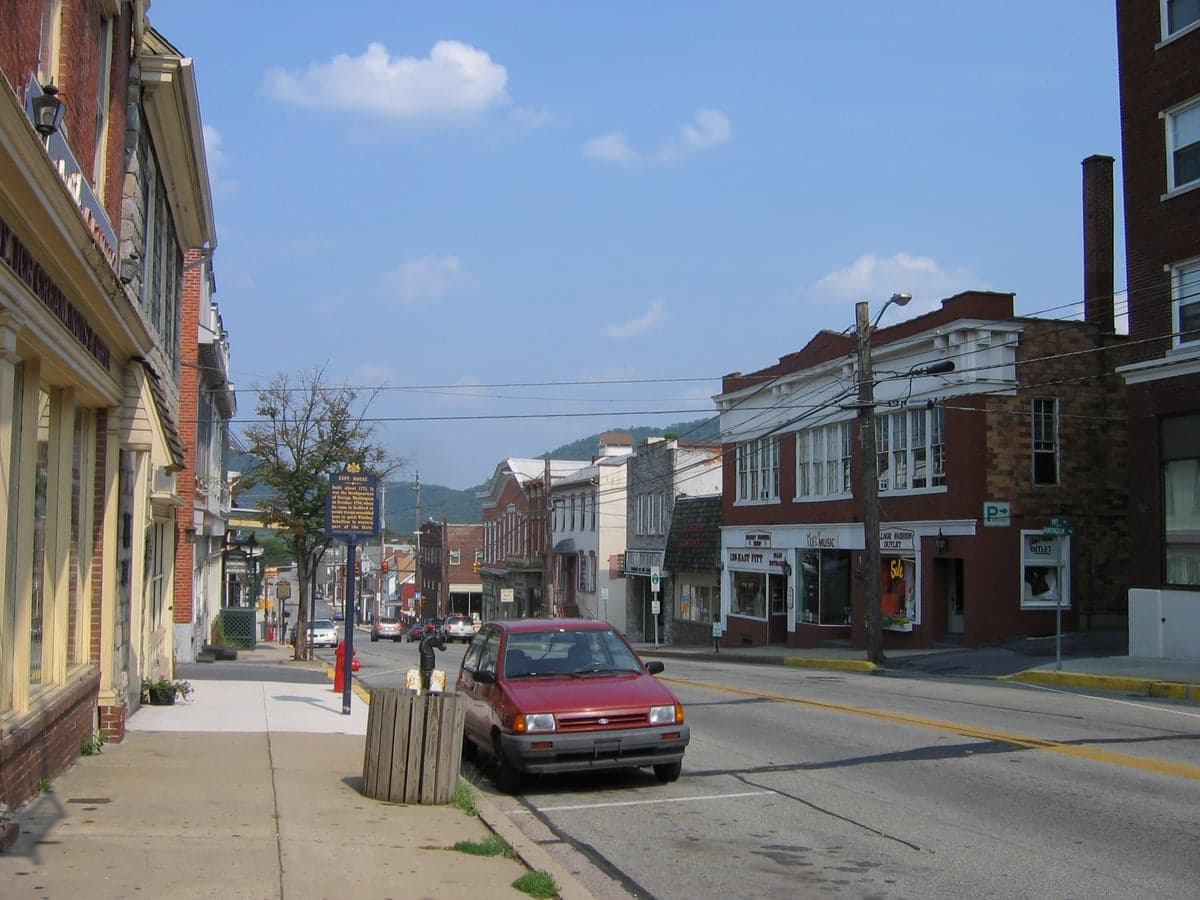
Photo: Wikipedia
Personal Sovereignty in Bedford, PA
Strong independent fundamentals that actively favor personal liberty and low regulation.
What does Personal Sovereignty tell us?
Personal Sovereignty measures your capacity for self-reliance and independence with minimal government friction. Higher scores mean fewer barriers between you and the way you want to live... but it assumes you have the space you need and good neighbors.
What does this tell us?
Personal Sovereignty measures your capacity for self-reliance and independence with minimal government friction. Higher scores mean fewer barriers between you and the way you want to live... but it assumes you have the space you need and good neighbors.
State Policy
Energy independence: Net exporter (274% of energy produced in-state)
Personal Liberty
Homesteading

Personal Liberty Analysis
Bedford, Pennsylvania offers a notably high degree of personal sovereignty, grounded in Pennsylvania's status as a shall-issue state for firearms, a state with no personal income tax on wages, and a county-level regulatory environment that is generally light-touch relative to urban and suburban areas of the Commonwealth. For individuals and families who prioritize autonomy—whether in self-defense, financial independence, or lifestyle choices—Bedford County provides a legal and cultural framework that leans heavily toward individual discretion rather than government prescription. The trade-off is that this freedom comes with limited public services and infrastructure, meaning residents must be prepared to handle more of their own needs, from snow removal to property maintenance, than they would in a more densely regulated jurisdiction.
Tax burden and regulatory posture in Bedford County
Pennsylvania’s tax structure is a mixed bag for sovereignty-minded residents. The state imposes a flat 3.07% personal income tax on all earned income, but notably does not tax wages separately—a single rate applies to salaries, wages, and business income. There is no state-level tax on Social Security benefits, and retirement income from pensions and 401(k)s is also exempt from state income tax, which is a significant advantage for retirees and those planning for financial independence. Bedford County itself levies a county-wide real estate tax of approximately 4.5 mills, and local school district taxes add another 20–30 mills depending on the district (e.g., Bedford Area School District is around 22 mills). Combined, property taxes on a median home value of roughly $150,000 run about $4,000–$5,000 annually—moderate by Pennsylvania standards but not negligible. Sales tax is 6% statewide, with no additional county-level surcharge. The regulatory posture in Bedford County is decidedly rural and permissive. Zoning is minimal outside the borough of Bedford itself; most of the county is unzoned, meaning there are no county-wide building codes or land-use restrictions for agricultural or residential uses on parcels over a certain size. The Pennsylvania Department of Environmental Protection (DEP) does enforce state-level environmental regulations, particularly for any activity involving waterways or wetlands, but for typical residential construction, the county’s permitting process is straightforward and inexpensive. The overall regulatory burden is low, especially for those engaged in agriculture, forestry, or small-scale home-based businesses.
Self-defense and gun law specifics in Bedford
Pennsylvania is a shall-issue state for concealed carry permits, meaning the Bedford County Sheriff’s Office must issue a License to Carry Firearms (LTCF) to any applicant who is not legally prohibited from possessing a firearm, provided they complete the application and pay the fee (currently $20 for a five-year license). There is no requirement for a training course, background check beyond the standard NICS check, or demonstration of need. Open carry is legal without a permit for anyone who can legally possess a firearm, though it is restricted in Philadelphia and a few other municipalities—Bedford County has no such local ordinances. The state preempts local firearm regulations, so no municipality in Bedford County can enact its own gun bans or restrictions. Stand-your-ground law applies in Pennsylvania: there is no duty to retreat before using deadly force if you are in a place where you have a legal right to be and you reasonably believe force is necessary to prevent death or serious bodily injury. Castle doctrine is also codified, with a presumption of reasonable fear of death or great bodily harm if an intruder has unlawfully entered your home or occupied vehicle. Magazine capacity is not restricted, and there is no state-level registry of firearms or licenses. For the sovereignty-minded, Bedford County offers one of the most permissive legal environments for self-defense in the northeastern United States.
Self-reliance and homesteading viability: lot sizes, zoning, and off-grid feasibility
Bedford County’s rural character makes it highly viable for homesteading and self-reliance. The county has no county-wide zoning, and most townships have minimal or no zoning ordinances. Where zoning exists (primarily in the borough of Bedford and a few larger townships like Bedford Township), it is generally permissive for agricultural and residential uses. Minimum lot sizes in unzoned areas are effectively determined by the Pennsylvania Sewage Facilities Act, which requires a percolation test for on-lot septic systems. In practice, this means a minimum lot size of about 1–2 acres for a conventional septic system, though larger lots are common and affordable. Off-grid living is legally feasible: there are no state or county laws prohibiting solar panels, rainwater collection, composting toilets, or alternative energy systems, provided they meet basic health and safety codes. The Pennsylvania Uniform Construction Code (UCC) applies to all new residential construction, but enforcement is often minimal in rural areas, and owner-occupied dwellings can be built under an owner-builder exemption that allows the owner to act as their own general contractor without a license. Well drilling is regulated by the DEP, but permits are routinely issued for private wells. The county’s agricultural heritage means that raising livestock, keeping bees, and growing food crops are common and accepted without special permits. For those seeking to reduce dependence on municipal utilities and supply chains, Bedford County offers a legal environment that supports a high degree of self-reliance.
Personal liberties: parental rights, medical autonomy, speech, and property
Pennsylvania law generally respects parental rights in education and healthcare. The state allows for homeschooling under Act 169, which requires parents to file an affidavit with the local school district, maintain a portfolio of student work, and have the student undergo annual standardized testing or evaluation. The requirements are moderate but not onerous, and the homeschooling community in Bedford County is active and well-supported. Medical autonomy is more constrained: Pennsylvania has not enacted broad medical freedom legislation, and vaccine mandates for school attendance remain in effect for standard childhood immunizations, though philosophical exemptions are not available (only medical and religious exemptions are recognized). The state does not have a right-to-try law for terminally ill patients, though federal law provides some access. Speech and assembly rights are protected under the First Amendment, and Bedford County has no notable local ordinances restricting public expression. Property rights are strong: Pennsylvania is a “property rights” state with a constitutional provision requiring just compensation for takings, and the state’s Agricultural Area Security Law allows landowners to voluntarily preserve farmland while retaining ownership. There is no state-level rent control, and landlord-tenant law is governed by the Pennsylvania Landlord and Tenant Act, which is generally balanced but slightly favors landlords. For the sovereignty-focused reader, the key takeaway is that Bedford County’s legal culture is one of non-interference in personal decisions, provided those decisions do not create clear public health or safety risks.
Relative to other areas of the United States, Bedford County ranks among the more sovereignty-friendly locations in the Northeast, comparable to rural counties in upstate New York or northern New England but with a notably lighter tax burden and more permissive gun laws. The absence of county-wide zoning, the shall-issue firearms permitting, the lack of a state wage tax, and the strong property rights culture create an environment where individuals and families can exercise a high degree of personal autonomy. The trade-offs are real: limited public transportation, fewer healthcare providers, and a slower pace of life that may not suit everyone. But for those who value freedom from regulatory overreach and the ability to make independent choices about self-defense, education, and lifestyle, Bedford, Pennsylvania represents a solid option in a region where such freedoms are increasingly constrained.

* Values derived from national, state, county, city and local statistics and may differ in a specific area. Last updated: 2026-11-21T15:27:20.000Z
Narrative content on this page is AI-generated and may contain mistakes. Verify any details that matter before acting on them.
ReloMaps may earn a commission from affiliate links at no extra cost to you.

