
Photo: Wikipedia
Political ClimatePolitical Climate in Arlington, VA
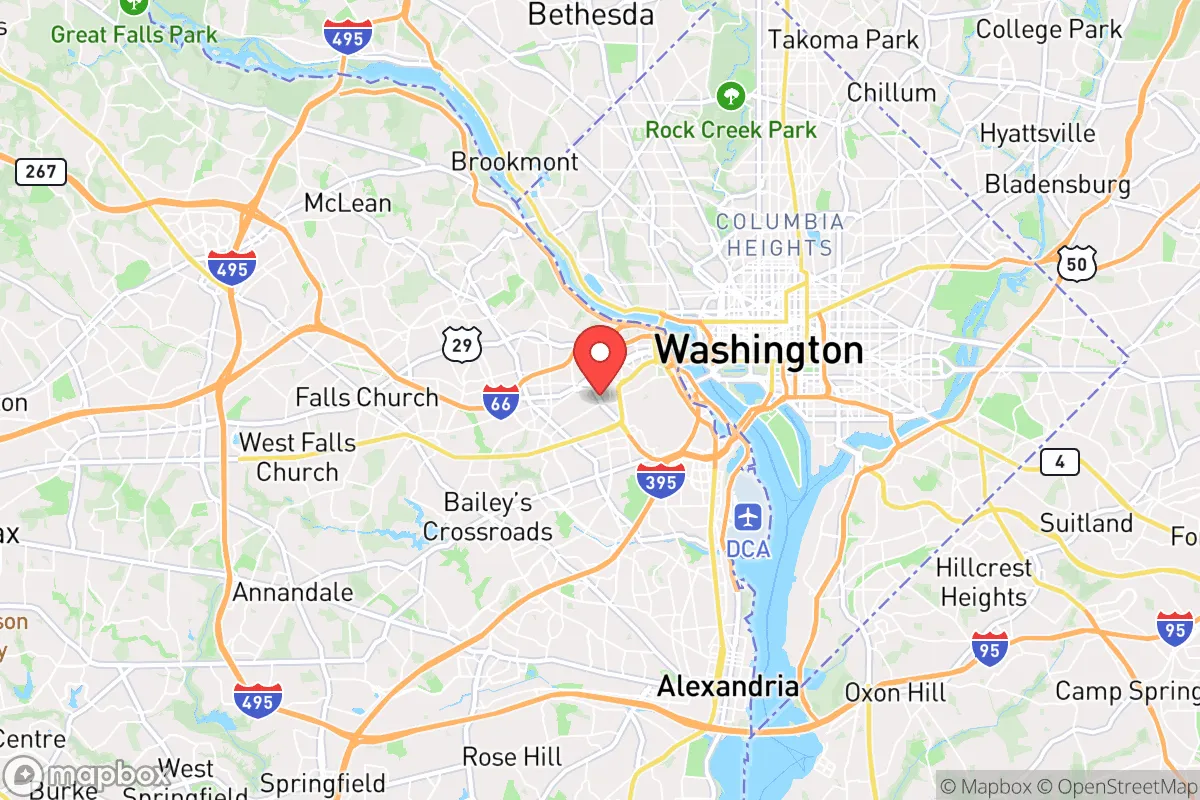
District shown is the primary district for this city’s centroid. Cities may span multiple districts.
Local Political AnalysisPolitical Analysis of Arlington, VA
Arlington, Virginia, is one of the most reliably Democratic jurisdictions in the entire country, with a Cook Partisan Voting Index (PVI) of D+26—meaning it votes about 26 points more Democratic than the national average. That’s not just blue; it’s deep indigo. In the 2024 presidential election, Arlington delivered over 80% of its vote to the Democratic candidate, a margin that has only widened over the past two decades. The county’s political trajectory has been steadily leftward since the 1990s, driven by an influx of highly educated professionals working in federal agencies, tech, and consulting, as well as a growing population of young families and transplants from other blue metros. The shift is so pronounced that even the county’s few remaining Republican-leaning precincts—mostly in the more affluent, older neighborhoods near Chain Bridge—have been shrinking in relative influence.
How it compares
To understand just how distinct Arlington is, look at the state-level PVI: Virginia as a whole is D+4, a competitive lean-blue state that still has plenty of red in its rural and exurban stretches. Arlington’s D+26 is a full 22 points more Democratic than the state average. That gap is enormous. For context, neighboring Falls Church City (D+28) and Alexandria (D+24) are similarly blue, but drive just 15 minutes west to Fairfax County’s outer suburbs—like Centreville or Chantilly—and you’ll find a more mixed political landscape, with PVI around D+10 to D+12. Go another 30 minutes west to Loudoun County’s rural western half or Prince William County’s Manassas area, and you’ll hit precincts that vote Republican by double digits. Even closer, the town of Vienna (Fairfax County) has a PVI around D+15, still significantly less blue than Arlington. The contrast is stark: Arlington is a Democratic stronghold in a state that, while trending blue, still has enough conservative voters to keep statewide races competitive.
What this means for residents
For liberal residents, Arlington’s political climate means local governance that aligns closely with their values: robust public transit investment (the Silver Line expansion, bus rapid transit), aggressive affordable housing policies, and some of the most progressive land-use and environmental regulations in the state. The county board is uniformly Democratic, and local elections often turn on intra-party debates about density and development rather than partisan battles. For conservative residents, the reality is more about being a small minority. You won’t find many Republican campaign signs in yards, and local political discourse can feel one-sided. That said, Arlington’s hyper-educated, policy-focused culture means that even conservatives can find common ground on issues like fiscal transparency, school quality, and neighborhood preservation—though they’ll rarely win a county-wide vote. The practical effect is that conservative residents often engage more in civic associations, homeowner groups, or state-level politics (where their vote still matters in Virginia’s competitive statewide races) rather than local county elections.
Culturally, Arlington’s political lean shapes daily life in tangible ways. The county’s zoning code is among the most restrictive in the region on single-family-only areas, pushing for more townhomes and apartments. Its school system, Arlington Public Schools, is heavily focused on equity initiatives and diversity programming, which is a point of pride for many but a source of frustration for some parents who feel academic rigor takes a backseat. The county also has a strong “sanctuary” stance on immigration enforcement, and its police department has adopted some of the most progressive use-of-force policies in Virginia. For anyone moving here, the key takeaway is that Arlington is not politically neutral—it’s a place where progressive values are baked into the infrastructure, from the bike lanes to the library programming. If that aligns with your worldview, you’ll feel right at home. If it doesn’t, you’ll still find a vibrant, safe, and well-run community—but you’ll be in a clear political minority, and local elections will rarely go your way.

State Political ClimatePolitical Climate in Virginia
State Political AnalysisPolitical Environment in the State
Virginia is a state that has shifted from a reliably conservative-leaning swing state to a solidly Democratic-leaning one over the past two decades, now carrying a Cook PVI of D+4. The transformation has been driven primarily by explosive population growth in the Washington, D.C. suburbs, particularly in Northern Virginia, which now dominates statewide elections. While the state still elects a Republican governor (as it did with Glenn Youngkin in 2021), the underlying trend is clear: the Democratic coalition is larger and more durable, built on a foundation of affluent, college-educated voters in the suburbs and a growing minority population. For a conservative relocator, this means the state’s political center of gravity is in places like Arlington and Fairfax, not Roanoke or Lynchburg.
Urban vs. rural divide
The political map of Virginia is a textbook example of the urban-rural split. The entire Democratic margin comes from three major population centers: Northern Virginia (Fairfax, Loudoun, Prince William counties), the Richmond metro (Henrico and Chesterfield counties), and Hampton Roads (Virginia Beach, Norfolk, Chesapeake). In 2020, Joe Biden won Fairfax County by over 300,000 votes — more than his entire statewide margin of victory. Meanwhile, rural and exurban areas like Southwest Virginia (Bristol, Wise County) and the Shenandoah Valley (Harrisonburg, Staunton) vote heavily Republican, often by 30-40 point margins. The key battlegrounds are the fast-growing exurbs like Loudoun County and Spotsylvania County, which have flipped from red to blue over the last decade as D.C. commuters move further out. A conservative moving to Virginia should understand that their vote carries more weight in the state legislature than in presidential races, as the General Assembly’s districts are still competitive in many areas.
Policy environment
Virginia’s policy environment is a mixed bag that reflects its purple-to-blue trajectory. The state has a flat income tax rate of 5.75%, with a standard deduction that has been increased under Governor Youngkin. Sales tax is 5.3% (higher in Northern Virginia and Hampton Roads for local transportation projects). Property taxes are set locally and vary widely — Loudoun County’s rate is about $1.20 per $100 of assessed value, while Bristol’s is around $0.80. On regulation, Virginia is a Dillon Rule state, meaning localities only have powers explicitly granted by the state legislature — this limits the ability of cities like Richmond or Charlottesville to enact their own gun or rent control ordinances. Education policy has been a flashpoint: Youngkin pushed for “parental rights” in education, including a model policy on transgender students that requires parental notification and restricts bathroom access. The state also passed a school choice expansion in 2024, creating education savings accounts for students with disabilities. Healthcare is dominated by the Medicaid expansion passed in 2018 under Democratic Governor Ralph Northam, which now covers over 600,000 low-income adults. Election laws are relatively moderate: no-excuse absentee voting, same-day registration, and voter ID requirements that are less strict than Texas but stricter than California.
Recent policy direction
The last five years have seen Virginia lurch left on social issues and then partially pull back under Youngkin. On gun rights, the 2020 Democratic wave passed a package of laws including universal background checks, a “red flag” law (extreme risk protection orders), and a one-handgun-per-month limit. Youngkin has not been able to repeal these, but his administration has loosened enforcement and appointed pro-Second Amendment judges. On parental rights and education, the 2024 “Parents’ Bill of Rights” (HB 1387) requires schools to notify parents of any changes to a student’s mental, emotional, or physical health — a direct response to transgender policies in Fairfax and Loudoun. On abortion, Virginia remains an outlier in the South: abortion is legal up to 26 weeks, with no waiting period or mandatory ultrasound. Youngkin attempted to pass a 15-week ban in 2023 but failed due to a split legislature. On voting access, the state has moved toward convenience: no-excuse absentee voting was made permanent in 2021, and same-day voter registration was expanded. On property rights, Virginia has a strong “right to farm” law protecting agricultural operations from nuisance lawsuits, but localities in Northern Virginia have aggressively used zoning to block new housing, driving up costs. On privacy and surveillance, the state passed a comprehensive data privacy law in 2021 (the Virginia Consumer Data Protection Act), giving residents the right to access, correct, and delete personal data held by companies.
Civil unrest & political movements
Virginia has been a stage for some of the most visible political flashpoints in the country. The 2017 Unite the Right rally in Charlottesville — which turned violent and left one counter-protester dead — remains a defining scar, leading to the removal of Confederate statues and a statewide debate over public memory. The 2020 protests in Richmond over racial justice and police reform saw the Robert E. Lee statue on Monument Avenue become a focal point for both Black Lives Matter demonstrators and armed counter-protesters. On the right, the “Parents Matter” movement in Loudoun County — sparked by a 2021 sexual assault case involving a transgender student — has become a national template for conservative school board activism. Immigration politics are less heated than in border states, but Prince William County has a history of aggressive immigration enforcement (its 2007 policy was a model for other localities), while Arlington and Alexandria are de facto sanctuary cities. Election integrity remains a live issue: after the 2020 election, a Republican-led audit found no widespread fraud, but the state GOP continues to push for stricter voter ID laws. A new resident will notice that political bumper stickers and yard signs are common in the suburbs but rare in rural areas — the divide is visible and felt.
Projection
Over the next 5-10 years, Virginia is likely to become more Democratic, not less. The in-migration from D.C. and the Northeast is accelerating, particularly in Loudoun, Prince William, and Stafford counties. These new arrivals are younger, more diverse, and more liberal than the existing population. The 2024 election results showed Biden winning Virginia by 5 points, down from 10 in 2020, but the underlying demographics still favor Democrats. The Republican path to winning statewide depends on turning out rural voters at record levels while holding the exurbs — a strategy that worked for Youngkin in 2021 but failed for the party in 2023 legislative races. The 2025 gubernatorial election will be a key test: if a Republican can win again, it suggests the state is still competitive; if not, the D+4 PVI may become D+6 or D+7. For a conservative moving in now, expect that your vote will matter most in local and state legislative races, and that the cultural environment in the suburbs will continue to shift left. The rural areas will remain deeply conservative, but they will have less and less influence over statewide policy.
Bottom line for a new resident: If you’re a conservative, you can find a strong community in the Shenandoah Valley, Southwest Virginia, or the exurbs of Richmond and Hampton Roads. But you should expect to live under a state government that is increasingly liberal on social issues, gun rights, and education. If you’re a liberal, you’ll find a welcoming environment in the D.C. suburbs, Richmond, and Charlottesville, with a state government that generally aligns with your values. Either way, Virginia offers a high quality of life, strong schools, and a diverse economy — but the political climate is one you’ll need to navigate, not ignore.
* Values derived from national, state, county, city and local statistics and may differ in a specific area. Last updated: 2026-10-01T19:42:59.000Z
Narrative content on this page is AI-generated and may contain mistakes. Verify any details that matter before acting on them.
ReloMaps may earn a commission from affiliate links at no extra cost to you.

