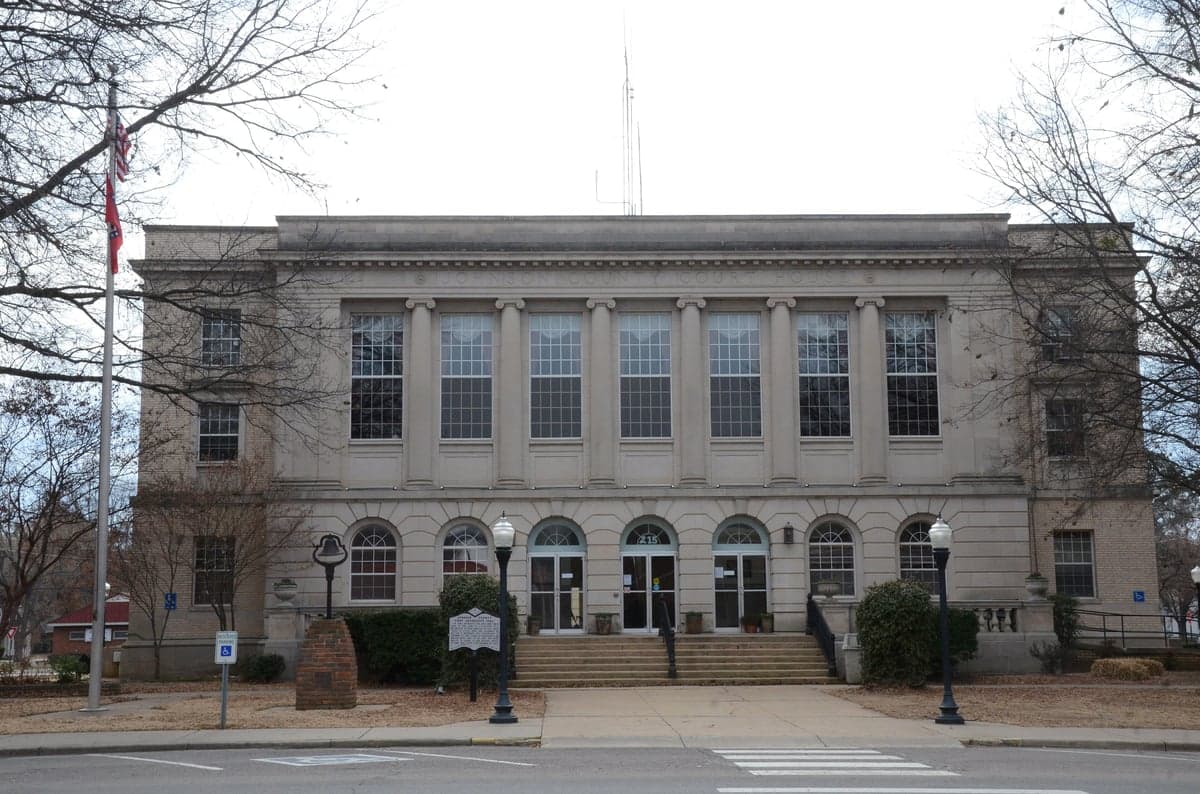
Photo: Wikipedia
Political ClimatePolitical Climate in Johnson County
Showing district-level results — no local-only data available.
Local Political AnalysisPolitical Analysis of Johnson County
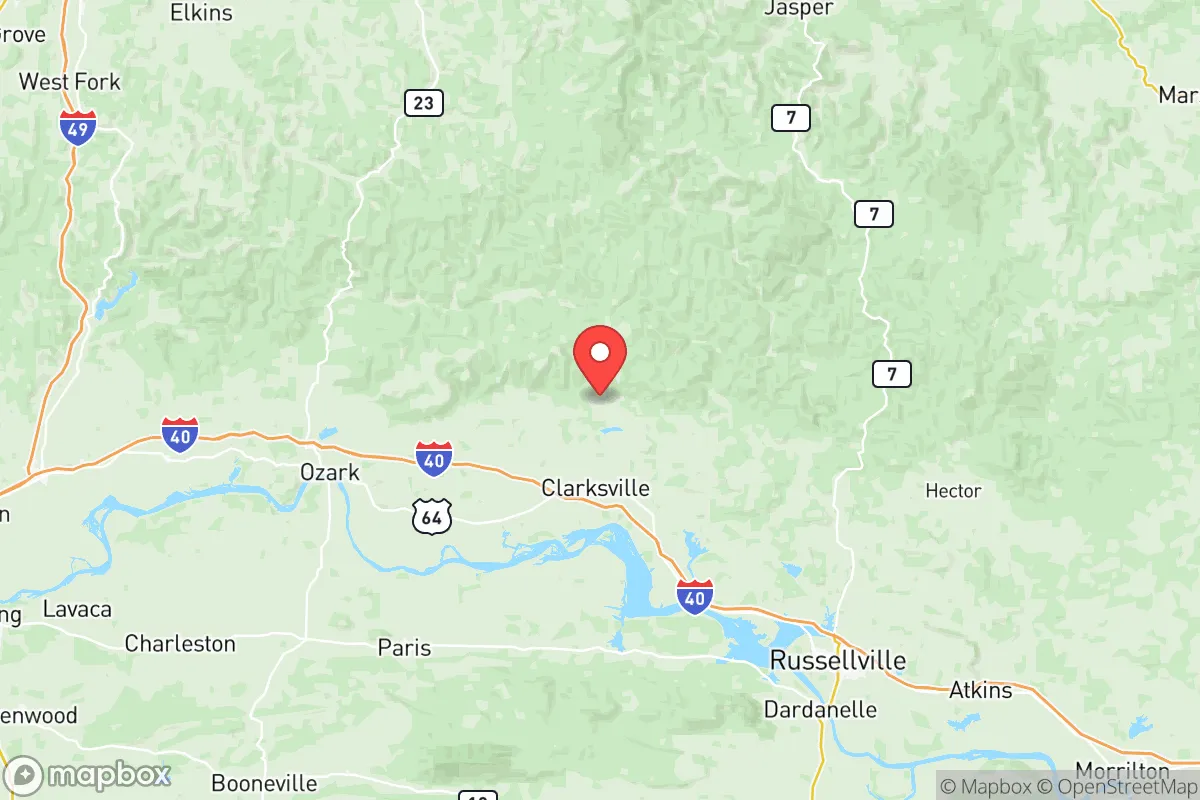
Johnson County, Arkansas, is reliably Republican, with a Cook Partisan Voting Index (PVI) of R+20, making it a deeper shade of red than the state of Arkansas as a whole, which sits at R+16. This isn't a new development; the county has been trending rightward for decades, but the shift has accelerated since the early 2000s, mirroring the broader realignment of rural America. The county seat, Clarksville, is the only real population center and tends to be the most politically moderate area, while the smaller towns and unincorporated areas—places like Coal Hill, Lamar, and Knoxville—are where Republican margins are most lopsided. You won't find any precincts that consistently vote blue, but Clarksville's precincts, particularly those near the University of the Ozarks, can sometimes produce closer races, especially in local elections.
How it compares
Compared to the state of Arkansas, Johnson County is about 4 points more conservative on the PVI scale, which is a meaningful gap. That difference is most visible in how the county votes on state-level ballot measures. For example, while Arkansas as a whole has shown some willingness to support progressive initiatives like the 2020 minimum wage increase and medical marijuana, Johnson County has consistently voted against such measures by wider margins. The county's Republican lean is also more entrenched than in neighboring counties like Pope County (home to Russellville), which has a similar but slightly less conservative PVI of R+18. The real contrast, however, is with the state's more competitive regions. While Pulaski County (Little Rock) and Washington County (Fayetteville) have become more Democratic-leaning in recent cycles, Johnson County has moved in the opposite direction, solidifying its position as one of the most reliably Republican counties in the Arkansas River Valley.
What this means for residents
For conservative residents, the political climate is comfortable and affirming. Local government, from the county quorum court to the school board, is dominated by Republicans, and policy decisions tend to reflect that majority. You'll find that issues like gun rights, limited government, and traditional social values are widely supported. For liberal or moderate residents, the reality is more about finding your niche. While you won't face overt hostility, you will be in a clear minority. The University of the Ozarks provides a small, more progressive bubble within Clarksville, but outside of that, political discussions can be one-sided. The practical effect is that local elections are often decided in the Republican primary, which means the general election is usually a formality. This can be frustrating for those who don't align with the dominant party, but it also means that local politics are often less contentious than in swing areas, with a focus on practical governance rather than partisan warfare.
One cultural distinction worth noting is the county's strong connection to the Arkansas River Valley and its agricultural and industrial roots. This isn't the Ozarks or the Delta; it's a region defined by the river, the railroad, and a working-class ethos. That identity shapes the political conversation, which tends to prioritize economic development, infrastructure (like the ongoing improvements to Highway 64), and support for local industries like poultry processing and manufacturing. There's also a notable strain of libertarian-leaning independence here, especially in the more rural precincts, where residents are skeptical of both federal overreach and heavy-handed local regulation. This isn't a county that's interested in political drama; it's a place where people want to be left alone to work, hunt, and raise their families, and the voting patterns reflect that straightforward, no-nonsense worldview.

State Political ClimatePolitical Climate in Arkansas
State Political AnalysisPolitical Environment in the State
Arkansas is a deeply red state with a Cook Partisan Voting Index of R+16, meaning it votes about 16 points more Republican than the national average in presidential elections. The state hasn't backed a Democrat for president since Bill Clinton (a native son) carried it in 1996, and the GOP now holds every statewide office, supermajorities in both legislative chambers, and all four U.S. House seats. Over the last 20 years, the shift has been dramatic — Arkansas was a competitive swing state as recently as the early 2000s, but a combination of national polarization, rural realignment, and the collapse of the old conservative Democratic "Blue Dog" tradition has turned it into one of the most reliably Republican states in the South.
Urban vs. rural divide
The political map of Arkansas is a textbook case of the urban-rural split. The only reliably blue stronghold is Pulaski County, home to Little Rock, which consistently votes Democratic by double digits — in 2024, Kamala Harris carried it by about 12 points. Outside of Pulaski, the only other counties that occasionally lean blue are Crittenden County (Memphis suburbs, heavily African American) and Chicot County in the Delta. The rest of the state is deeply red, with rural counties in the Ozarks, the River Valley, and southern Arkansas routinely delivering 70-80% Republican margins. The northwest corner, anchored by Fayetteville and Bentonville, is an interesting case — Washington County (Fayetteville) has been trending purple as the University of Arkansas and Walmart's corporate presence draw younger, more educated transplants. It voted for Trump in 2024, but by a much narrower margin than the rest of the state. Meanwhile, Benton County (Bentonville, Rogers) remains solidly red, driven by a booming economy and a heavily white, suburban, and religious population.
Policy environment
Arkansas's policy environment is consistently conservative, with a strong emphasis on low taxes, limited regulation, and social conservatism. The state has a flat income tax of 4.4% (down from 7% in 2015, with further cuts phased in), a state sales tax of 6.5% (with local add-ons pushing it higher in some cities), and no estate tax. Property taxes are among the lowest in the country, averaging about 0.6% of assessed value. The regulatory posture is business-friendly, with right-to-work laws, no state-level minimum wage above the federal floor (though a 2024 ballot measure raised it to $15 by 2026), and a tort reform system that caps non-economic damages in medical malpractice cases at $500,000. On education, Arkansas has a robust school choice landscape — the LEARNS Act, passed in 2023, created universal Education Freedom Accounts (vouchers) worth roughly $6,600 per student, which can be used for private school tuition, homeschooling expenses, or tutoring. The state also bans nearly all abortions, with no exceptions for rape or incest, following the trigger law that took effect after Dobbs. Election laws have tightened: voter ID is required, absentee ballot drop boxes are banned, and early voting hours were reduced in 2021.
Recent policy direction
The last three years have seen a flurry of legislation that pushes Arkansas further right across multiple dimensions. On gun rights, the state enacted permitless carry in 2021 and passed a "Second Amendment Sanctuary" law in 2023 that prohibits state enforcement of any future federal gun restrictions. On parental and education rights, the LEARNS Act (2023) also banned "critical race theory" and "indoctrination" in public schools, required schools to post curriculum materials online, and made it easier for parents to challenge library books. On speech and privacy, Arkansas passed Act 689 in 2023, which requires public libraries to create review processes for "age-inappropriate" materials and allows local governments to defund libraries that don't comply — a law currently being challenged in court. On medical and bodily autonomy, the state's near-total abortion ban is paired with a 2023 law restricting gender-affirming care for minors, banning puberty blockers, hormone therapy, and surgery. On property rights, Arkansas has strong eminent domain protections and no statewide rent control. On voting and ballot access, the 2021 law (Act 249) shortened the early voting window from 15 to 10 days, banned ballot harvesting, and required a photo ID for absentee voting. A 2023 law also purged inactive voters from the rolls more aggressively.
Civil unrest & political movements
Arkansas has not seen the kind of large-scale civil unrest that has hit larger states, but there have been notable flashpoints. In 2020, Black Lives Matter protests in Little Rock and Fayetteville drew hundreds of participants, with some clashes and arrests, but they were relatively small compared to national protests. The state has a visible but not dominant organized activist scene on both sides: on the right, groups like the Arkansas Family Council and the state's chapter of Moms for Liberty have been highly effective in pushing school board and library policy; on the left, the Arkansas Public Policy Panel and Indivisible chapters in Little Rock and Fayetteville organize around voting rights and healthcare access. Immigration politics are less heated here than in border states — Arkansas has no sanctuary cities, and a 2019 law (Act 104) requires local law enforcement to cooperate with federal immigration authorities. There has been some election integrity controversy: in 2022, a lawsuit challenged the state's ban on absentee ballot drop boxes, and in 2024, the state's aggressive voter roll purges drew criticism from voting rights groups. Secession and nullification rhetoric is mostly fringe, though a 2021 resolution affirming "state sovereignty" passed the legislature symbolically.
Projection
Over the next 5-10 years, Arkansas is likely to remain solidly Republican, but the margins may narrow slightly in the northwest corridor as Fayetteville and Springdale continue to attract out-of-state transplants from bluer states. The state's population growth is concentrated in Benton and Washington counties, which are becoming more diverse and more educated — trends that historically push leftward. Meanwhile, the rural Delta and southern Arkansas are losing population, which could amplify the urban-rural divide. The GOP's supermajorities are secure for now, but internal fractures are emerging between the business-friendly, Chamber of Commerce wing (dominant in Northwest Arkansas) and the more populist, culture-war-focused faction (stronger in the rural south and east). A relocator moving in now should expect a state that remains deeply conservative on social and fiscal issues, but with a growing suburban-libertarian streak in the northwest that may moderate some policies over time — particularly on education and economic regulation.
For a new resident, the bottom line is this: Arkansas offers a low-tax, low-regulation environment with strong gun rights, school choice, and a conservative social framework. Liberal residents will find little political representation outside of Little Rock and pockets of Fayetteville, and should expect state policy to continue moving right on abortion, LGBTQ+ rights, and education. Conservative residents will find a state that largely aligns with their values, but should be aware that the northwest corridor is slowly diversifying and may become a political battleground within a decade. Regardless of your politics, the practical reality is that Arkansas is a place where state government is small, local control is strong, and the pace of change is slow — for better or worse.
* Values derived from national, state, county, city and local statistics and may differ in a specific area. Last updated: 2026-07-15T15:51:37.000Z
Narrative content on this page is AI-generated and may contain mistakes. Verify any details that matter before acting on them.
ReloMaps may earn a commission from affiliate links at no extra cost to you.

