
Photo: Wikipedia
Personal Sovereignty in Johnson County
Viable for self-reliance. Generally workable, though some barriers may limit total independence.
What does Personal Sovereignty tell us?
Personal Sovereignty measures your capacity for self-reliance and independence with minimal government friction. Higher scores mean fewer barriers between you and the way you want to live... but it assumes you have the space you need and good neighbors.
What does this tell us?
Personal Sovereignty measures your capacity for self-reliance and independence with minimal government friction. Higher scores mean fewer barriers between you and the way you want to live... but it assumes you have the space you need and good neighbors.
State Policy
Energy independence: Importer (35% of energy produced in-state)
Personal Liberty
Homesteading

Personal Liberty Analysis
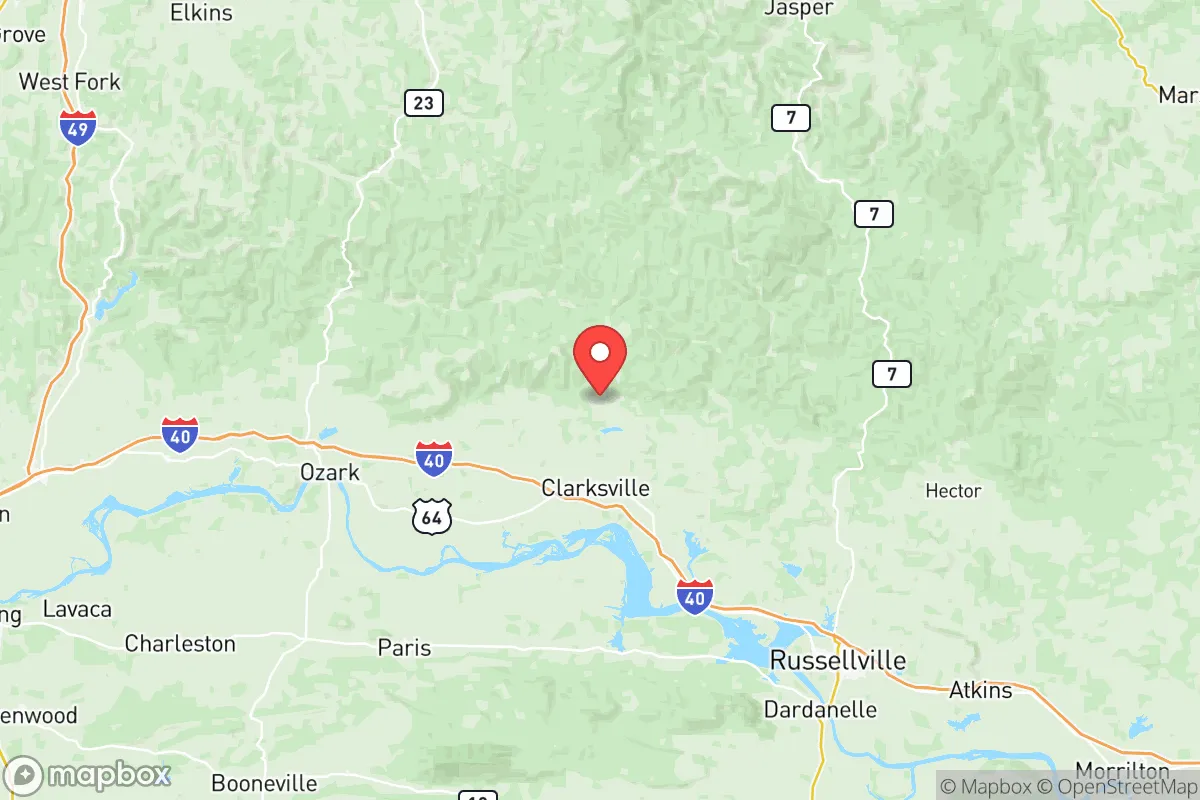
Johnson County, Arkansas offers a notably high degree of personal sovereignty, shaped by a state-level legal framework that prioritizes limited government, strong gun rights, and minimal regulatory interference in daily life. Located in the Arkansas River Valley between the Ozark and Ouachita National Forests, the county provides an environment where individual autonomy is the default, with local governance in towns like Clarksville, Lamar, and Knoxville generally deferring to state preemption on key liberty issues. For single individuals and families seeking to minimize government involvement in their personal and economic decisions, Johnson County presents a compelling option, particularly when compared to more regulated urban centers in neighboring states.
Tax burden and regulatory posture for residents and small businesses
Johnson County operates under Arkansas's relatively low-tax framework, which directly supports personal financial sovereignty. The state levies a flat income tax rate of 4.4% as of 2026, with no local income tax, meaning residents in Clarksville and Hartman keep more of their earnings than in states with progressive or municipal income taxes. Property taxes in Johnson County are among the lowest in the state, with an effective rate typically around 0.5% to 0.6% of assessed home value, and the county assessor's office maintains a straightforward, non-adversarial appraisal process. Sales tax in the county is 9.5% (state plus local), which is moderate for Arkansas but higher than some rural counties; however, the absence of complex business licensing requirements or onerous zoning boards in unincorporated areas makes it easier for small-scale entrepreneurs and home-based businesses to operate without bureaucratic friction. The regulatory posture is best described as light-touch: there are no county-level rental inspection programs, no local minimum wage ordinances exceeding the state's $11.00/hour floor, and no special use permits required for typical home occupations like landscaping, consulting, or online retail.
Self-defense and gun law specifics in Johnson County
Arkansas is a constitutional carry state, and Johnson County fully reflects that legal reality. Any law-abiding adult 21 or older may carry a concealed handgun without a permit, and open carry is also legal without a license. The county sheriff's office in Clarksville processes concealed carry licenses for those who want reciprocity with other states, but there is no local pressure to obtain one for daily carry. Stand-your-ground and castle doctrine laws are codified in state statute, providing broad legal protection for the use of deadly force in self-defense, with no duty to retreat in any place where the individual is lawfully present. Johnson County has no local ordinances restricting firearm possession in parks, public buildings, or businesses beyond what state law mandates, and the county's rural character means that shooting on private property is generally permitted, subject to standard discharge ordinances near occupied dwellings. The gun culture here is practical and integrated into daily life, with multiple firearm retailers and shooting ranges in the Clarksville area, and no local political momentum toward additional restrictions.
Self-reliance and homesteading viability across the county
Johnson County is one of the more homestead-friendly areas in Arkansas, with land use regulations that strongly favor individual self-reliance. Unincorporated areas, including the rural stretches around Ozone, Hagarville, and Lamar, have no county-wide zoning, meaning residents can keep livestock, build workshops, and establish gardens without seeking permits or variances. Minimum lot sizes in unincorporated areas are effectively governed by state subdivision regulations rather than local planning boards, allowing for acreage purchases as small as one to five acres for a homestead. Off-grid living is legally feasible: there are no county mandates requiring connection to municipal water or sewer, and rainwater catchment systems are unrestricted. Solar panel installation requires no county permit, though interconnection with the grid requires utility approval from Arkansas Valley Electric Cooperative or Ozarks Electric Cooperative. The county does enforce standard septic system permitting through the Arkansas Department of Health, but the process is straightforward and inexpensive compared to more regulated states. For those seeking true self-sufficiency, the mountainous terrain around Ozone offers affordable land with abundant water sources, while the flatter river bottom areas near Clarksville provide better soil for gardening.
Personal liberties: parental rights, medical autonomy, speech, and property
Arkansas law provides strong protections for parental rights, and Johnson County's local culture reinforces those protections. Parents have the legal right to direct their children's education, including homeschooling without state-mandated curriculum approval, and the county has a robust homeschooling community with support networks in Clarksville and Lamar. Medical autonomy is similarly respected: Arkansas does not mandate COVID-19 or childhood vaccination for school attendance, and there are no county-level health orders that override individual medical choice. Free speech protections are robust, with no local ordinances restricting public expression, and the county's political climate is overwhelmingly conservative, meaning dissenting views are generally tolerated rather than suppressed. Property rights are strongly protected under Arkansas's private property laws, with no county-level rent control, no inclusionary zoning mandates, and no local historic preservation districts that restrict what owners can do with their land. Eminent domain is rarely exercised for non-transportation purposes, and the county's planning department is small and non-intrusive.
Overall, Johnson County ranks among the more sovereignty-friendly areas in the South, offering a regulatory environment that is noticeably lighter than neighboring Washington County (Fayetteville) or Sebastian County (Fort Smith). The combination of constitutional carry, low taxes, minimal zoning, and strong parental and medical autonomy creates a framework where individuals and families can live largely free from government interference. For those prioritizing personal freedom over access to urban amenities, Johnson County represents a practical, legally grounded choice that consistently respects individual decision-making across the major domains of daily life.

* Values derived from national, state, county, city and local statistics and may differ in a specific area. Last updated: 2026-07-15T15:51:37.000Z
Narrative content on this page is AI-generated and may contain mistakes. Verify any details that matter before acting on them.
ReloMaps may earn a commission from affiliate links at no extra cost to you.

