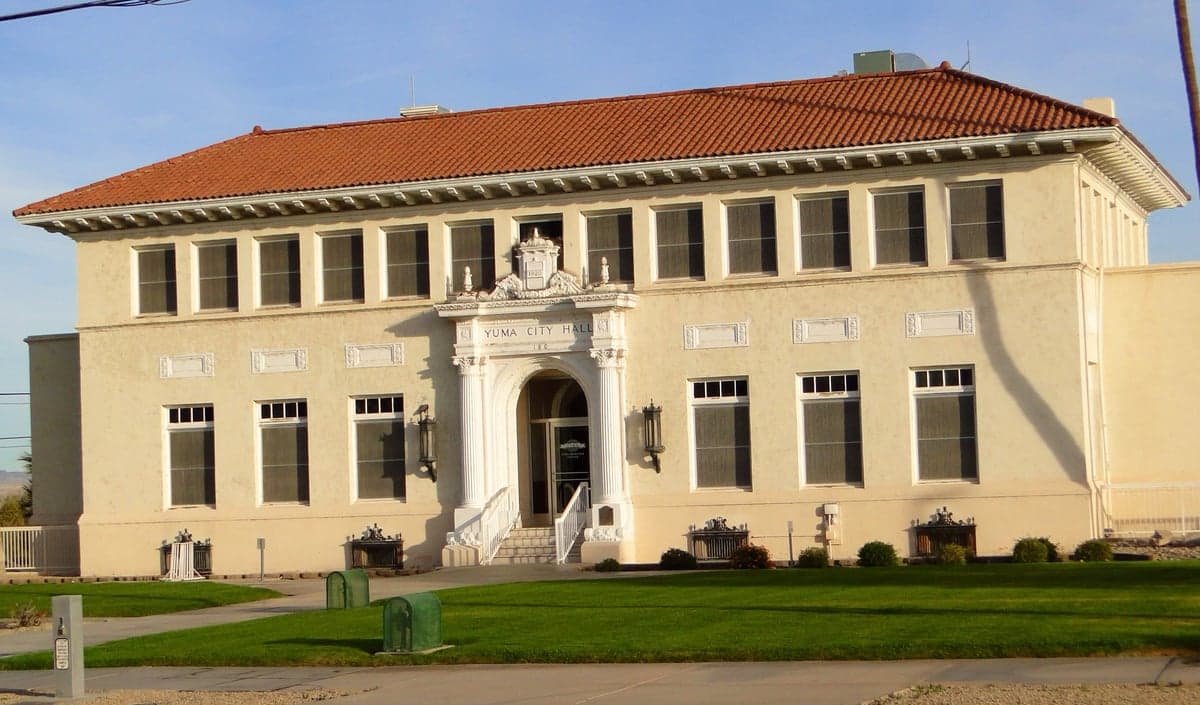
Photo: Wikipedia
Political ClimatePolitical Climate in Yuma County
Showing district-level results — no local-only data available.
Local Political AnalysisPolitical Analysis of Yuma County
Yuma County is a solidly Republican stronghold in southwestern Arizona, carrying a Cook Partisan Voting Index of R+15, which makes it significantly more conservative than the state as a whole (rated EVEN). The county has voted for the GOP presidential candidate in every election since 2000, though the margins have tightened slightly in recent cycles as the broader state has shifted leftward. This isn't a monolith, though — the politics vary noticeably between the agricultural heartland, the city of Yuma proper, and the smaller towns like Somerton and San Luis, which lean more Democratic due to their large Latino populations.
How it compares
Arizona as a whole is a true battleground state, with its Cook PVI of EVEN reflecting the tight margins between Democrats and Republicans in statewide races. Yuma County, by contrast, is reliably red at the county level, but the internal dynamics are more nuanced. The city of Yuma itself is a mix: precincts near the downtown core and around Arizona Western College tend to lean blue, while the outlying areas — especially the rural farming communities east of town and the Foothills area south of the Gila River — are deeply conservative. San Luis and Somerton, both majority-Hispanic border towns, consistently vote Democratic, but their turnout is often lower than the more affluent, white-majority precincts in the county's northern and eastern reaches. This means the county's overall R+15 rating masks a real urban-rural and ethnic divide that plays out in local school board and city council races.
What this means for residents
For conservative residents, Yuma County offers a political environment where their values are broadly reflected in local governance — the county board of supervisors is reliably Republican, and the sheriff's office and other elected positions tend to lean conservative. For liberal residents, the reality is more about finding community in the blue-leaning pockets of Yuma city proper or in the border towns, where Democratic candidates often win local races. Statewide, Yuma County's GOP lean means it's a reliable source of Republican votes in statewide elections, but its influence is diluted by the rapid growth of Maricopa County and the leftward shift of Pima County. In practice, this means that while Yuma County residents may feel their local politics are stable, their impact on state-level outcomes is shrinking as Arizona becomes more competitive.
Culturally, Yuma County's politics are shaped by its agricultural economy, its large military presence (Marine Corps Air Station Yuma), and its border location. The county's strong Republican lean is reinforced by a high proportion of veterans and retirees, while the Democratic vote is concentrated among younger, more diverse populations in the border towns and the city. Policy-wise, this means local debates often center on water rights, border security, and agricultural labor — issues that cut differently across the county's political divides. The trajectory is toward a slow but steady diversification, as the Latino population grows and younger residents move in, but the county's R+15 rating is likely to persist for the foreseeable future, even as Arizona itself remains a toss-up.

State Political ClimatePolitical Climate in Arizona
State Political AnalysisPolitical Environment in the State
Arizona is the ultimate swing state in 2026, holding a Cook Partisan Voting Index of EVEN, meaning it votes almost exactly with the national average. Over the past 20 years, it has shifted from a reliably Republican stronghold—where George W. Bush won by 11 points in 2004—to a fiercely competitive battleground decided by margins of less than one percent in 2020 and 2022. The dominant coalitions are a fast-growing, diverse Maricopa County suburban bloc that leans center-left, pitted against a deeply conservative rural and exurban base concentrated in places like Mohave and Yavapai counties, with a rising independent vote in Pima County and the Phoenix metro fringe.
Urban vs. rural divide
The political map of Arizona is defined by the urban-rural chasm. Maricopa County, home to Phoenix, Mesa, Chandler, and Scottsdale, contains over 60% of the state's population and has been the epicenter of the shift. Once a GOP bastion, Maricopa voted for Joe Biden in 2020 and has since elected Democrats to statewide office, driven by college-educated suburbanites in Paradise Valley and Tempe who are increasingly moderate-to-liberal on social issues but fiscally cautious. Pima County, anchored by Tucson, is a reliable Democratic stronghold, while the fast-growing exurbs like Queen Creek and Buckeye remain deeply red. Rural counties—Apache, Navajo, Yavapai, and Mohave—vote Republican by 30-50 point margins, powered by mining, ranching, and retirement communities. The result is a state where statewide races are decided by a few thousand votes in the Phoenix suburbs, not by the rural counties that dominate the map visually.
Policy environment
Arizona's policy environment is a study in contrasts. The state has a flat income tax rate of 2.5% (passed in 2021) and no estate tax, making it attractive for high earners and retirees. Property taxes are low relative to the national average, and sales taxes are moderate but vary by city. The regulatory posture is generally business-friendly, with right-to-work laws and limited zoning in rural areas. Education policy is a flashpoint: the state has one of the most expansive school choice programs in the nation, including Empowerment Scholarship Accounts (ESAs) that allow public funds to follow students to private or homeschool settings, but public school funding per pupil remains near the bottom nationally. Healthcare policy is mixed—Arizona expanded Medicaid under the Affordable Care Act in 2013, but the state has some of the most restrictive abortion laws in the country post-Dobbs, with a near-total ban (SB 1457) that has been partially blocked by courts. Election laws have been a national focus: the state requires voter ID at the polls, conducts universal mail-in voting (a system popular with both parties), and has seen repeated audits and legal challenges since 2020.
Recent policy direction
The recent policy direction in Arizona reflects a state pulling in two directions at once. On gun and self-defense law, Arizona is a constitutional carry state (no permit needed to carry concealed) and has a "stand your ground" statute, with no recent moves to tighten restrictions. Parental and education rights have been strengthened by the expansion of ESAs and a 2022 law requiring schools to post curriculum materials online, though a 2024 ballot measure to enshrine school choice in the constitution failed narrowly. Speech and privacy are generally protected under a robust state constitution, but a 2023 law (HB 2616) restricts the teaching of "divisive concepts" in public schools, mirroring national culture-war battles. Medical and bodily autonomy is the most volatile area: a 2024 ballot initiative (Proposition 139) to enshrine abortion rights up to fetal viability passed with 62% of the vote, overriding the legislature's near-total ban, but enforcement remains tied up in court. Property rights are strong, with no statewide rent control and limited eminent domain use. Taxation is trending downward—the 2021 flat tax cut is being phased in through 2027. Voting and ballot access remain a partisan battleground: the state passed a 2022 law (HB 2492) requiring proof of citizenship to vote in federal elections, which the Supreme Court partially upheld in 2024, while a 2020 ballot measure (Proposition 208) to tax the wealthy for education was struck down by courts.
Civil unrest & political movements
Civil unrest and political movements in Arizona are visible and organized. The state was ground zero for election integrity activism after 2020, with the controversial "Cyber Ninjas" audit of Maricopa County ballots drawing national attention and sparking ongoing distrust among a significant portion of Republican voters. Immigration politics are a constant flashpoint: the 2010 SB 1070 "show me your papers" law was largely struck down, but border security remains a top issue, with the state sending National Guard troops to the border and passing a 2024 law (HB 2820) making illegal entry a state crime, mirroring Texas's approach. Organized activist movements include a well-funded progressive coalition (Mi AZ, LUCHA) focused on voting rights and abortion access, and a grassroots conservative network (Arizona Freedom Caucus, Turning Point Action) that has pushed for election reforms and school choice. Protests have been frequent but largely peaceful—the 2020 George Floyd protests in Phoenix saw some property damage, and the 2022 abortion ban protests drew thousands to the capitol. A new resident would notice the omnipresence of political yard signs, active local party chapters, and a media landscape dominated by dueling partisan outlets.
Projection
Over the next 5-10 years, Arizona is likely to remain a swing state but with a slight Democratic lean in presidential years, driven by continued in-migration from California and the Midwest, the growing Latino electorate (now 25% of voters), and the suburbanization of Maricopa County. However, the state's rural and exurban areas are also growing, and the Republican Party is investing heavily in turning out low-propensity voters in places like Yavapai and Pinal counties. The key demographic wildcard is the influx of retirees and remote workers from blue states—they tend to bring moderate-to-liberal social views but fiscally conservative preferences, which could keep the state competitive for another decade. The policy trajectory will likely see continued fights over abortion (with the 2024 initiative creating a permanent legal battle), school choice expansion, and water management (a growing bipartisan concern). A new resident moving in now should expect a state where every election is a nail-biter, where policy swings with the party in power, and where grassroots activism on both sides is a fact of daily life.
For a new resident, the bottom line is that Arizona offers low taxes, strong property rights, and a business-friendly climate, but with a volatile political environment where the rules on abortion, education, and voting can change with each election cycle. Conservatives will find a state that respects gun rights, school choice, and limited government, but they will need to contend with a growing Democratic coalition that has won the last two presidential elections here. Liberals will find a state with a vibrant activist community and a path to power through the suburbs, but they will face a legislature that is often hostile to their priorities. The practical takeaway: Arizona is not a settled political landscape—it is a live experiment in what happens when a red state turns purple, and the outcome is still being written.
* Values derived from national, state, county, city and local statistics and may differ in a specific area. Last updated: 2026-07-10T15:42:52.000Z
Narrative content on this page is AI-generated and may contain mistakes. Verify any details that matter before acting on them.
ReloMaps may earn a commission from affiliate links at no extra cost to you.

