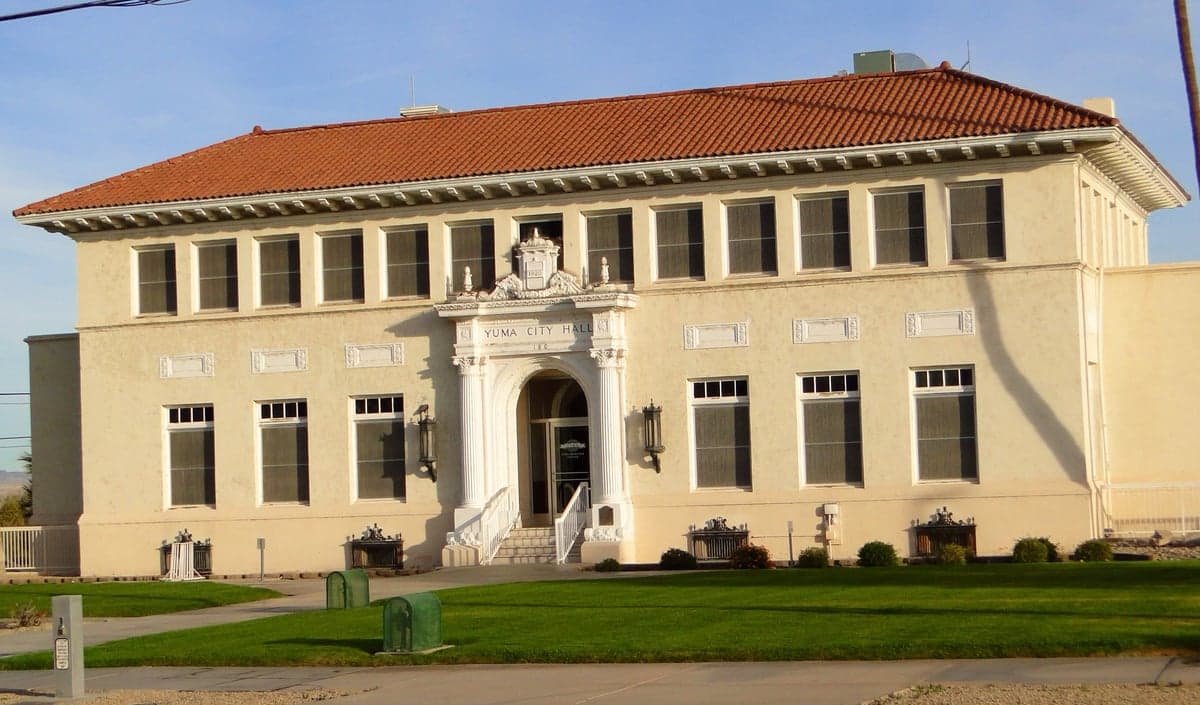
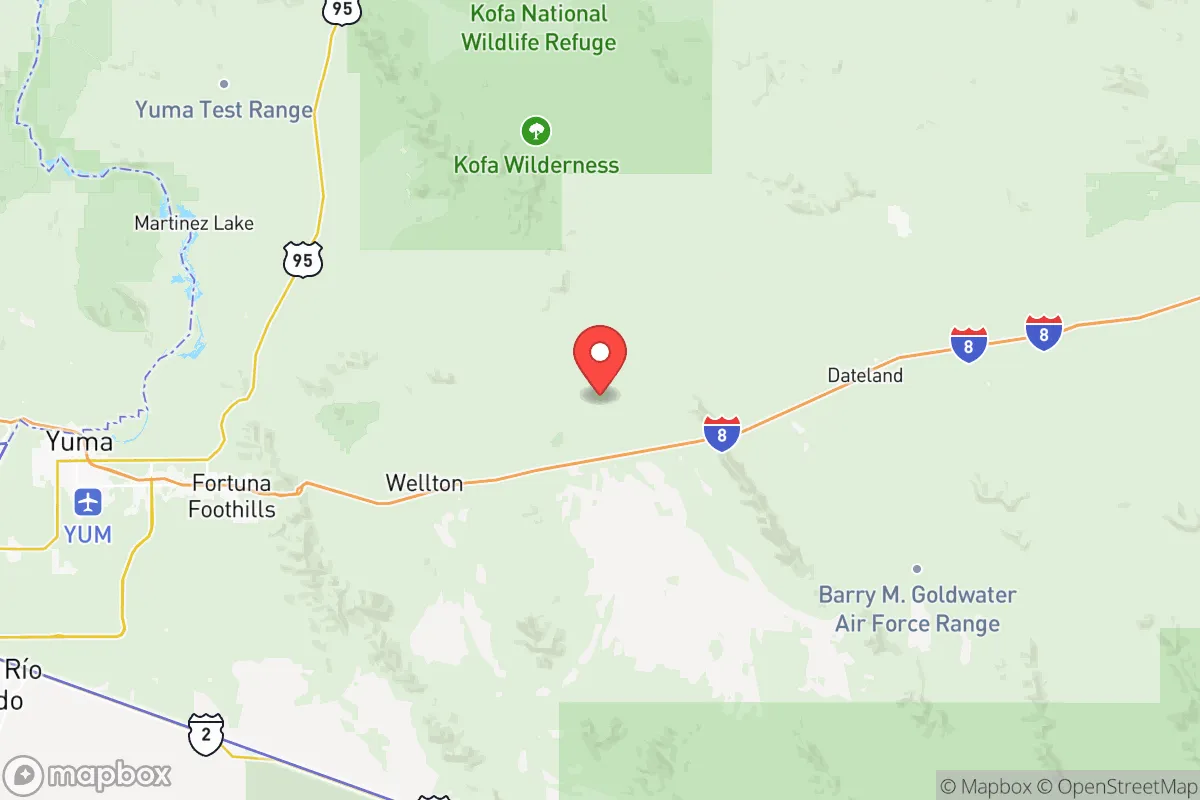
Photo: Wikipedia
Demographics of Yuma County
Affluence Level in Yuma County
A below-average socioeconomic profile. Incomes, home values, and educational attainment trail the U.S., with higher poverty and unemployment.
People of Yuma County
Today, Yuma County, Arizona is home to 207,685 residents, a population defined by its deep Hispanic heritage and strategic location on the U.S.-Mexico border. With a population that is 64.4% Hispanic and 29.6% White, the county is one of the most distinctly bicultural regions in the American Southwest, where Spanish is heard as often as English in grocery stores and city halls. The population is young, with a median age well below the national average, and is concentrated in the city of Yuma, with smaller clusters in Somerton, San Luis, and Wellton. The county's identity is shaped by a unique blend of century-old agricultural roots, a large seasonal population of "Winter Visitors" or snowbirds, and a growing military presence tied to the Marine Corps Air Station (MCAS) Yuma.
Settlement & growth (pre-1960)
Long before European contact, the area now known as Yuma County was the homeland of the Quechan (Yuma) people, a tribe of the Yuman language family who farmed the fertile floodplains along the Colorado River. The first Europeans to arrive were Spanish explorers and missionaries in the 16th and 17th centuries, but permanent colonization did not take hold until the late 18th century. In 1780, the Spanish established two settlements, Mission San Pedro y San Pablo de Bicuñer and Mission Puerto de Purísima Concepción, near what is now the city of Yuma. These missions were short-lived; the Quechan rebelled in 1781, killing most of the settlers and missionaries, and the Spanish did not re-establish a permanent presence in the area for decades.
American settlement began in earnest after the Mexican-American War (1846-1848) and the Gadsden Purchase of 1853, which fixed the current U.S.-Mexico border and brought the region under American control. The discovery of gold in California drew thousands of fortune-seekers through the area, and the town of Yuma (originally called Colorado City) was founded in 1854 as a ferry crossing on the Colorado River. The U.S. Army established Fort Yuma in 1850 on the California side of the river, and later built a major quartermaster depot in Yuma itself, which became a critical supply hub for the entire Southwest. The Southern Pacific Railroad reached Yuma in 1877, transforming the small outpost into a transportation and agricultural center.
The first major non-Native population wave was overwhelmingly Anglo-American, drawn by the promise of irrigated agriculture. The Yuma Valley was one of the first regions in the West to benefit from large-scale irrigation projects, with the Yuma Irrigation Project (authorized in 1904) and the construction of Laguna Dam (completed in 1909) opening thousands of acres to farming. Cotton, lettuce, and citrus became the economic backbone, and the population grew steadily from a few hundred in the 1870s to roughly 9,000 by 1920. This early Anglo population was largely of Midwestern and Southern origin — farmers from Kansas, Nebraska, Texas, and Missouri who brought with them a conservative, Protestant, small-town culture that still echoes in parts of the county today, particularly in the smaller communities of Wellton and Roll.
The second major wave, beginning in the 1910s and accelerating through the 1940s and 1950s, was Mexican. The Mexican Revolution (1910-1920) pushed tens of thousands of refugees north, and the Bracero Program (1942-1964) brought contracted Mexican laborers to work the fields of Yuma County. Many stayed, settling in the city of Yuma's barrios and in the agricultural towns of Somerton and San Luis. By 1960, the Hispanic share of the county's population had grown substantially, though exact figures from the era are imprecise because the Census did not consistently track Hispanic origin until 1980. What is clear is that by mid-century, Yuma County was already a bicultural community, with a significant Spanish-speaking population working in agriculture and a smaller Anglo population dominating business, government, and the professions.
Modern era (post-1965)
The 1965 Hart-Cellar Act, which abolished the national-origins quota system, had a profound effect on Yuma County, though not in the same way it reshaped major coastal cities. For Yuma, the most significant post-1965 demographic shift was the acceleration of cross-border migration from Mexico, both legal and undocumented. The agricultural economy continued to demand low-wage labor, and the county's position directly on the border made it a natural destination for Mexican immigrants. The town of San Luis, founded in 1930 but incorporated only in 1979, grew explosively from a few hundred residents in 1970 to over 15,000 by 2000, and today it is over 95% Hispanic. Somerton, similarly, transformed from a small Anglo farming community into a predominantly Hispanic town of over 14,000.
The post-1965 era also saw the growth of a significant seasonal population. "Winter Visitors," mostly retired Anglos from the Midwest and Canada, began arriving in large numbers in the 1970s and 1980s, drawn by Yuma's warm winter climate. They established RV parks and mobile home communities, particularly in the Foothills area east of the city of Yuma and around the town of Wellton. This seasonal influx, which can add 85,000 or more people to the county from November through March, has created a distinct dual economy and a cultural divide between the year-round, largely Hispanic population and the seasonal, largely Anglo population.
Another major post-1965 development was the expansion of MCAS Yuma, which became a master jet base and the Marine Corps' premier aviation training facility. The base brought in a steady stream of military personnel and their families, a population that is more racially diverse than the county's Anglo population but still predominantly White and Black. The military presence has been a stabilizing force for the county's economy and has introduced a more transient, nationally representative demographic element to a region that was historically insular.
Domestic migration from the Rust Belt and California has been a smaller factor in Yuma County than in Phoenix or Tucson, but it has been growing. Since the 1990s, a modest but steady stream of Californians — many of them Hispanic families priced out of the California housing market — have moved to Yuma and San Luis, attracted by lower home prices and the familiar desert landscape. This has reinforced the county's Hispanic character while also bringing in a more urban, politically diverse population than the county's traditional Anglo conservative base.
Today, the county's demographic profile is clear: 64.4% Hispanic, 29.6% White, 1.6% Black, 1.0% East/Southeast Asian, and 0.1% Indian (subcontinent). The foreign-born share is 13.2%, nearly all of Mexican origin. The county is notably less educated than the national average, with only 16.7% of adults holding a bachelor's degree or higher, reflecting the agricultural and service-based economy. The Black population, though small, is concentrated around MCAS Yuma and in the city of Yuma itself, while the East/Southeast Asian population is tiny and dispersed, with no distinct ethnic enclave.
The future
Yuma County is projected to continue growing, driven by natural increase (a high birth rate among the Hispanic population) and continued migration from Mexico and California. The county's population is expected to reach roughly 250,000 by 2040, with the Hispanic share rising to 70% or higher. The Anglo population, already aging and declining in absolute numbers, will continue to shrink as a percentage, though the seasonal Winter Visitor population may remain stable or grow slightly as the Baby Boom generation retires.
The most significant demographic trend is the gradual suburbanization of the Hispanic population. Historically concentrated in the older barrios of Yuma and in the border towns of San Luis and Somerton, Hispanic families are increasingly moving into previously Anglo-dominated neighborhoods in the Foothills and into newer subdivisions in east Yuma and Wellton. This is creating a more integrated, less segregated county, though economic disparities between Hispanic and Anglo households remain significant. The military presence at MCAS Yuma is likely to remain stable or grow, as the base is considered strategically important for the Marine Corps' aviation training mission.
Culturally, Yuma County is becoming more assertively Hispanic, with Spanish-language media, Mexican-American holidays, and bicultural identity becoming the norm rather than the exception. At the same time, the county remains politically conservative, with a strong Republican lean among both Anglo and Hispanic voters, particularly in local elections. The county's future identity is likely to be that of a predominantly Hispanic, working-class, agricultural and military community with a strong conservative bent — a profile that is increasingly common in the borderlands but still distinctive within Arizona.
For someone moving to Yuma County now, the bottom line is this: you are entering a community that is young, family-oriented, and deeply rooted in Mexican-American culture, where agriculture and the military are the twin pillars of the economy, and where the pace of life is slower and more traditional than in Phoenix or Tucson. The county is becoming more Hispanic, more suburban, and more integrated, but it remains a place where English and Spanish coexist, where the desert and the river define daily life, and where the population is shaped as much by the border as by the interstate.

* Values derived from national, state, county, city and local statistics and may differ in a specific area. Last updated: 2026-07-10T15:42:52.000Z
Narrative content on this page is AI-generated and may contain mistakes. Verify any details that matter before acting on them.
ReloMaps may earn a commission from affiliate links at no extra cost to you.

