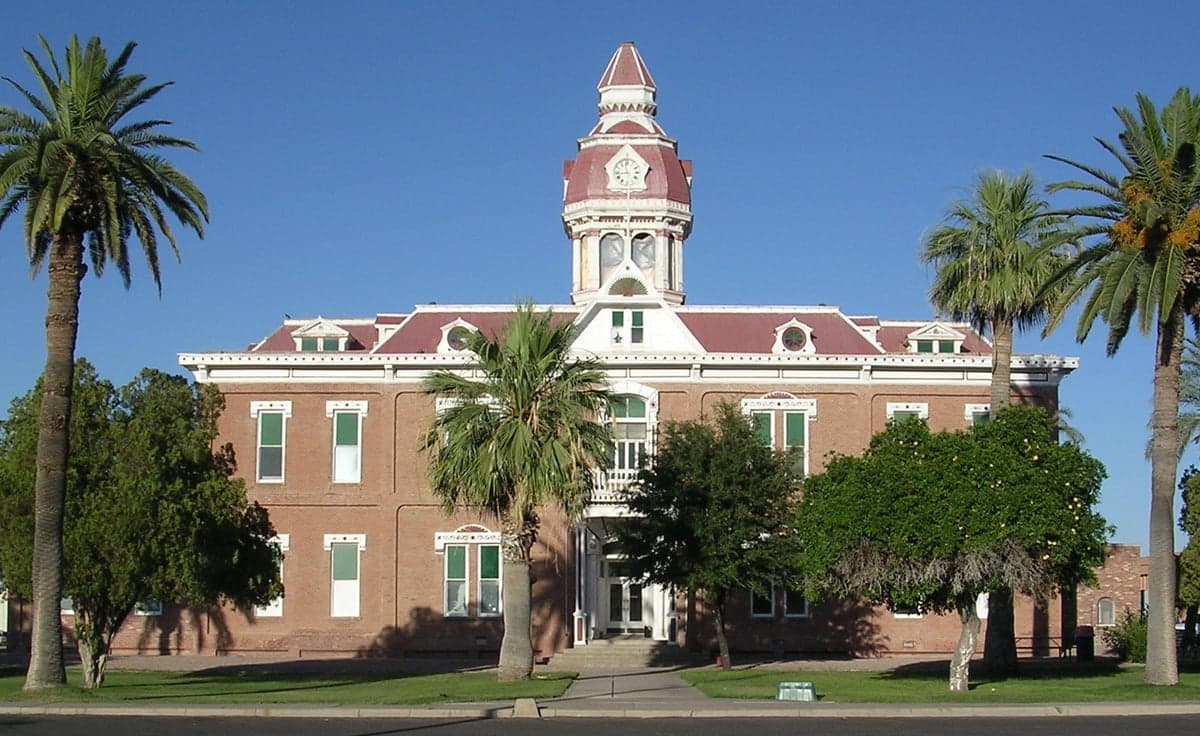
Photo: Wikipedia
Political ClimatePolitical Climate in Pinal County
Showing district-level results — no local-only data available.
Local Political AnalysisPolitical Analysis of Pinal County
Pinal County has shifted from a reliably blue-collar Democratic stronghold to a solidly Republican-leaning area, now carrying a Cook PVI of R+7. That's a dramatic swing from just a decade ago, when the county was considered a true bellwether, and it puts the area a full seven points to the right of the national average. The shift is driven largely by explosive population growth in places like Maricopa and San Tan Valley, where conservative-leaning retirees and families from Maricopa County have settled, overwhelming the older, more moderate voting base in the copper-mining towns and agricultural communities.
How it compares
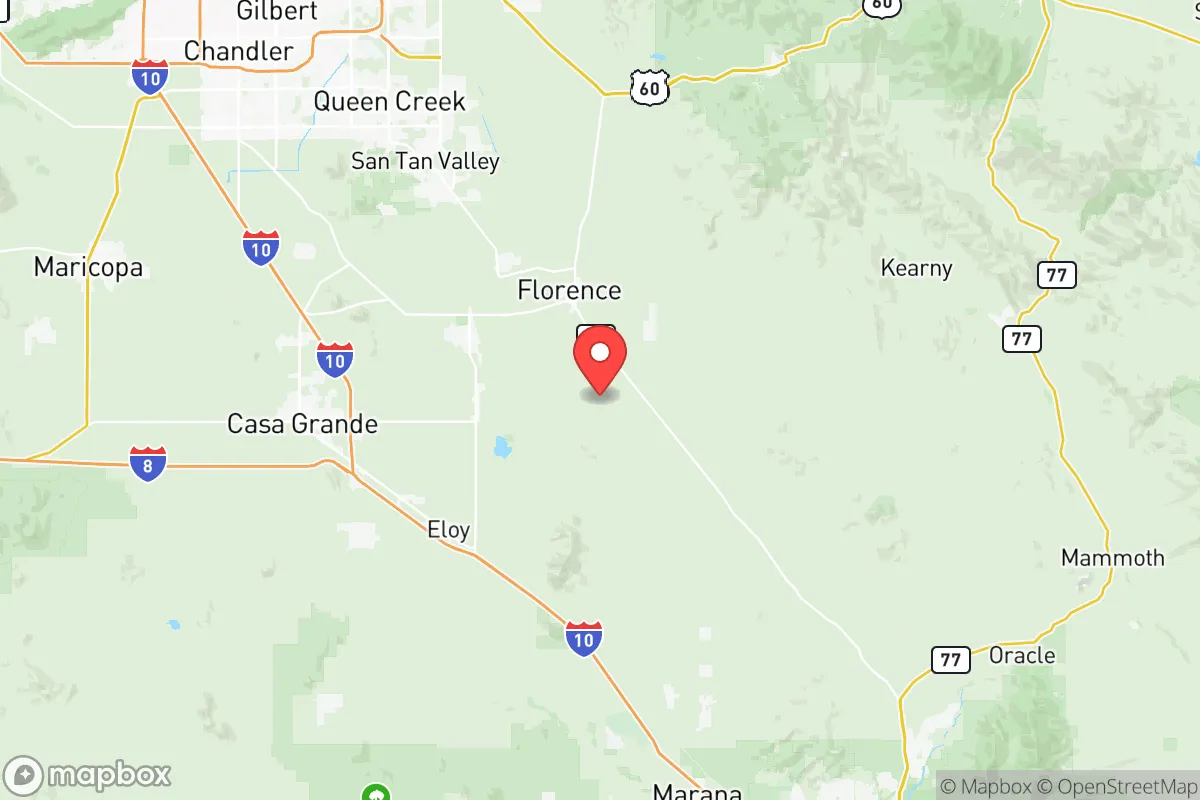
While Pinal County is now R+7, the state of Arizona as a whole sits at EVEN on the Cook PVI, making it one of the most competitive swing states in the country. That gap of seven points is significant: Pinal County is now a reliable Republican anchor in a state that can go either way. In the 2024 presidential election, Pinal County voted for Donald Trump by about 15 points, while the statewide margin was just over 5 points. The county's vote totals now regularly account for roughly 8-10% of the statewide electorate, up from around 5% in 2000. This growing Republican base in Pinal has made it harder for Democrats to win statewide races, even as Maricopa County trends toward the center. The political geography within the county is not uniform, however. The city of Florence, the county seat, leans heavily Republican, as does most of the sprawling exurban development around Maricopa and Casa Grande. The town of Kearny, a former mining hub, still trends more Democratic, though its population is small and shrinking. The precincts around Oracle and Mammoth show more variation, often swinging between parties depending on the candidate, making them the closest thing to swing territory left in the county.
What this means for residents
For conservative residents, Pinal County's political lean means their votes carry real weight in local elections, and the county commission and school boards have been reliably Republican for years. Policy reflects that: zoning tends to favor development, taxes are kept low, and the county has been a vocal supporter of Second Amendment rights and border security measures. For liberal residents, the reality is that they are a clear minority in most precincts, though not an invisible one. The growing population in Casa Grande has brought a more diverse and younger electorate, and Democratic candidates can sometimes win city council seats there. Statewide, Pinal's Republican tilt means that Democratic voters here have less influence than they would in Maricopa or Pima counties, but the county's increasing population means both parties are paying more attention. The practical effect for most people is that local political conversations tend to assume a conservative baseline, but the rapid growth is slowly introducing more ideological variety, especially in the larger towns.
Culturally, Pinal County feels more like the rural West than the Phoenix metro, even though it's physically close. There's a strong independent streak, a distrust of both Phoenix and Tucson, and a sense that the county is charting its own course. Policy-wise, the county has been aggressive in pushing back against state-level mandates on land use and water management, preferring local control. The county's stance on immigration enforcement has been consistently hardline, with the sheriff's office participating in 287(g) agreements with ICE. On the other hand, the rapid growth has forced some pragmatic compromises: water conservation rules have been tightened even in conservative-leaning towns, and there's broad support for expanding broadband and road infrastructure, regardless of party. The political climate here is less about ideological purity and more about a practical, live-and-let-live conservatism, with the understanding that the county's explosive growth will continue to reshape its politics for the next decade.

State Political ClimatePolitical Climate in Arizona
State Political AnalysisPolitical Environment in the State
Arizona has transformed from a reliably Republican stronghold into the nation’s premier political battleground, with a Cook Partisan Voting Index of EVEN. Over the past 20 years, the state has shifted from a solid red anchor of the Sun Belt to a true purple state, driven by explosive growth in Maricopa County and the influx of voters from bluer states. The dominant coalitions are now a near 50-50 split between a conservative base rooted in the exurbs and rural areas, and a growing coalition of suburban moderates, Latino voters, and transplants from California and the Midwest who have pushed the state to the left.
Urban vs. rural divide
The political map of Arizona is defined by the stark contrast between its major metro areas and the vast rural expanse. Maricopa County, home to Phoenix and its sprawling suburbs, is the entire ballgame — it casts about 60% of the state’s votes and has flipped from deep red to a narrow Democratic lean in presidential years. Within Maricopa, the city of Phoenix itself is reliably Democratic, while suburbs like Mesa and Gilbert remain conservative strongholds, though they are slowly moderating. Scottsdale and Paradise Valley are classic country-club Republican territory, but even there, the margins have tightened. Tucson and Pima County are the other major Democratic anchor, with the city itself being one of the most liberal in the Southwest. The rural counties — Yavapai (Prescott), Mohave (Kingman), and Cochise (Sierra Vista) — vote overwhelmingly Republican, often by 30-40 point margins. The swing counties that decide close elections are Pinal County (between Phoenix and Tucson), which is trending right but not as hard as the deep rural areas, and Yuma County, a border region with a large Latino population that has shifted toward Democrats in recent cycles.
Policy environment
Arizona’s policy environment reflects its purple status: a mix of traditionally conservative governance with some notable progressive exceptions. The state has a flat income tax rate of 2.5%, one of the lowest in the nation, and no estate tax. Property taxes are also relatively low, though they vary by county. The regulatory posture is generally business-friendly, with right-to-work laws and minimal union influence. On education, the state has a robust school choice system, including the nation’s most expansive Empowerment Scholarship Account program, which allows parents to use public funds for private school tuition. However, per-pupil funding remains below the national average, a frequent point of contention. Healthcare policy is a mixed bag: Arizona expanded Medicaid under the Affordable Care Act, but the state also has some of the loosest regulations on telehealth and direct-primary care arrangements. Election laws have been a flashpoint: the state has no-excuse mail-in voting (used by over 80% of voters), but also passed strict voter ID requirements and a 2022 law that purges inactive voters from the rolls. The state has a Republican-controlled legislature and a Democratic governor as of 2026, creating a divided government that often produces compromise budgets but gridlock on social issues.
Recent policy direction
The last five years have seen Arizona lurch in both directions on key liberty issues, depending on the topic. On gun rights, the state is a constitutional carry state since 2010, with no permit required to carry a concealed weapon, and preemption laws that block local gun ordinances. In 2024, the legislature passed a bill allowing firearms on public university campuses, though it was vetoed by Governor Katie Hobbs. On parental rights and education, the 2022 expansion of the ESA voucher program was a major win for school choice advocates, and a 2023 law requires schools to notify parents of any changes to a student’s mental or physical health services. On speech, the state has no general anti-SLAPP law, which leaves journalists and activists somewhat exposed to defamation suits. Privacy and surveillance are a growing concern: the state passed a biometric privacy law in 2024 that restricts how private companies can collect facial recognition data, but there is no comprehensive data privacy law for consumers. Medical and bodily autonomy is the most volatile issue: in 2024, Arizona voters passed Proposition 139, enshrining abortion access up to fetal viability in the state constitution, overriding a near-total ban from 1864 that the state Supreme Court had briefly revived. This was a major defeat for the pro-life movement. Property rights are strong, with no statewide rent control and relatively low eminent domain usage. On voting and ballot access, the state has expanded early voting and mail-in ballots, but also passed a 2022 law requiring proof of citizenship to vote in federal elections, which was partially blocked by courts. The overall direction is a tug-of-war: the legislature pushes right on cultural issues, while voters and the governor push back on abortion and election access.
Civil unrest & political movements
Arizona has been a hotbed of political activism on both sides, often centered on immigration and election integrity. The 2010 SB 1070 law, which required police to check immigration status during stops, sparked massive protests and boycotts, and the issue remains raw. In 2024, the state saw large demonstrations both for and against the abortion ban, with thousands rallying at the state capitol in Phoenix. The border crisis has fueled a strong presence of militia-style groups in Cochise and Santa Cruz counties, as well as organized humanitarian aid groups that leave water and supplies for migrants. Election integrity has been a persistent flashpoint since 2020: the state was ground zero for the “Stop the Steal” movement, with the controversial Cyber Ninjas audit of Maricopa County ballots in 2021 drawing national attention. This has led to a deep distrust of election administration among some conservatives, while Democrats have organized heavily around voting rights. The Sanctuary City debate is active in Tucson and Phoenix, where city councils have passed resolutions limiting cooperation with federal immigration enforcement, though state law preempts them. A new resident would notice the omnipresence of political yard signs, the intensity of local news coverage of the border, and the frequency of protests at the capitol, especially during legislative sessions.
Projection
Over the next 5-10 years, Arizona is likely to remain a competitive swing state, but the demographic trends favor a slow, steady shift toward the center-left. The state is growing by about 100,000 people per year, with most new residents coming from California, Illinois, and other blue states. These transplants tend to be moderate to liberal on social issues but fiscally conservative, which could push the state toward a more libertarian-leaning purple. The Latino population, now about 32% of the state, is younger and growing, and while it is not monolithic, it leans Democratic by about 20 points. The rural counties will continue to vote heavily Republican, but their share of the overall vote is shrinking. The key battleground will be the suburban ring of Maricopa County — places like Chandler, Peoria, and Surprise — where the fastest-growing demographic is college-educated independents. A resident moving in now should expect that the state will continue to be a political rollercoaster, with close elections, divided government, and frequent ballot initiatives on hot-button issues. The Republican Party will likely remain competitive but may need to moderate on abortion and immigration to win statewide, while Democrats will need to hold the center on crime and the economy to avoid losing the suburban vote they gained in 2020.
For a new resident, the bottom line is that Arizona offers a unique blend of low taxes and business-friendly policy with a highly engaged, polarized electorate. If you are conservative, you will find a strong community in the suburbs and rural areas, but you will need to accept that the state is no longer a safe bet for Republicans in statewide races. If you are liberal, you will find a growing coalition in the cities and a governor who can veto the most conservative legislation, but you will face a legislature that is firmly in Republican hands. The practical takeaway is that Arizona rewards political engagement — your vote genuinely matters here, and the policy direction of the state will be decided by a few thousand swing voters in the Phoenix suburbs for the foreseeable future.
* Values derived from national, state, county, city and local statistics and may differ in a specific area. Last updated: 2026-07-17T22:43:09.000Z
Narrative content on this page is AI-generated and may contain mistakes. Verify any details that matter before acting on them.
ReloMaps may earn a commission from affiliate links at no extra cost to you.

