
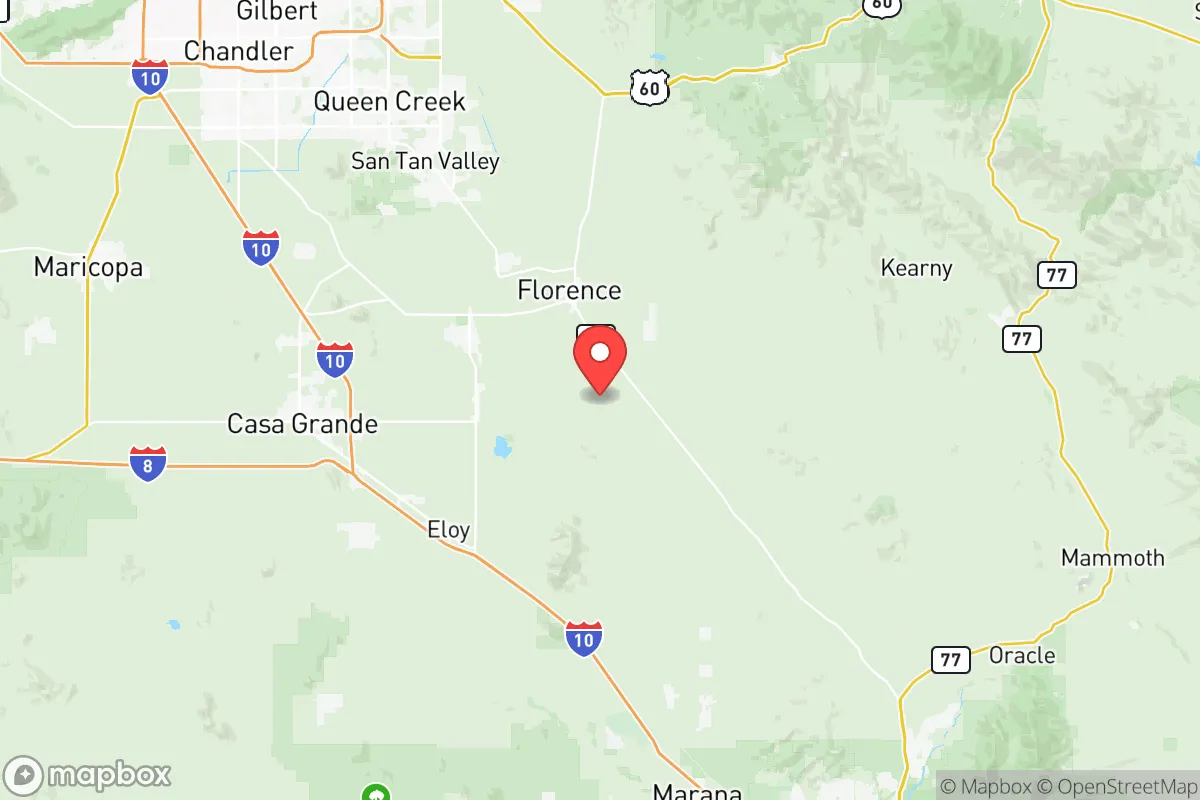
Photo: Wikipedia
Personal Sovereignty in Pinal County
Viable for self-reliance. Generally workable, though some barriers may limit total independence.
What does Personal Sovereignty tell us?
Personal Sovereignty measures your capacity for self-reliance and independence with minimal government friction. Higher scores mean fewer barriers between you and the way you want to live... but it assumes you have the space you need and good neighbors.
What does this tell us?
Personal Sovereignty measures your capacity for self-reliance and independence with minimal government friction. Higher scores mean fewer barriers between you and the way you want to live... but it assumes you have the space you need and good neighbors.
State Policy
Energy independence: Importer (20% of energy produced in-state)
Personal Liberty
Homesteading

Personal Liberty Analysis
Pinal County, Arizona, offers one of the stronger personal sovereignty environments in the Sun Belt, combining a low state tax burden with a permissive regulatory posture that appeals to individuals and families seeking maximum autonomy. The county’s governance leans heavily toward local control, with minimal interference in daily life from either the state capital in Phoenix or the county seat in Florence. For a relocation-minded reader prioritizing self-reliance, Pinal County presents a landscape where property rights, self-defense, and homesteading are broadly protected, though the degree of freedom varies noticeably between its rural expanses and its growing suburban corridors.
Tax burden and regulatory posture in Pinal County
Arizona’s flat income tax rate of 2.5% and a state sales tax of 5.6% keep the overall tax burden low, and Pinal County adds no county-level sales tax beyond the state rate, making it one of the more tax-friendly counties in the state. Property taxes are modest, with an effective rate around 0.62% of assessed value, well below the national average. The regulatory environment is light-touch: there are no countywide zoning overlays for most unincorporated areas, and building permit requirements are minimal in towns like Casa Grande and Eloy, where the county’s planning department processes most residential permits within two weeks. In contrast, the city of Maricopa has adopted more structured subdivision regulations, including mandatory homeowners’ association covenants on newer developments, which can limit individual autonomy for those buying in planned communities. Overall, the county’s posture is permissive, with the state’s right-to-farm laws and lack of rent control reinforcing a hands-off approach to property use.
Self-defense and gun law specifics in Pinal County
Arizona is a constitutional carry state, meaning no permit is required to carry a concealed firearm for anyone legally allowed to possess one, and Pinal County’s sheriff’s office is known for a pro-Second Amendment stance, with a shall-issue policy for permits that is processed within 30 days. The county has no additional firearm restrictions beyond state law, and open carry is legal without a license. In towns like Florence and Apache Junction, gun culture is deeply embedded, with multiple shooting ranges and firearms retailers serving a population that views self-defense as a personal right. Stand-your-ground laws apply statewide, and there is no duty to retreat in any place where a person is lawfully present. For those concerned about defensive use of force, Pinal County’s legal environment is among the most protective in the Southwest, with no county-level ordinances restricting magazine capacity or firearm storage.
Self-reliance and homesteading viability in Pinal County
Homesteading and off-grid living are viable in Pinal County, particularly in its unincorporated areas where lot sizes can be as large as 40 acres and zoning is minimal. In Kearny and Superior, rural parcels often come with no building codes beyond basic septic and well requirements, allowing for self-built structures and alternative energy systems. The county allows rainwater harvesting without a permit, and solar panel installation is unrestricted, though net metering rules are set by the state’s largest utility, Arizona Public Service, which can limit full energy independence. In Casa Grande, agricultural zoning permits small-scale farming and livestock on parcels as small as one acre, while Eloy has a growing community of off-grid residents using composting toilets and solar arrays. However, in the more suburban Maricopa and San Tan Valley, HOAs and city codes often prohibit livestock, outdoor storage, and non-standard construction, making true homesteading impractical. Water rights are a key consideration: most rural parcels require a well permit from the Arizona Department of Water Resources, and in the active management area around Florence, new wells for non-exempt uses face stricter scrutiny. Overall, the county offers strong homesteading potential for those willing to locate outside its planned communities.
Personal liberties in Pinal County
Parental rights are broadly protected under Arizona law, which includes a statutory presumption that parents have the right to direct their children’s education, healthcare, and religious upbringing. Pinal County has no county-level mandates on school curriculum or vaccination requirements, leaving those decisions to individual school districts and families. Medical autonomy is similarly strong: Arizona does not have a state-level vaccine passport requirement, and Pinal County’s health department has not imposed local mandates beyond state guidance. Speech and assembly rights are fully protected, with the county’s board of supervisors historically taking a hands-off approach to public demonstrations and political signage. Property rights are reinforced by Arizona’s strict eminent domain laws, which require just compensation and a public purpose, and Pinal County has not pursued controversial takings in recent years. For those who value minimal government intrusion into personal decisions, the county’s legal framework is consistently permissive.
Compared to other parts of the Southwest, Pinal County stands out for its combination of low taxes, constitutional carry, and homesteading-friendly zoning, particularly in its rural towns like Kearny and Superior. While suburban pockets such as Maricopa and San Tan Valley impose more restrictions through HOAs and city codes, the county as a whole offers a high degree of personal sovereignty that aligns with a self-reliant lifestyle. For individuals and families who prioritize autonomy over convenience, Pinal County provides one of the most freedom-respecting environments in Arizona, with the caveat that water availability and utility access remain practical constraints in its most remote areas.

* Values derived from national, state, county, city and local statistics and may differ in a specific area. Last updated: 2026-07-17T22:43:09.000Z
Narrative content on this page is AI-generated and may contain mistakes. Verify any details that matter before acting on them.
ReloMaps may earn a commission from affiliate links at no extra cost to you.

