
Photo: Wikipedia
Demographics of Apalachicola, FL
Affluence Level in Apalachicola, FL
A below-average socioeconomic profile. Incomes, home values, and educational attainment trail the U.S., with higher poverty and unemployment.
People of Apalachicola, FL
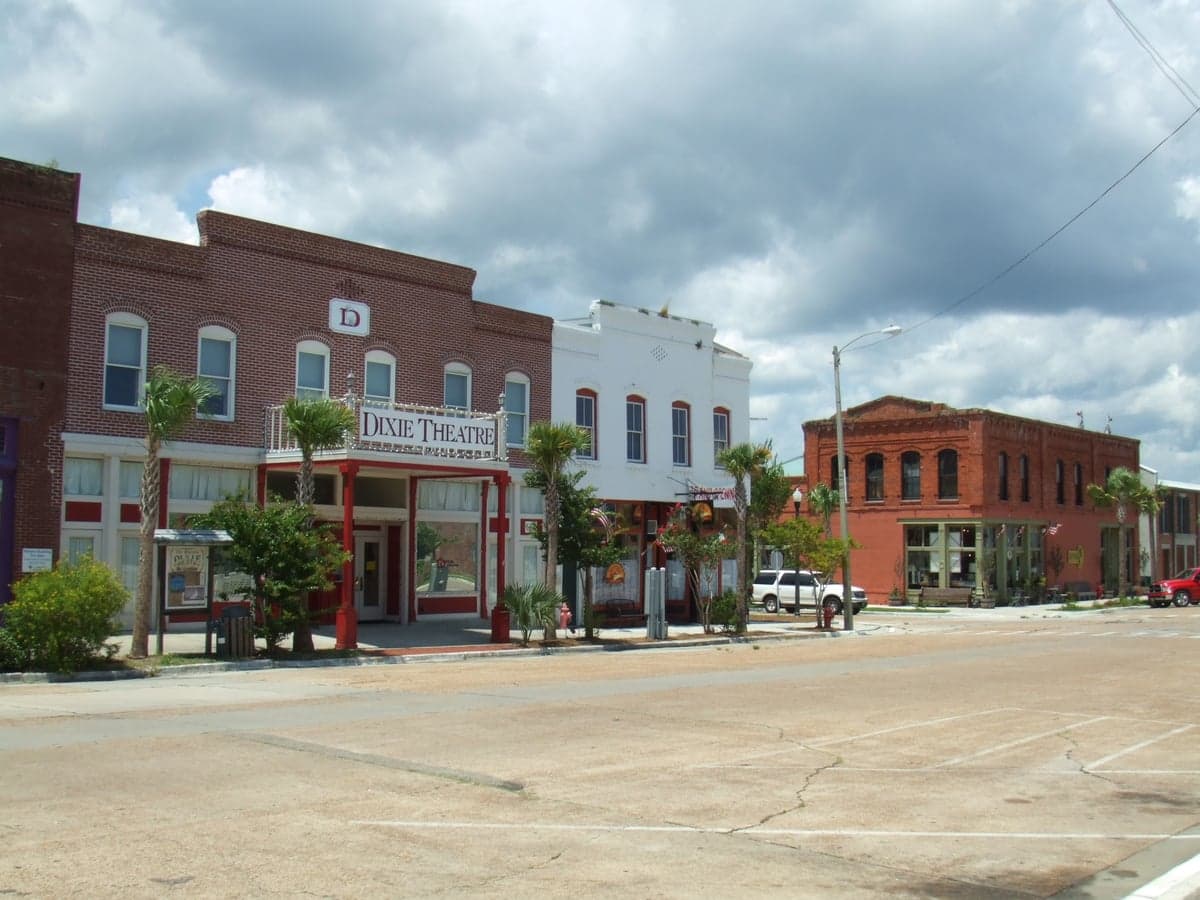
The people of Apalachicola, Florida today number just 2,304 residents, forming a tight-knit community where a Black minority of 27.0% and a White majority of 61.9% coexist alongside small Hispanic (3.5%) and East/Southeast Asian (1.0%) populations. With a foreign-born share of only 2.1%, this is a deeply native-born city, shaped by generations of families tied to the sea and the land. Its distinctive identity is rooted in a working waterfront, historic architecture, and a palpable sense of isolation—a place where the population has remained remarkably stable for decades, resisting the rapid growth seen elsewhere in the Florida Panhandle.
How the city was settled and grew
Apalachicola’s human history begins with its strategic location at the mouth of the Apalachicola River, which made it a natural hub for trade and transportation. The city was formally incorporated in 1831, but its population boom came in the 1830s and 1840s, driven by the cotton trade. Planters from Georgia and the Carolinas shipped cotton downriver to Apalachicola’s port, where it was loaded onto schooners bound for New England and Europe. This trade drew a wave of White merchants, ship captains, and laborers, who settled in the Historic District along Water Street and Avenue E, building the Greek Revival and Victorian homes that still define the city’s character. Enslaved Black people were brought to work the cotton warehouses, docks, and ships, forming the foundation of the city’s Black community. After the Civil War, many freedmen remained, establishing neighborhoods like Mill Pond and Sixth Street, where descendants still live today. The late 19th and early 20th centuries saw a second wave tied to the seafood industry—oysters, shrimp, and fish—which drew a mix of White and Black workers, as well as a small number of Greek and Italian immigrants who settled near the waterfront in the Scipio Creek area. By 1950, the population had peaked near 3,000, with the economy firmly anchored in fishing and forestry.
Modern era (post-1965)
The post-1965 era brought significant demographic shifts, though Apalachicola’s population has since declined from its mid-century peak. The 1970s and 1980s saw the collapse of the local oyster industry due to overharvesting and environmental changes, prompting an out-migration of younger residents, particularly Black families, who moved to larger cities like Tallahassee and Atlanta for work. This contributed to a gradual aging of the population and a slight increase in the White share, as some retirees from the Northeast and Midwest began buying historic homes in the Historic District and along Riverfront Park. The Hispanic population, now at 3.5%, grew modestly in the 1990s and 2000s, driven by Mexican and Central American workers drawn to construction and service jobs tied to tourism and second-home development. These families have concentrated in the Eastside neighborhood, near Highway 98, where rental housing is more affordable. The East/Southeast Asian community (1.0%) is small and dispersed, with no single ethnic enclave, though a few families operate restaurants and retail businesses in the downtown core. The Indian-subcontinent population remains at 0.0%. The city’s Black population, while still substantial at 27.0%, has become more concentrated in the Mill Pond and Sixth Street areas, reflecting historical settlement patterns and limited new housing development.
The future
Apalachicola’s population is projected to remain stable or decline slightly over the next decade, as the city lacks the economic drivers—large employers, major highways, or new housing developments—that fuel growth elsewhere. The foreign-born share (2.1%) is unlikely to rise significantly, given the limited job opportunities beyond tourism, fishing, and small-scale retail. The Hispanic population may grow incrementally as service-sector workers continue to arrive, but the city’s high housing costs and aging infrastructure will likely keep overall diversity in check. The White population, buoyed by retirees and remote workers seeking a slower pace, is expected to hold steady or increase slightly, particularly in the Historic District and along the waterfront. The Black population may continue a slow decline as younger generations leave for better economic prospects. The city’s cultural identity is becoming more oriented toward heritage tourism and second-home ownership, which could further shift the demographic balance toward older, wealthier White residents.
For someone moving in now, Apalachicola offers a deeply rooted, historically rich community where the past is still visible in every street and dock. The population is stable, aging, and increasingly White, with a small but persistent Black minority and a tiny Hispanic presence. It is not a place of rapid change or new diversity, but rather a city that holds onto its people and its stories—a quiet, waterfront enclave where the next decade will likely look much like the last.

* Values derived from national, state, county, city and local statistics and may differ in a specific area. Last updated: 2026-11-05T17:47:29.000Z
Narrative content on this page is AI-generated and may contain mistakes. Verify any details that matter before acting on them.
ReloMaps may earn a commission from affiliate links at no extra cost to you.

