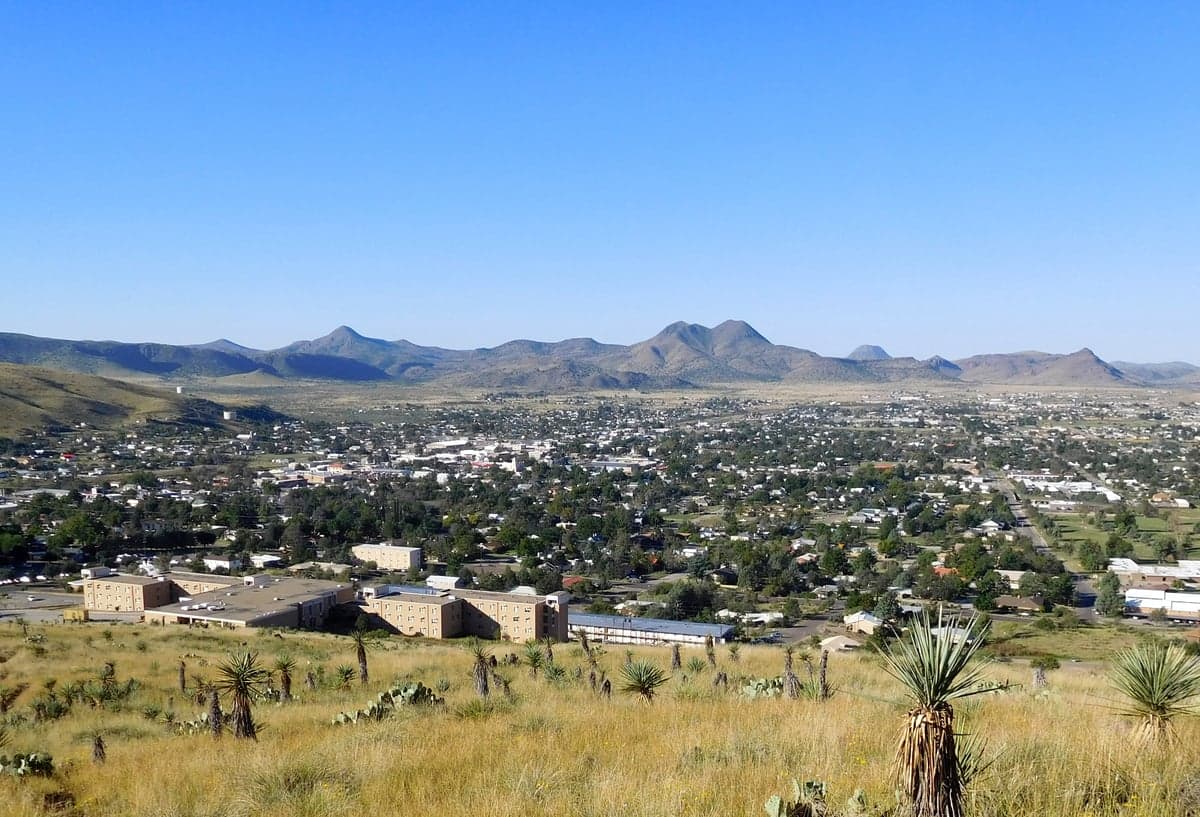
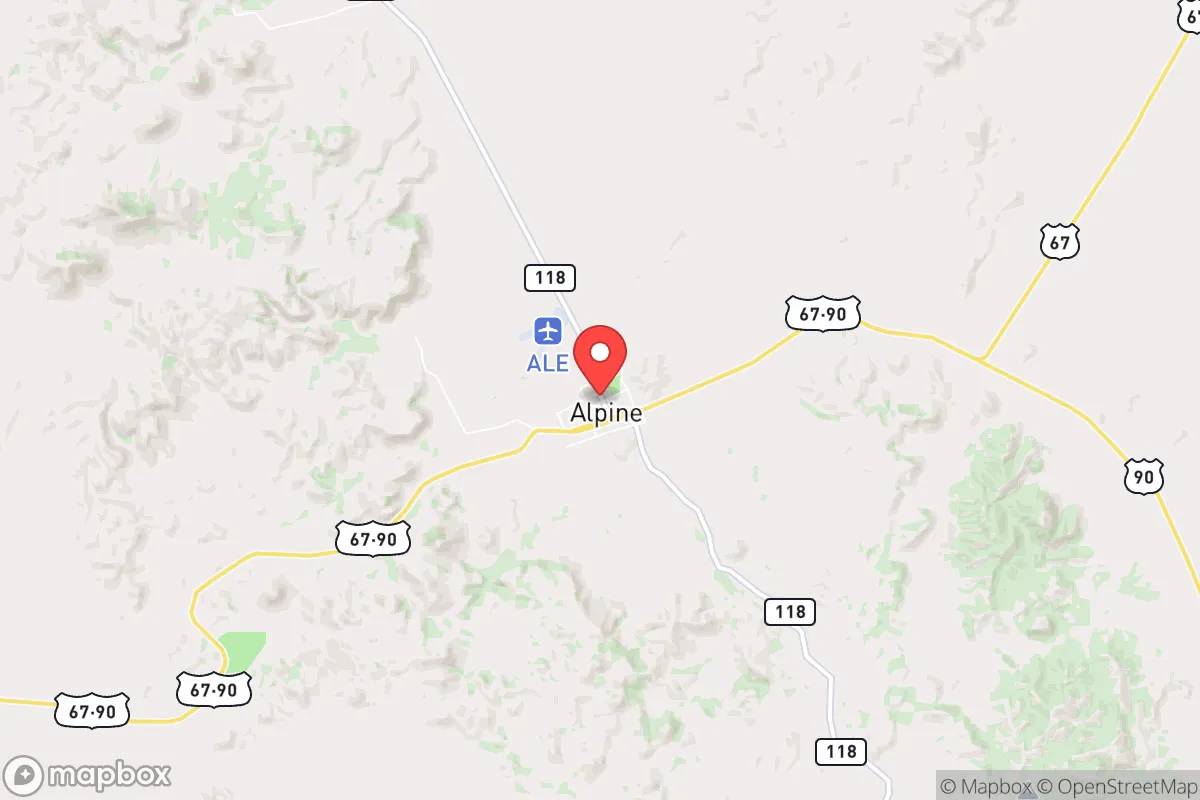
Photo: Wikipedia
Political ClimatePolitical Climate in Alpine, TX
District shown is the primary district for this city’s centroid. Cities may span multiple districts.
Local Political AnalysisPolitical Analysis of Alpine, TX
Alpine, Texas, sits in Brewster County, the largest county in the state, and its politics are a fascinating blend of deep-red rural tradition and a noticeable blue-leaning academic and artistic influence. The area carries a Cook Partisan Voting Index of R+7, meaning it votes about seven points more Republican than the national average, but that number doesn't tell the whole story. In reality, Alpine is a small island of purple in a sea of crimson, with the surrounding unincorporated areas and ranches pulling the county solidly right, while the Sul Ross State University campus and the downtown arts scene create a persistent, vocal liberal minority. The trajectory here is slow but real: the town is getting slightly more Democratic with each cycle, driven by an influx of retirees, remote workers, and artists drawn to the Big Bend lifestyle, while the surrounding ranch country remains as Republican as ever.
How it compares
Compared to the rest of Texas, Alpine is a political outlier in its own region. Drive 60 miles east to Fort Stockton or 90 miles north to Pecos, and you'll find counties that routinely vote 80-85% Republican. Alpine, by contrast, often sees Brewster County split closer to 60-40 in favor of Republicans in statewide races, with the town itself sometimes going blue in local elections. The state of Texas as a whole has a Cook PVI that is not officially calculated for the entire state, but it's widely considered a lean-Republican state (roughly R+5 to R+6 in recent cycles), meaning Alpine's R+7 is actually a bit more Republican than the state average on paper. In practice, however, the town's political reality is far more mixed than that number suggests. The 2022 gubernatorial race saw Greg Abbott win Brewster County with about 58% of the vote, while Beto O'Rourke took roughly 40%—a much closer margin than in neighboring Terrell or Pecos counties, where Abbott won by 40 points or more.
What this means for residents
For conservative residents, Alpine feels like a comfortable but not overwhelming environment. You'll find plenty of fellow Republicans at the local coffee shop, and the county government and sheriff's office lean conservative. The local school board and city council, however, are often more balanced, with progressive voices holding seats on issues like environmental conservation and affordable housing. For liberal residents, Alpine is a relative haven in a deeply conservative region. You can be openly progressive without facing the hostility you might in smaller West Texas towns, and the presence of Sul Ross State University provides a steady stream of like-minded people. That said, both sides will tell you that the real political divide in Alpine isn't Republican vs. Democrat—it's between the "townies" and the "ranchers," with the former generally more moderate or liberal and the latter solidly conservative. The practical effect is that most local debates—over water rights, development, or tourism—tend to be pragmatic rather than ideological, with both sides finding common ground on keeping Alpine's character intact.
One cultural distinction that sets Alpine apart from much of Texas is its strong environmental and conservationist streak, which cuts across party lines. Ranchers and environmentalists often find themselves on the same side when it comes to opposing large-scale solar farms or fracking in the Big Bend region, creating a unique political alliance you don't see in Houston or Dallas. The town also has a notably active LGBTQ+ community for a West Texas town of 6,000 people, with a visible Pride event each year that draws support from both liberal and moderate residents. Looking ahead, the long-term trend points toward Alpine becoming more politically competitive, but it's unlikely to flip blue anytime soon. The real story is that Alpine is a place where political labels matter less than whether you show up for the community—a reality that both conservatives and liberals here genuinely appreciate.

State Political ClimatePolitical Climate in Texas
State Political AnalysisPolitical Environment in the State
Texas has been a reliably Republican state for the past three decades, but the margin has been shrinking. In 2024, Donald Trump won the state by roughly 9 points, down from 11 points in 2020 and 16 points in 2016. The dominant coalition remains a mix of rural conservatives, suburban moderates, and evangelical voters, but explosive growth in the urban crescent—from Dallas-Fort Worth down through Austin and San Antonio to Houston—is steadily shifting the state’s political center of gravity. The long-term trajectory is a slow, uneven move toward competitiveness, though the state’s Republican-controlled legislature continues to push a deeply conservative agenda that shapes daily life for everyone living here.
Urban vs. rural divide
The political map of Texas is a study in extremes. The state’s five biggest metros—Houston, Dallas-Fort Worth, San Antonio, Austin, and El Paso—account for over 70% of the population and lean increasingly Democratic. Austin and El Paso are the bluest major cities in the state, with Travis County delivering 71% for Biden in 2020 and El Paso County giving him 66%. Meanwhile, the vast rural and exurban expanse—places like the Panhandle around Lubbock, East Texas timber country, and the Hill Country west of San Antonio—votes overwhelmingly Republican. The real battleground is the suburbs. Collin County (north of Dallas) and Fort Bend County (southwest of Houston) have flipped from solid red to purple or even blue in the last two cycles, driven by an influx of college-educated professionals and Asian-American and Hispanic voters. The result is a state where the legislature remains firmly in GOP hands due to gerrymandering, but the presidential margin keeps tightening.
Policy environment
Texas has no state income tax, which is the single biggest policy draw for relocators. Property taxes are high to compensate—averaging around 1.6% of assessed value—but a 2023 law capped appraisal increases for non-homesteaded properties at 20% annually. The regulatory posture is famously business-friendly: no state-level occupational licensing for many trades, weak union protections (Texas is a right-to-work state), and minimal environmental review for new construction. On education, the state funds schools primarily through local property taxes, leading to wide disparities between wealthy suburbs and rural districts. The school choice debate is ongoing; in 2023, Governor Abbott pushed a universal education savings account (ESA) bill that failed in the House due to rural Republican opposition, but it’s expected to return. Healthcare policy is dominated by the state’s refusal to expand Medicaid under the ACA, leaving roughly 18% of Texans uninsured—the highest rate in the nation. Election laws have tightened: the 2021 SB 1 banned 24-hour and drive-through voting, imposed new ID requirements for mail ballots, and gave partisan poll watchers more access. For a conservative relocator, the low taxes and light regulation are major draws; for a liberal one, the limited safety net and restrictive voting laws are significant trade-offs.
Recent policy direction
The last three legislative sessions have pushed Texas decisively to the right on multiple fronts. On gun rights, the state became a permitless carry state in 2021 (HB 1927), allowing anyone 21 or older who can legally possess a firearm to carry it openly or concealed without a license. On parental rights and education, the 2023 HB 900 (the "READER" act) requires book vendors to rate materials for "sexually explicit" content,
* Values derived from national, state, county, city and local statistics and may differ in a specific area. Last updated: 2026-10-02T21:29:06.000Z
Narrative content on this page is AI-generated and may contain mistakes. Verify any details that matter before acting on them.
ReloMaps may earn a commission from affiliate links at no extra cost to you.

