Photo: Wikipedia
Demographics of Alpine, TX
Affluence Level in Alpine, TX
A middle-class area roughly in line with national averages across income, home values, education, and employment.
People of Alpine, TX
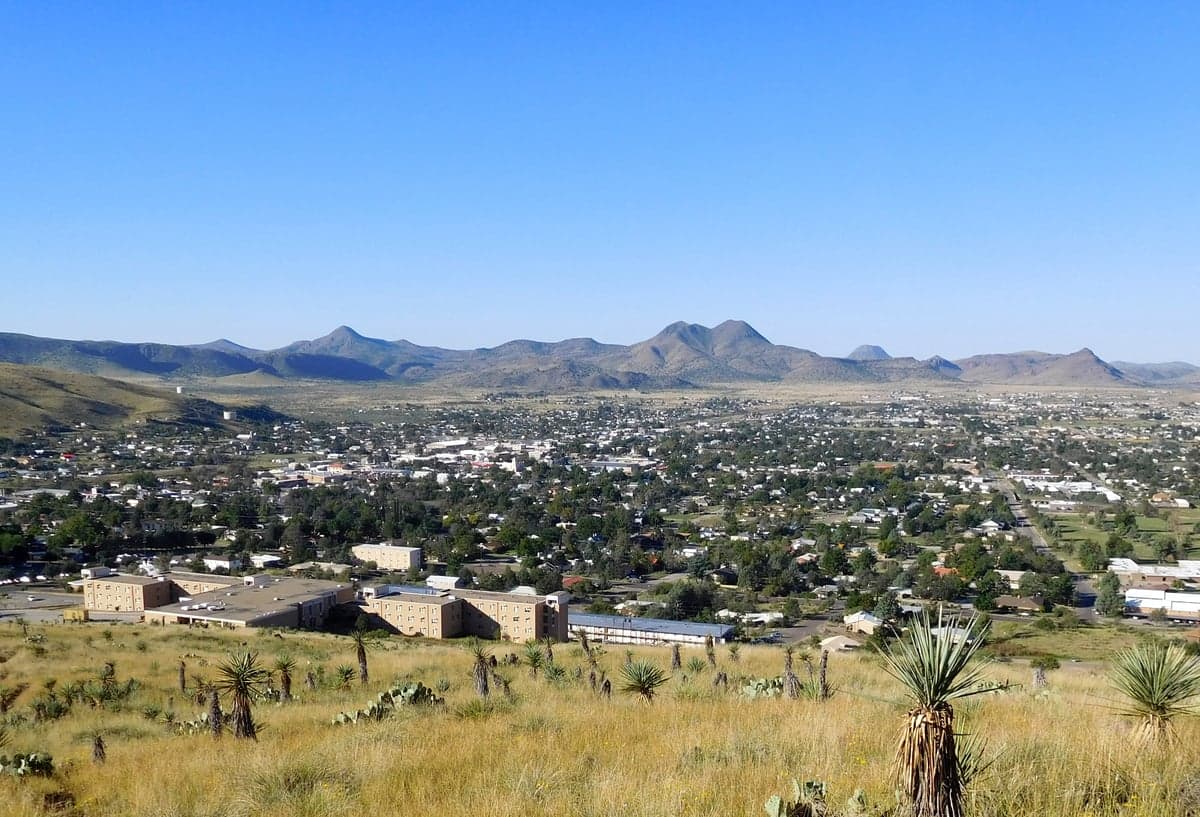
The people of Alpine, Texas today form a compact, culturally distinct community of 6,003 residents defined by a near-even split between Hispanic (49.5%) and White (46.7%) populations, with small East/Southeast Asian (1.7%) and Black (0.4%) communities. This is a college town anchored by Sul Ross State University, giving it a notably high college-educated share of 42.3% — far above the Texas average. Alpine’s identity is a blend of West Texas ranching heritage, a historic railroad and mercantile past, and a growing outdoor-recreation and arts scene, all set against the dramatic backdrop of the Davis Mountains.
How the city was settled and grew
Alpine was founded in 1882 as a water stop and freight station on the Galveston, Harrisburg & San Antonio Railway, which pushed through the region to connect San Antonio with El Paso. The original population was overwhelmingly Anglo-American — railroad workers, cattle ranchers, and merchants drawn by the promise of open range and rail access. The town was formally platted in 1883, and by the 1890s it had become the commercial hub for a vast ranching territory. The historic downtown district, centered on Murphy Avenue and Holland Avenue, was built by these early Anglo settlers, with stone and brick commercial buildings that still stand today. Mexican-American families began arriving in significant numbers during the Mexican Revolution (1910–1920), fleeing violence and seeking work on ranches and the railroad. They settled primarily in the West Side neighborhood, west of the railroad tracks, where adobe and frame homes housed a growing Tejano community. The establishment of Sul Ross State University in 1917 brought a new wave of faculty and students, many from other parts of Texas, and created a small but influential professional class. Through the mid-20th century, Alpine remained a small, overwhelmingly Anglo ranching and college town, with the Hispanic population concentrated on the West Side and in the South Side area near the old stockyards.
Modern era (post-1965)
The 1965 Hart-Cellar Act did not dramatically reshape Alpine’s demographics, as the city remained largely a domestic migration destination. The most significant post-1965 shift has been the steady growth of the Hispanic population, driven by natural increase and continued migration from the Rio Grande Valley and northern Mexico. By the 2000 census, the Hispanic share had risen to roughly 40%, and by 2020 it had reached 49.5%. This growth has been absorbed primarily in the West Side and South Side neighborhoods, which have become predominantly Hispanic working-class areas. Meanwhile, the East Side and North Side neighborhoods, closer to the university and the newer commercial strip along Highway 90, remain majority White and more affluent. The university itself has been a major driver of in-migration, attracting students and faculty from across Texas and, to a lesser extent, from other states. The small East/Southeast Asian community (1.7%) is largely composed of university-affiliated families and faculty, concentrated in the University Hills area near campus. The Black population (0.4%) is very small and dispersed, with no distinct neighborhood concentration. The foreign-born share is just 4.0%, well below the national average, indicating that Alpine’s diversity is primarily a story of domestic migration and natural growth rather than international immigration.
The future
Alpine’s population is projected to remain stable or grow slowly, with the Hispanic share likely continuing to rise gradually as the White population ages and younger Hispanic families have more children. The city is becoming slightly more diverse, but the change is incremental — not transformative. New residential development is concentrated in subdivisions on the eastern edge of town, such as those off Highway 90 toward Marathon, which are attracting a mix of retirees, remote workers, and university employees. These newer areas are more integrated than the historic West Side/East Side divide, suggesting a gradual dispersal of the Hispanic population into previously White-dominated neighborhoods. The cultural identity of Alpine is evolving from a ranching-and-railroad town into a hybrid: part college town, part outdoor-recreation gateway (Big Bend National Park is 90 minutes away), and part retirement destination for those seeking a low-cost, low-crime West Texas lifestyle. The arts scene, anchored by the historic downtown district and venues like the Granada Theatre, is drawing a creative class that is predominantly White and college-educated, which could reinforce some economic and cultural divides even as residential patterns blur.
For someone moving in now, Alpine offers a stable, safe, and culturally distinct community where the ranching past and the university present coexist. The population is slowly becoming more Hispanic and more educated, but the pace of change is moderate. New arrivals will find a town where the West Side and East Side still carry historical meaning, but where the newer subdivisions are building a more integrated future. The bottom line: Alpine is a small West Texas city with a clear sense of place, a growing Hispanic majority, and a university-driven economy that keeps it from the decline seen in many rural towns.

* Values derived from national, state, county, city and local statistics and may differ in a specific area. Last updated: 2026-10-02T21:29:06.000Z
Narrative content on this page is AI-generated and may contain mistakes. Verify any details that matter before acting on them.
ReloMaps may earn a commission from affiliate links at no extra cost to you.

