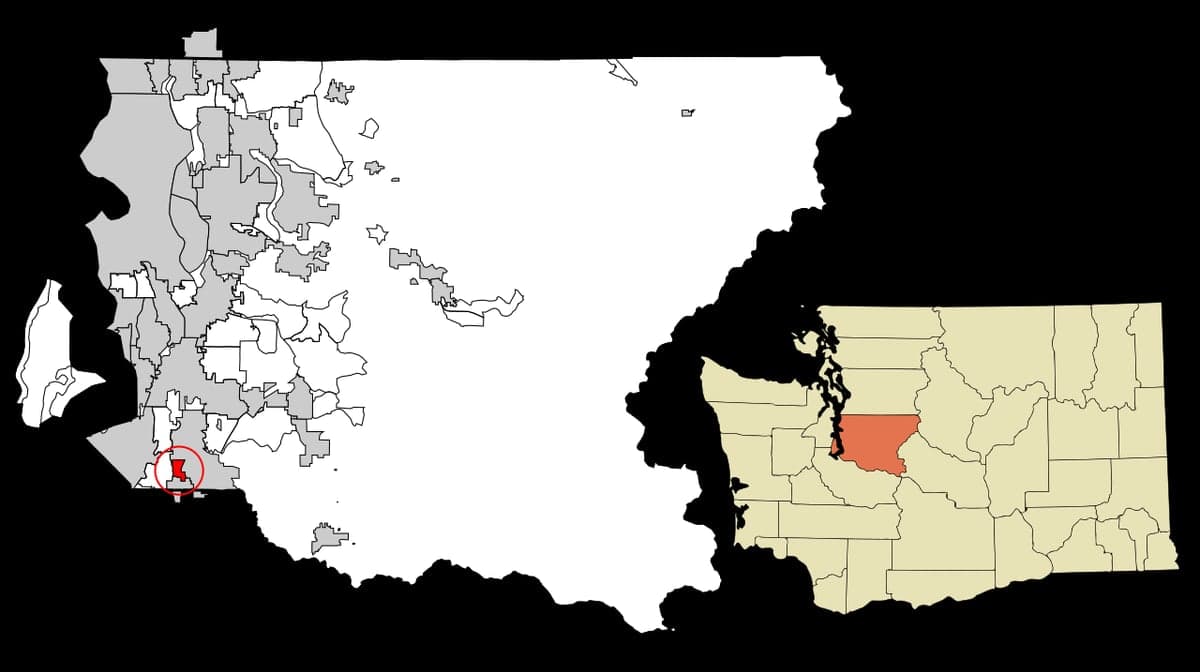
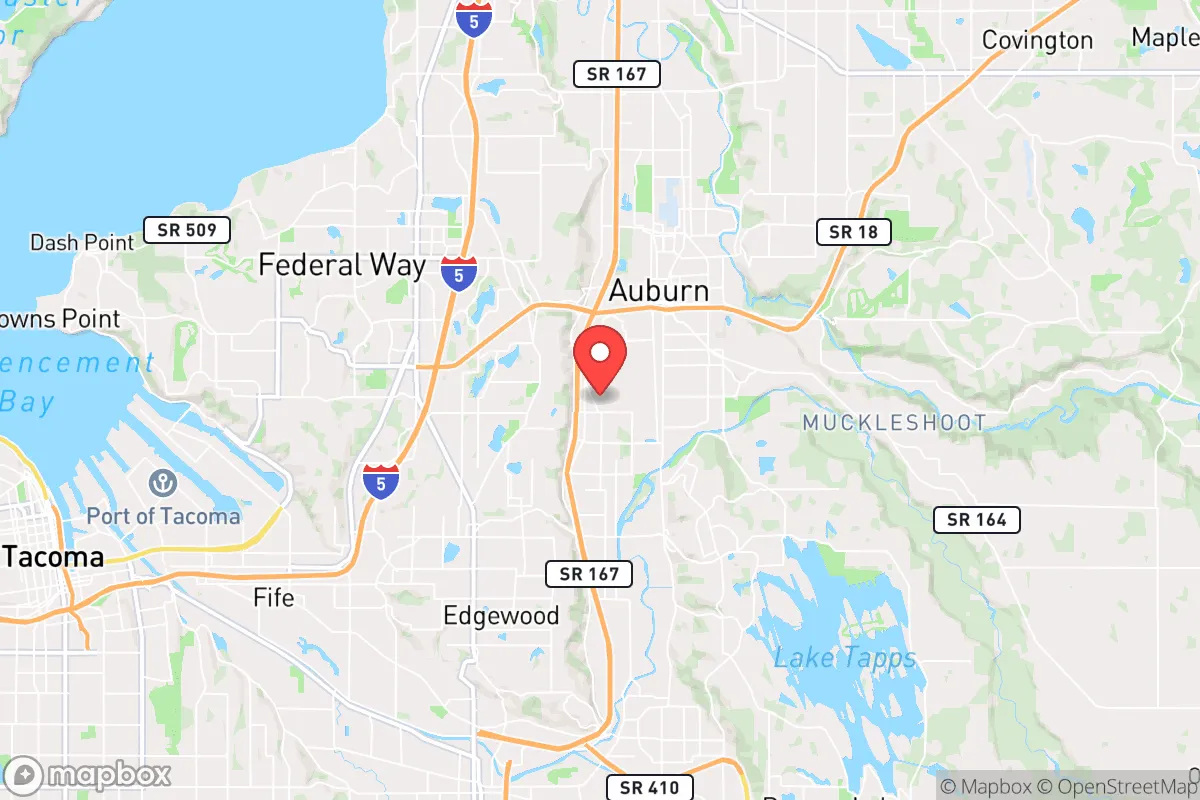
Photo: Wikipedia
Political ClimatePolitical Climate in Algona, WA
District shown is the primary district for this city’s centroid. Cities may span multiple districts.
Local Political AnalysisPolitical Analysis of Algona, WA
Algona is a solidly blue dot in a blue state, carrying a Cook PVI of D+22 that puts it well to the left of the national average. That number isn't just a statistic—it reflects a working-class, union-heavy history that still shapes local politics today. The city itself has been reliably Democratic for decades, and the trajectory is holding steady: as the broader Seattle-Tacoma metro area continues to grow and diversify, Algona's lean is only getting more entrenched. You won't find much political whiplash here; the needle hasn't moved much since the 1990s, and it's not likely to swing anytime soon.
How it compares
Compared to Washington state as a whole, Algona is noticeably more liberal. The state's overall Cook PVI isn't publicly calculated, but the general consensus is that Washington leans Democratic by roughly D+8 to D+10—so Algona is about 12 to 14 points more Democratic than the state average. That gap becomes stark when you look at nearby towns. Head east to Enumclaw or south to Bonney Lake, and you'll find communities that vote more conservative, often by double digits. Even neighboring Auburn and Kent are slightly less blue than Algona, though they're still Democratic-leaning. The real contrast is with rural King County pockets like Black Diamond or the unincorporated areas around Ravensdale, where Trump outperformed his statewide numbers by 15-20 points. So if you're a conservative in Algona, you're in a clear minority, but you're not alone—just drive 15 minutes east and the political landscape flips.
What this means for residents
For liberal residents, Algona is comfortable ground. Local elections tend to be decided in the primary, and Democratic candidates for county and state office routinely win by wide margins. You'll see yard signs for progressive causes, and the city council generally aligns with Democratic priorities on housing, transit, and environmental policy. For conservative residents, the reality is more about adaptation than alienation. You can still find like-minded neighbors—especially in the older, single-family-home neighborhoods—but you won't see much representation on the dais. Property taxes and zoning decisions tend to reflect the majority's preferences, which means denser development and more public transit investment than you'd get in a red-leaning suburb. That said, the city is small enough (around 3,500 people) that personal relationships often trump party lines. A conservative who shows up to planning commission meetings and volunteers at the fire department will still be heard, even if they're outvoted.
Cultural and policy distinctions
One thing that sets Algona apart from bluer parts of Seattle proper is its pragmatic, blue-collar flavor. This isn't a place where politics is a hobby—it's a place where people care about potholes, school funding, and the cost of living. The city's proximity to the Port of Seattle and major logistics hubs means labor unions still carry real weight, and that keeps the local Democratic Party grounded in economic issues rather than cultural ones. You won't see the same intensity around, say, defunding the police or radical land-use reforms that you'd find in Capitol Hill. Instead, the conversation tends to center on affordable housing, traffic relief on Highway 167, and keeping the local schools funded. For newcomers, the political climate here is less about ideology and more about practical outcomes—which is probably why the city has stayed stable even as the region around it has changed so fast.

State Political ClimatePolitical Climate in Washington
State Political AnalysisPolitical Environment in the State
Washington State has been a reliably Democratic stronghold for over a decade, but its political reality is far more complex than a simple blue label. The state’s overall lean is driven by the massive, left-leaning population centers of King County (Seattle) and its immediate suburbs, which together cast roughly a third of the state’s votes. However, the rest of the state—particularly east of the Cascade Range—is deeply conservative, creating one of the sharpest urban-rural divides in the country. Over the last 20 years, the state has shifted leftward at the presidential level (voting for Democrats by double digits since 2008), but down-ballot races and local governance often tell a more nuanced story, with Republicans holding competitive seats in the legislature and winning statewide races as recently as 2012.
Urban vs. rural divide
The political map of Washington is essentially two states in one. The western third, dominated by the Puget Sound region, is where the Democratic majority lives. Seattle, Bellevue, Redmond, and Tacoma are the engine of the state’s blue vote, with King County alone providing a margin of over 500,000 votes in recent presidential elections. In contrast, the eastern two-thirds of the state—places like Spokane, Yakima, and the Tri-Cities (Kennewick, Pasco, Richland)—vote reliably Republican. Spokane County, the state’s second-most populous, has been trending purple but still leans right in most races. The rural counties east of the Cascades, such as Grant, Douglas, and Okanogan, are deeply red, often voting 70% or more for Republican candidates. This divide isn’t just about geography; it’s cultural and economic, with the west coast economy tied to tech and services, while the east relies on agriculture, manufacturing, and natural resources.
Policy environment
Washington’s policy environment is shaped by its progressive tax structure and regulatory posture. The state has no personal or corporate income tax, relying instead on a high sales tax (state rate of 6.5%, with local add-ons pushing it over 10% in some cities) and property taxes. This makes it relatively tax-friendly for high earners but regressive for lower-income households. The regulatory climate is business-friendly in some sectors (tech, aerospace) but heavily restrictive in others (energy, land use, firearms). Education policy is a mixed bag: the state funds K-12 through a progressive levy system, but teacher unions are powerful, and school choice options are limited compared to other states. Healthcare is dominated by the state’s robust Medicaid expansion and a strong public health infrastructure. Election laws are among the most accessible in the nation—all-mail voting, same-day registration, and automatic voter registration are standard—which tends to boost Democratic turnout but also makes voting convenient for everyone.
Recent policy direction
Over the last five years, Washington has moved decisively left on several fronts, with notable legislation that a relocator should weigh carefully. On gun rights, the state passed a ban on high-capacity magazines (over 10 rounds) in 2022, along with a requirement for a 10-day waiting period and enhanced background checks on all firearm sales. Self-defense law remains a “duty to retreat” standard, with no stand-your-ground statute. On education and parental rights, the state has expanded LGBTQ+ inclusive curriculum requirements and passed laws limiting parental notification about student gender identity in some cases, which has been a flashpoint for conservative families. Speech and privacy: the state has strong data privacy laws (the Washington Privacy Act) and protects abortion access as a fundamental right, with no gestational limits. Property rights are constrained by the Growth Management Act, which limits development in rural areas and requires cities to plan for density. On taxation, voters have repeatedly rejected a state income tax, but a capital gains tax on high earners (over $250,000 in gains) was passed in 2021 and is being challenged in court. Ballot access remains wide open, with no voter ID requirement beyond a signature match.
Civil unrest & political movements
Washington has a history of visible political activism, particularly in Seattle. The 2020 protests following George Floyd’s death led to the establishment of the Capitol Hill Autonomous Zone (CHAZ), a brief but highly publicized occupation that became a national symbol of the city’s progressive activism. Since then, organized movements on both sides have remained active. On the left, groups like the Washington State Labor Council and environmental organizations (e.g., 350 Seattle) push for climate action and workers’ rights. On the right, the Washington State Republican Party has seen a grassroots resurgence in rural counties, with groups like the Spokane County Republicans and the Washington Gun Rights Coalition organizing against state-level gun laws. Immigration politics are a major flashpoint: Washington is a sanctuary state, with state law prohibiting local law enforcement from cooperating with federal immigration authorities in most cases. This has led to tensions in cities like Yakima and Pasco, where agricultural communities have large immigrant populations. Election integrity controversies have been minimal compared to other states, though some rural counties have passed symbolic resolutions questioning the security of all-mail voting.
Projection
Over the next 5-10 years, Washington’s political trajectory points toward continued Democratic dominance at the state level, but with growing friction between the urban core and the exurban/rural periphery. In-migration from California and other high-cost states is fueling growth in places like Spokane Valley, Vancouver (Clark County), and Bellingham, which are trending more moderate or even left-leaning as new residents arrive. Clark County, just across the river from Portland, Oregon, has flipped from red to purple and is now a key swing area. Meanwhile, the rural east is losing population and political influence, but its voters are becoming more entrenched and organized. Expect further leftward movement on gun control, environmental regulation, and social policy, but also a growing pushback from rural counties exploring “home rule” or even secession rhetoric (the “Liberty State” movement in eastern Washington has gained some traction, though it remains fringe). For a new resident, the practical reality is that if you live in Seattle or its suburbs, you’ll experience a deeply progressive environment; if you live in Wenatchee, Walla Walla, or Colville, you’ll find a conservative community that feels increasingly at odds with the state government.
For someone moving to Washington, the bottom line is that your experience of the state’s politics will depend almost entirely on where you settle. If you’re a conservative looking for a community that shares your values, the eastern half of the state offers affordable housing, strong schools in some districts, and a slower pace of life—but you’ll be living under state laws you likely disagree with on guns, taxes, and education. If you’re a liberal, the western cities offer a vibrant, policy-forward environment with strong public services, but you’ll pay for it with high housing costs and a regressive tax system. Either way, Washington is a state where your local community matters more than the state government, and that’s a reality worth understanding before you pack your bags.
* Values derived from national, state, county, city and local statistics and may differ in a specific area. Last updated: 2026-09-03T05:10:55.000Z
Narrative content on this page is AI-generated and may contain mistakes. Verify any details that matter before acting on them.
ReloMaps may earn a commission from affiliate links at no extra cost to you.

