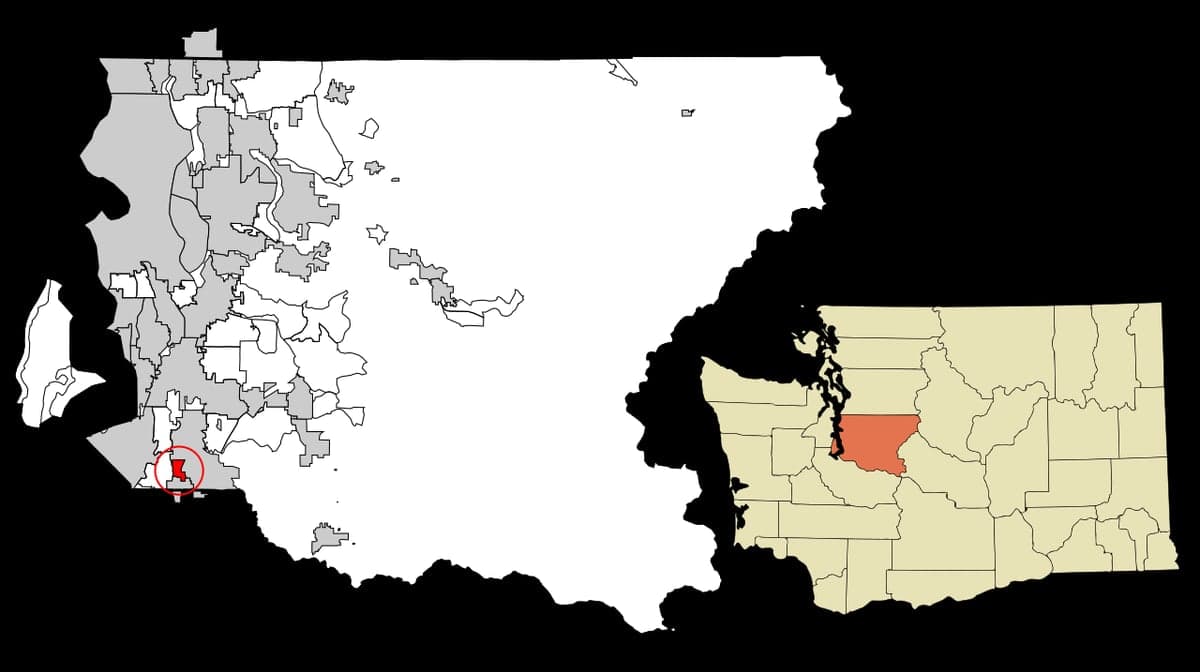
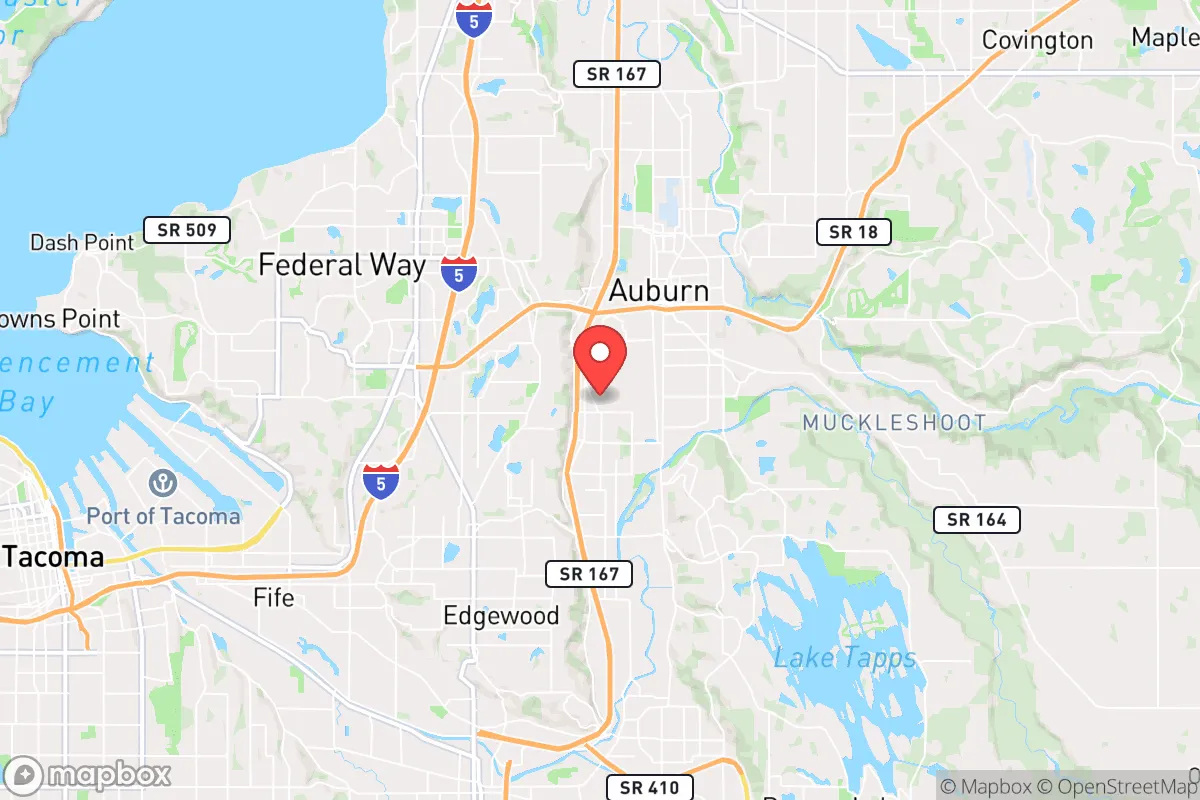

Photo: Wikipedia
Demographics of Algona, WA
Affluence Level in Algona, WA
A middle-class area roughly in line with national averages across income, home values, education, and employment.
People of Algona, WA
The people of Algona, Washington, today form a compact, working-class community of 3,239 residents that stands out as one of the most racially and ethnically diverse small cities in King County. With a White population of just 36.7%, a Hispanic share of 28.0%, and significant East/Southeast Asian (10.8%), Black (9.0%), and Indian-subcontinent (4.2%) communities, Algona is a dense, family-oriented enclave where no single group holds a majority. Its identity is shaped by modest single-family homes, a strong sense of local independence, and a population that is younger and less college-educated (15.5%) than the regional average, reflecting its roots as a blue-collar satellite of Auburn and Seattle.
How the city was settled and grew
Algona’s human history begins not with pioneers but with the railroad. The city was platted in 1906 along the Northern Pacific Railway line, and its original population was almost entirely White, drawn from Midwestern and Scandinavian farming families who arrived to work the fertile bottomlands of the Green River Valley. The earliest settled area, known as the Old Town core along Algona Boulevard, was built by these homesteaders and remains the historic heart of the city, lined with early-20th-century houses and small commercial buildings. A second wave arrived during World War II, when the Boeing boom in nearby Seattle and the opening of the Auburn rail yards brought workers to the area. These new residents, still predominantly White, filled out the North Algona neighborhood, a grid of modest wartime-era homes north of the railroad tracks. Through the 1950s and early 1960s, Algona remained a small, nearly all-White farming and railroad town, with a population that hovered around 1,500 and a cultural identity rooted in its Lutheran churches and volunteer fire department.
Modern era (post-1965)
The 1965 Immigration and Nationality Act fundamentally reshaped Algona’s population. Beginning in the 1970s, the city became a destination for immigrants seeking affordable housing and proximity to industrial and warehouse jobs in the Kent-Auburn corridor. The first major non-White group to arrive were East/Southeast Asian families, particularly Vietnamese and Filipino immigrants, who settled in the South Algona area near the city’s southern boundary. By the 1990s, Hispanic families—many from Mexico and Central America—began moving into the Algona-Pacific border neighborhoods, drawn by work in landscaping, construction, and food processing. The most recent wave, beginning around 2010, has been Indian-subcontinent families, who have concentrated in the West Algona subdivision, a newer development of townhomes and small single-family houses built on former agricultural land. Today, the city’s foreign-born population stands at 12.9%, and the White share has fallen from over 90% in 1980 to 36.7% in 2024. The Black population, at 9.0%, is largely composed of African American families who moved from Seattle’s Central District during the 1990s and 2000s, settling in the Algona Heights area east of the railroad tracks.
The future
Algona’s population is projected to continue diversifying, with the White share likely falling below 30% by 2040. The Hispanic and Indian-subcontinent communities are growing fastest, driven by both international migration and higher birth rates among younger families. New housing construction is concentrated in the West Algona and Algona-Pacific border areas, where infill townhome projects are attracting first-time homebuyers priced out of Seattle and Bellevue. The city’s cultural identity is evolving from a quiet railroad town into a multiethnic, working-class suburb where Spanish, Tagalog, Vietnamese, and Hindi are heard in local grocery stores and parks. The low college-attainment rate (15.5%) suggests that Algona will remain a blue-collar community, but the increasing diversity is creating new civic institutions—such as the Algona Community Center’s multicultural events—that are slowly replacing the old Lutheran-church social fabric. For someone moving in now, Algona offers a genuinely integrated, family-oriented environment where housing remains relatively affordable (median home value around $450,000) and where the population is young, diverse, and rooted in the local industrial economy.
Algona is becoming a stable, multiracial working-class suburb—a place where the American melting pot is still actively simmering, and where new arrivals of all backgrounds find a foothold in the region’s expensive housing market. For conservative-leaning families who value self-reliance, local community, and affordable homeownership, it represents a rare pocket of diversity without the high costs and cultural upheaval of Seattle’s core neighborhoods.

* Values derived from national, state, county, city and local statistics and may differ in a specific area. Last updated: 2026-09-03T05:10:55.000Z
Narrative content on this page is AI-generated and may contain mistakes. Verify any details that matter before acting on them.
ReloMaps may earn a commission from affiliate links at no extra cost to you.

