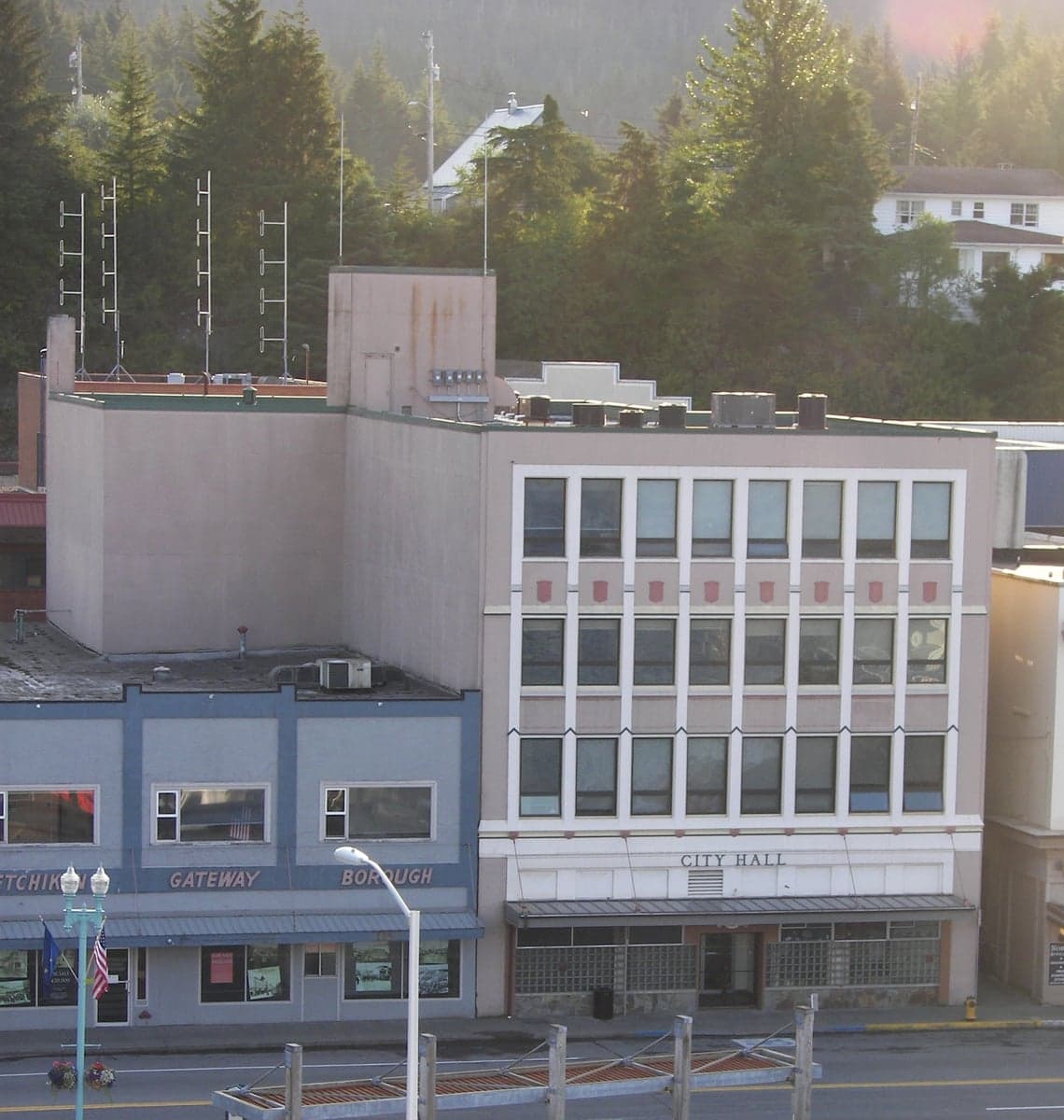
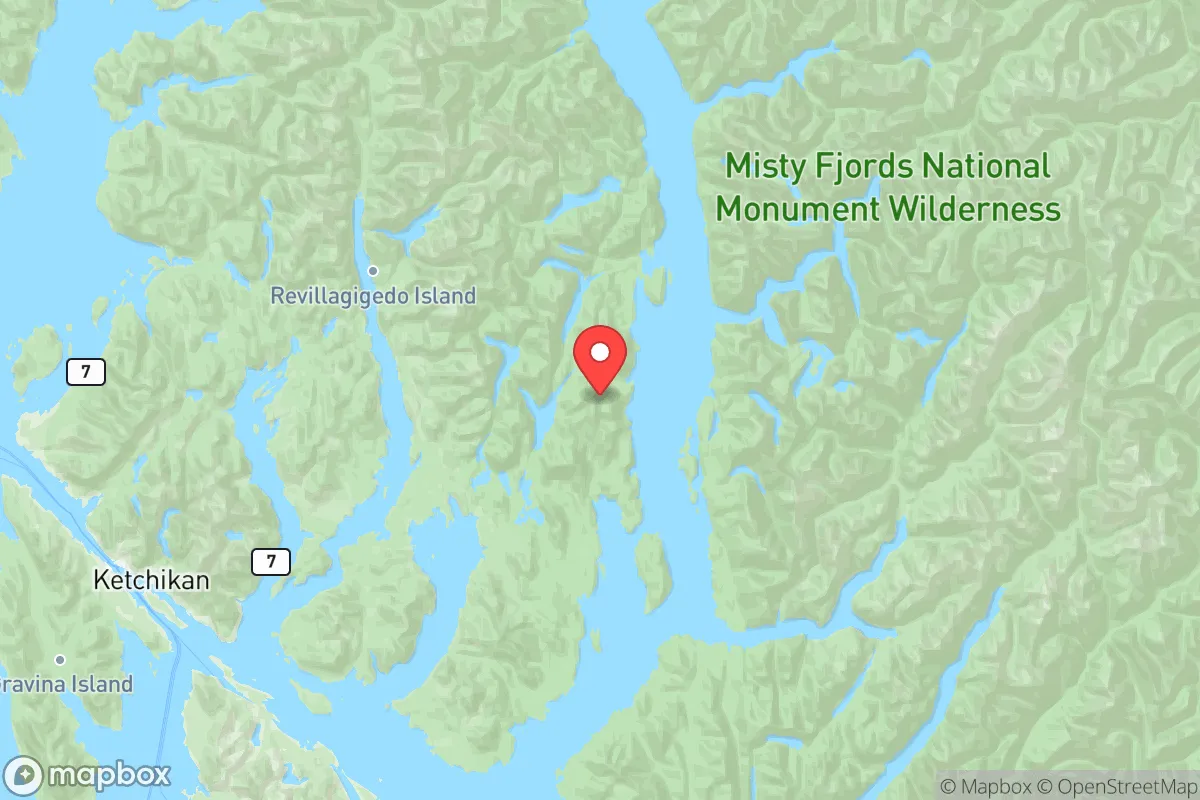
Photo: Wikipedia
Political ClimatePolitical Climate in Ketchikan Gateway County
Showing state-level results — no local-only data available.
Local Political AnalysisPolitical Analysis of Ketchikan Gateway County
Ketchikan Gateway County is a reliably Republican stronghold, mirroring the state of Alaska's overall partisan lean with a Cook PVI of R+6. However, the political reality on the ground is more nuanced than a single statistic suggests, shaped by the distinct economic priorities and cultural identities within the borough. The county's trajectory has been one of steady, if not dramatic, Republican dominance, though Democratic and independent candidates often remain competitive in local races, particularly in the city of Ketchikan itself.
How it compares
While both Ketchikan Gateway County and Alaska share an R+6 rating, the comparison flattens significant local variation. The city of Ketchikan, the county's population center, is a relative blue dot in a red region. Precincts within the city proper—particularly in the downtown and waterfront areas—frequently vote for Democratic state legislative candidates and have supported local ballot measures with a more progressive flavor. In contrast, the outlying communities tell a different story. Saxman, a small Tlingit village just south of Ketchikan, leans reliably Democratic, a reflection of its strong Alaska Native identity and community-oriented governance. Meanwhile, unincorporated areas like Ward Cove and Settlement Point tend to vote solidly Republican, often by margins of 10-15 points higher than the county average. The swing precincts are found in the moderate residential neighborhoods of Ketchikan's North Tongass Highway corridor, where fishing industry families and small business owners split tickets based on candidate stances on resource management and local taxation.
What this means for residents
For conservative residents, Ketchikan Gateway County offers a comfortable political environment where Republican candidates typically win countywide races by 5-10 points. The school board and borough assembly often feature conservative majorities, which means property tax limits and pro-fishery development policies are generally favored. However, local politics remain intensely personal and issue-driven rather than purely partisan. For liberal residents, the reality is not one of isolation, but of strategic engagement. There are active Democratic and independent caucuses, and progressive candidates have won city council seats in Ketchikan and Saxman. The key battleground is not party registration but the fishing industry—a sector that unites and divides people across ideological lines. Debates over salmon habitat protection, cruise ship emissions, and timber management often draw bipartisan coalitions, making the local political scene more fluid than red-blue maps suggest.
Culturally, one of the most distinct local policy differences from the rest of Alaska is the county's unique relationship with the Tongass National Forest. Ketchikan residents are deeply engaged in federal land-use decisions, with a long history of both pro-logging and pro-conservation activism. This creates a political climate where activists from both sides are visible and vocal, and where "green" or "industry" labels don't always align with national party lines. The county also has a notably high rate of union membership among fishermen and cannery workers, which adds a populist streak to local politics that can swing either left or right. Looking ahead, the growing influence of remote workers and second-home buyers is slowly bringing more moderate-to-liberal voters into the city precincts, but the outlying areas continue to harden their Republican lean. The next five to ten years will likely see Ketchikan Gateway County remain a competitive but conservative-leaning borough, with the city as a persistent progressive anchor and the rural areas as a counterweight.

State Political ClimatePolitical Climate in Alaska
State Political AnalysisPolitical Environment in the State
Alaska has long been a politically distinctive state, with a Cook PVI of R+6 that reflects its Republican lean in presidential races, but its political culture is far more libertarian and independent than the partisan label suggests. Voters here have a strong streak of distrusting both parties, having elected a sitting governor (Mike Dunleavy) as a Republican while also sending the state’s sole House member, Mary Peltola, a Democrat, to Congress in 2022—the first Alaska Native to hold the seat. Over the past two decades, the state has become slightly more Republican in presidential contests—Donald Trump won it by 10 points in 2020, down from Mitt Romney’s 14-point margin in 2012—but the real story is the persistence of a politically fluid electorate that prizes resource development, personal autonomy, and local control over party loyalty.
Urban vs. rural divide
The political map of Alaska is defined by a stark urban-rural split. The Anchorage bowl—including Anchorage proper and its suburbs like Eagle River and Palmer—accounts for roughly 40% of the state’s population and leans Republican, but with a significant moderate-to-liberal minority. Anchorage itself voted for Joe Biden in 2020 by a slim margin, a flip from its support for Trump in 2016, driven by younger professionals and union households in the city core. The Matanuska-Susitna Borough, just north of Anchorage and encompassing the rapidly growing towns of Wasilla and Palmer, is the state’s most reliably red region, with Trump winning it by 30 points in 2020. Its mix of evangelical Christians, military retirees, and homestead-minded families aligns closely with the state GOP’s most conservative wing. Fairbanks, the state’s second-largest city, is a classic swing zone—its university population and government workforce lean blue, but the surrounding Interior is deeply red. Juneau, the state capital, is a Democratic stronghold, reflecting its concentration of state employees, environmentalists, and service-sector workers. Rural Alaska, particularly the remote villages of the Yukon-Kuskokwim Delta and the North Slope, votes overwhelmingly Democratic in national races thanks to strong support for Native tribal interests and federal funding, but often backs Republicans at the state level who deliver on subsistence and resource issues. The divide isn’t just about party—it’s about access: the urban voters in Anchorage and Juneau drive culture-war debates, while rural voters prioritize food security, energy costs, and local sovereignty.
Policy environment
Alaska’s policy environment is defined by its lack of a state income tax and a unique reliance on oil revenues and the Permanent Fund Dividend (PFD)—the annual check every resident receives, currently around $1,600 per person. This tax structure creates a low-friction environment for individuals and businesses, but it also means the state budget is volatile, tied to oil prices and production levels. The regulatory posture is generally pro-development, especially for resource extraction: the Alaska Department of Natural Resources actively encourages mining, oil and gas, and timber projects, though environmental reviews can be lengthy in areas near federal lands (which cover 60% of the state). Education policy is decentralized, with local school districts wielding significant control, but the state has been slow to fully fund K-12, leading to ongoing battles over per-student spending and school construction. Healthcare access is a major challenge: the state expanded Medicaid under the Affordable Care Act in 2015, but rural hospitals are chronically understaffed, and telemedicine is expanding. Election laws are among the most open in the nation—Alaska has no voter ID requirement for in-person voting, offers same-day registration, and uses a top-four primary system (passed via ballot initiative in 2020) that allows nonpartisan voters to participate. The state has no sales tax, but property taxes are low (average effective rate of 1.04%), and there’s no estate or inheritance tax.
Recent policy direction
Alaska’s recent policy direction has been a mix of fiscal pragmatism and cultural conservatism, with a strong libertarian streak influencing both. In the 2022-2023 legislative session, lawmakers passed Senate Bill 9, which restricts local jurisdictions from regulating firearms—a preemption law that ensures uniform gun rules across the state and reinforces a robust culture of self-defense. Public carry of handguns without a permit has been legal since 2003, and this session reinforced that by nullifying local efforts to restrict open carry. Education rights saw a fight in 2024: a proposed constitutional amendment to allow school vouchers or charter school expansion died in committee, but parental notification for any curriculum involving sexuality remains a live issue, mirroring national debates. On medical autonomy, Alaska remains a solidly pro-choice state—the state Supreme Court has repeatedly struck down restrictions under a state constitutional right to privacy that is stronger than the federal one. Abortion remains legal up to viability, with no mandatory waiting period or counseling requirement. Property rights are strongly protected: the state’s right-to-farm laws shield agricultural operations from nuisance lawsuits, and private property access for hunting and fishing (the “public trust doctrine”) is a cherished principle that both parties defend. Privacy and surveillance are less formalized—there’s no statewide ban on license plate readers or facial recognition by police, but local resistance is growing, especially in Anchorage. Voting access remains expansive: the top-four primary system, which passed with 52% in 2020, lets nonpartisan voters choose among all candidates regardless of party, and ranked-choice voting applies in general elections. That system faces an ongoing repeal effort—a 2024 ballot measure to undo it failed, but critics continue to organize.
Civil unrest & political movements
Alaska has seen relatively low levels of civil unrest compared to the Lower 48, but political movements here are intense and localized. The most visible flashpoint is over resource extraction: the fight over the Pebble Mine in the Bristol Bay region drew national protests from environmental groups, while the Willow Oil Project on the North Slope sparked smaller but vocal demonstrations in Anchorage and Fairbanks in 2023. These remain the primary axis of activism, splitting conservatives (who generally support development) from liberals (who prioritize salmon habitat and carbon limits). Immigration politics are muted—Alaska has a small foreign-born population (about 8%), and sanctuary city debates haven’t taken root; no municipalities have declared themselves sanctuary jurisdictions. Secessionist rhetoric pops up periodically—particularly the “Alaska Independence Party,” which regularly fields candidates proposing a vote on leaving the U.S.—but it remains fringe, polling in single digits. Election integrity controversies haven’t been as heated as in swing states; the 2020 and 2022 elections ran smoothly, with hand recounts in close races confirming results. The most organized activist movements are grassroots: on the left, groups like “Alaska Action Center” focus on ranked-choice voting and climate action; on the right, “Alaska Family Action” pushes for school choice and anti-abortion regulations. Both sides are small and donor-funded, but their energy is visible at legislative hearings in Juneau.
Projection
Over the next 5-10 years, Alaska’s political trajectory will be shaped by three forces: demographic aging, continued in-migration of remote workers and retirees, and the looming decline of oil revenues. The state’s population is aging—the median age is now 35, above the national average—and younger Alaskans are increasingly progressive on cultural issues, while older voters remain conservative. In-migration is modest but growing from the Pacific Northwest and Texas, with many new residents drawn to the low taxes and outdoor lifestyle. This will likely nudge the Anchorage area slightly to the left in presidential elections, but the Mat-Su borough will remain a Republican stronghold that offsets those gains. The biggest wildcard is the Permanent Fund and the state budget: as oil production declines (North Slope output is down 75% from its 1988 peak), pressure to impose a state income tax or sales tax will rise, which could split the GOP coalition between fiscal hawks who oppose new taxes and pragmatists who want to preserve services. Expect more frequent special sessions and voter initiatives on tax reform, with both parties courting the nonpartisan majority. Gun laws will stay loose; ranked-choice voting will be defended by a coalition of moderates, but a repeal effort may succeed if turnout drops in off-years. The state’s libertarian character—low taxes, light regulation, high personal autonomy—will persist, even as cultural battles over education and abortion intensify at the local level.
The bottom line for a relocator: Alaska offers a political environment that rewards independence more than partisanship. Conservative residents will find strong gun rights, low taxes, and a pro-development economy, but will need to accept ranked-choice voting, robust privacy protections for abortion access, and a decentralized educational system. Liberal residents will find a welcoming environment for reproductive freedom and tribal sovereignty, but will face a dominant resource-extraction economy and limited social services. Practical takeaway: join a community that matches your priorities—Wasilla for school choice and gun culture, Anchorage for a mix of industries and cultural diversity, Juneau for government work and environmental advocacy. Vote in the top-four primaries to make your voice heard regardless of party affiliation. The politics here is less about hard lines and more about how to balance a finite budget, a vast landscape, and fiercely independent residents.
* Values derived from national, state, county, city and local statistics and may differ in a specific area. Last updated: 2026-07-01T03:07:37.000Z
Narrative content on this page is AI-generated and may contain mistakes. Verify any details that matter before acting on them.
ReloMaps may earn a commission from affiliate links at no extra cost to you.

