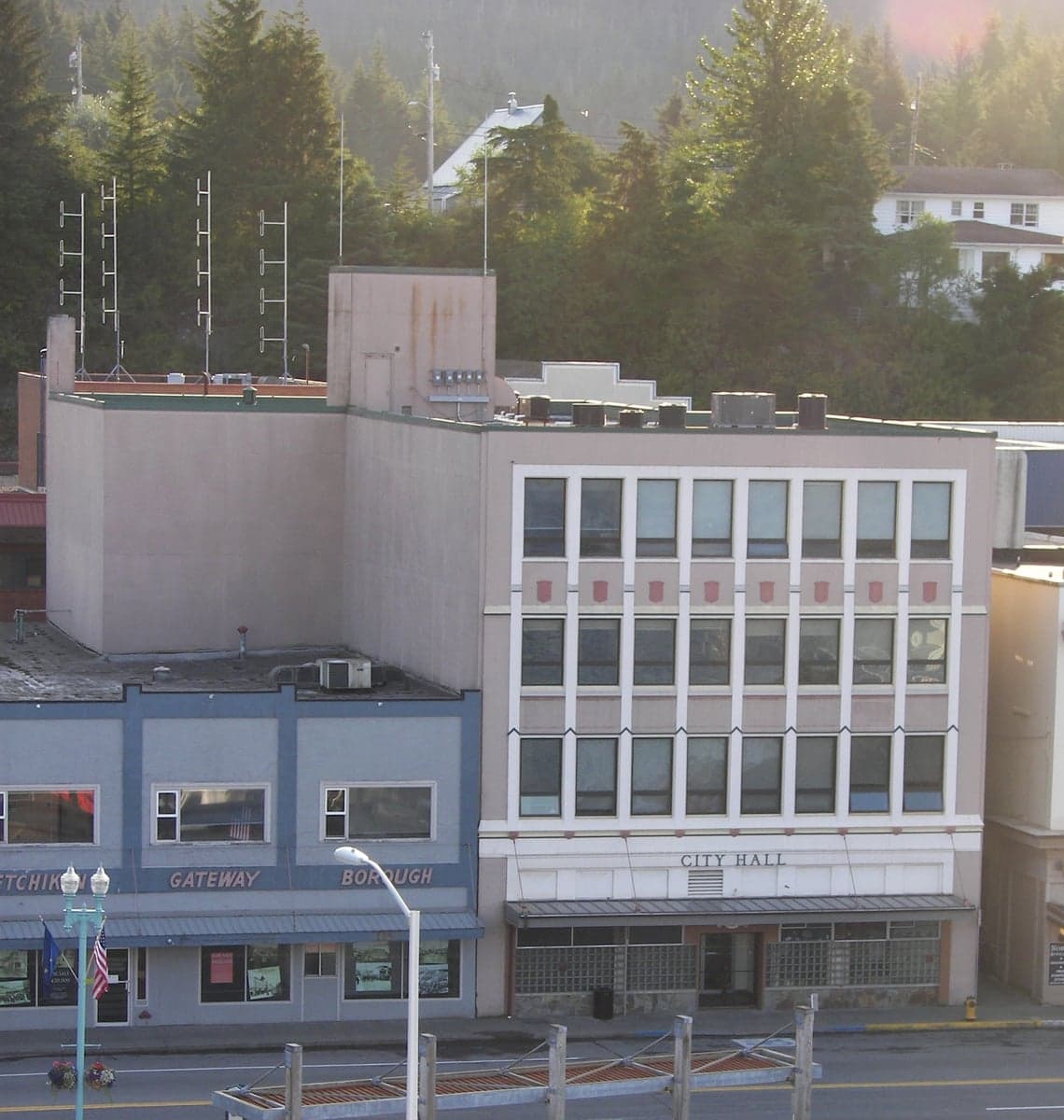
Photo: Wikipedia
Demographics of Ketchikan Gateway County
Affluence Level in Ketchikan Gateway County
A middle-class area roughly in line with national averages across income, home values, education, and employment.
People of Ketchikan Gateway County
The people of Ketchikan Gateway Borough are a compact, predominantly white population of 13,870, shaped by a century of industrial fishing, timber, and government service in Southeast Alaska’s temperate rainforest. The borough’s identity is distinctly Alaskan—independent, resourceful, and tied to the sea—with a notable East/Southeast Asian minority of 8.7% and a small but growing Hispanic community of 5.3%. Despite its remote island location, the population is relatively educated (27.0% college graduates) and has a low foreign-born share of 2.5%, reflecting a region where most residents are long-established or drawn by specific economic anchors rather than broad immigration trends.
Settlement & growth (pre-1960)
The Tlingit people, specifically the Taantʼa Ḵwáan (Tongass Tribe), inhabited the islands and mainland of what is now Ketchikan Gateway Borough for millennia before European contact. Their seasonal villages and fish camps dotted the coastline, with major settlements at what is now Saxman (just south of Ketchikan) and along the Tongass Narrows. Russian fur traders passed through in the late 18th century but established no permanent presence; the region remained overwhelmingly Tlingit until the late 19th century.
American settlement began in earnest after the 1867 Alaska Purchase, but the defining event was the 1885 discovery of gold on nearby Prince of Wales Island. Prospectors and entrepreneurs flooded in, and by 1887 the town of Ketchikan was founded as a cannery and supply hub. The first major non-Native wave was overwhelmingly white—Scandinavian, Irish, and Anglo-American men working in fishing, canning, and logging. The Tongass National Forest, established in 1907, and the Ketchikan Pulp Company mill (opened 1954) anchored a timber economy that drew additional white workers from the Pacific Northwest and Midwest through the 1950s. The borough’s other settlements—Saxman (a Tlingit village incorporated in 1929), Ward Cove (a company town for the pulp mill), and the unincorporated communities of Loring and Mountain Point—grew as satellite residential and industrial nodes. By 1960, Ketchikan’s population had reached roughly 6,500, with the borough’s character set as a white-majority, blue-collar, resource-extraction community with a significant Tlingit minority (roughly 15-20% at the time).
Modern era (post-1965)
The 1965 Hart-Cellar Act had minimal direct impact on Ketchikan Gateway Borough, as the region never attracted the large-scale immigration seen in urban centers. Instead, the post-1965 demographic story is one of domestic migration and industry decline. The timber industry collapsed in the 1990s due to environmental restrictions and market shifts; the Ketchikan Pulp Company mill closed in 1997, shedding over 500 jobs. This triggered a net out-migration of white working-class families, particularly from Ward Cove and the unincorporated areas, as residents left for Anchorage, Washington, or Oregon. The borough’s population peaked at 14,070 in 2000 and has since declined slowly to 13,870.
The East/Southeast Asian community (8.7%) is the most notable modern demographic shift. This population is almost entirely Filipino, concentrated in Ketchikan proper and Saxman, and traces its roots to two waves: first, cannery workers recruited in the 1920s-1940s, and second, healthcare and hospitality workers who arrived after the 1990s. The Filipino community is well-integrated, with a strong presence in the fishing industry, healthcare (Ketchikan Medical Center), and local government. The Hispanic population (5.3%) is newer, driven by Mexican and Central American workers in tourism, construction, and seafood processing since the 2000s, and is dispersed across Ketchikan and Saxman. The Black population (0.4%) and Indian subcontinent population (0.3%) are negligible, reflecting the borough’s limited economic draw for those groups. The Tlingit population has held steady at roughly 15-18%, concentrated in Saxman (where over 60% of residents are Alaska Native) and the Ketchikan Indian Community’s service area.
The future
Ketchikan Gateway Borough is likely to continue its slow population decline, with an aging white majority and modest growth among Hispanic and Filipino communities. The borough’s economy is shifting toward tourism (over 1 million cruise ship visitors annually) and healthcare, which may attract younger workers from outside Alaska but not in large numbers. The Tlingit population is expected to remain stable, with Saxman maintaining its role as a cultural and political hub. The borough is becoming slightly more diverse—Hispanic and Filipino shares are rising slowly—but it will remain overwhelmingly white and Alaska Native for the foreseeable future. New residents are most likely to settle in Ketchikan proper, where jobs and services are concentrated, rather than in the unincorporated areas or Ward Cove, which have seen housing stock age and depopulate.
For someone moving in now, Ketchikan Gateway Borough offers a stable, small-town Alaskan lifestyle with a strong sense of place and community, but limited economic opportunity and a population that is slowly shrinking. The borough’s future is tied to tourism and the resilience of its fishing industry, not to rapid growth or diversification. It is a place where newcomers will find a welcoming but insular culture, and where the Tlingit and Filipino communities provide the most visible cultural diversity.

* Values derived from national, state, county, city and local statistics and may differ in a specific area. Last updated: 2026-07-01T03:07:37.000Z
Narrative content on this page is AI-generated and may contain mistakes. Verify any details that matter before acting on them.
ReloMaps may earn a commission from affiliate links at no extra cost to you.

