Photo: Wikipedia
Political ClimatePolitical Climate in Russell County
Showing district-level results — no local-only data available.
Local Political AnalysisPolitical Analysis of Russell County
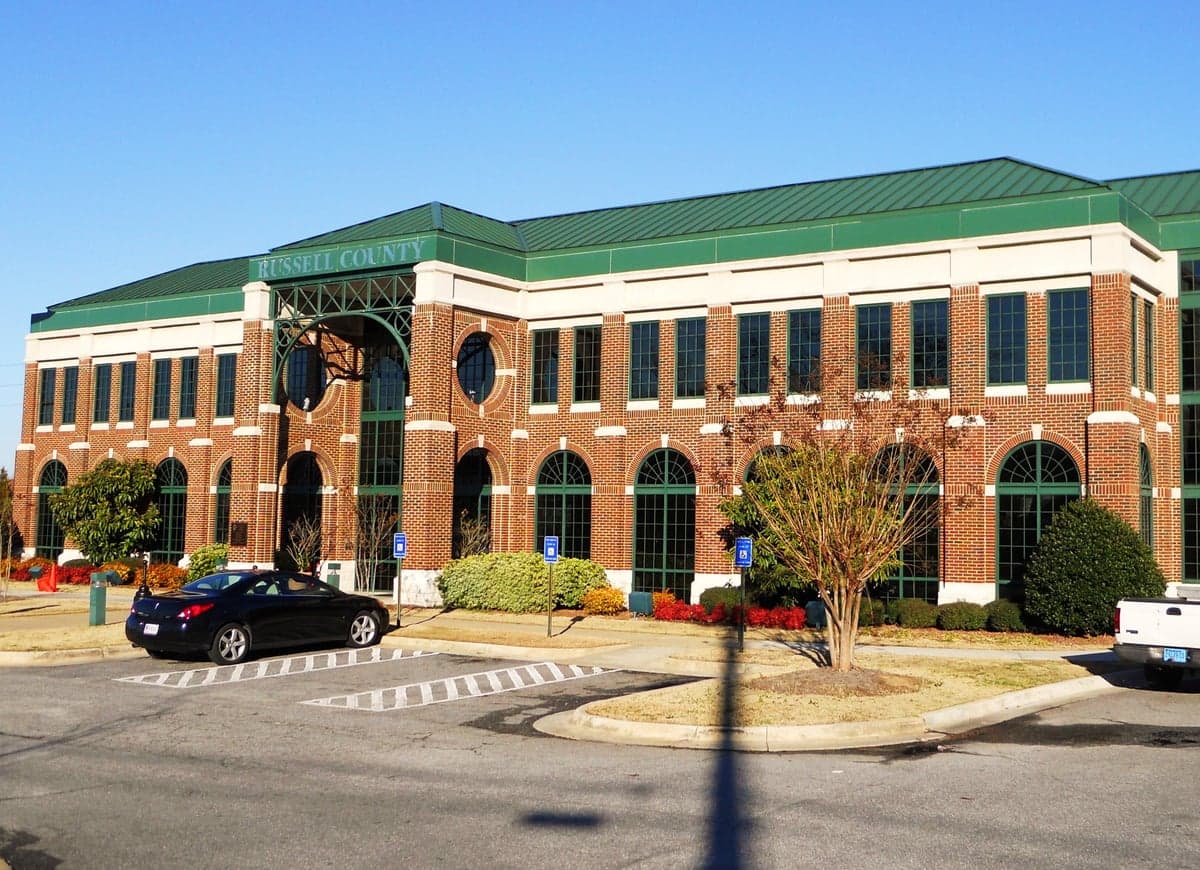
Russell County, Alabama, is a political outlier in the Deep South, carrying a Cook Partisan Voting Index (PVI) of D+5, which means it leans Democratic by five points relative to the national average. This stands in stark contrast to the surrounding state of Alabama, which has a PVI of R+14, a solidly Republican lean. The county's Democratic tilt is a legacy of its history and demographics, but it's not a monolith—the political reality is more nuanced than a single number suggests, with clear geographic and demographic splits that have shifted over the past decade.
How it compares
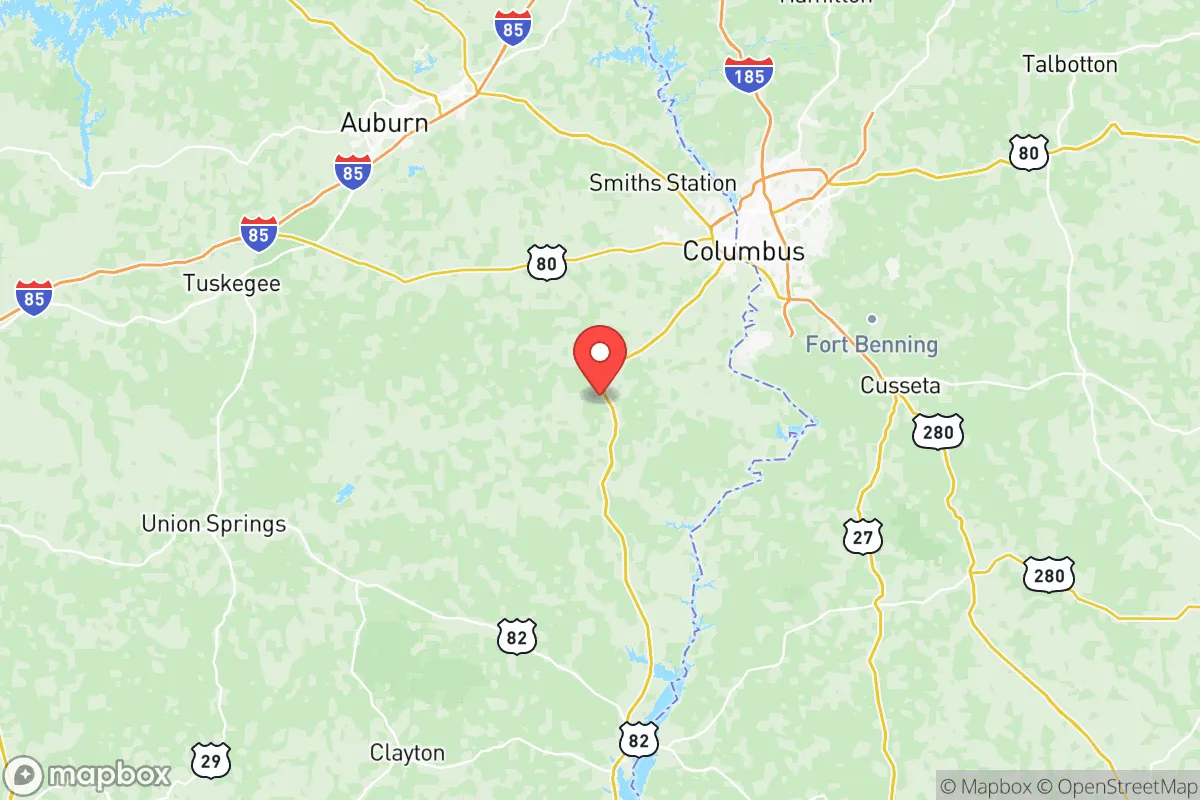
The D+5 rating for Russell County is a direct result of its majority-Black population and the strong Democratic voting bloc in the county seat, Phenix City. Phenix City, with its large African American community and union ties from the nearby Fort Moore (formerly Fort Benning), consistently delivers Democratic margins that outweigh the Republican votes from the county's more rural and white-majority areas. For instance, precincts in Phenix City like the ones around the downtown core and the Lakewood area regularly vote 70-80% Democratic. In contrast, the smaller towns and unincorporated areas—such as Hurstboro, Ladonia, and the more rural parts of Seale—lean heavily Republican, often by 20-30 points. The swing precincts are found in the newer subdivisions along Highway 431 and near the Lee County line, where younger, more moderate families are moving in. These areas can flip depending on the candidate, but they still tend to break slightly more Republican than the county as a whole. So while Russell County is D+5, it's a fragile Democratic hold, not a deep-blue stronghold.
What this means for residents
For a conservative resident, living in a D+5 county means you're in the minority locally, but you're in the majority statewide. You'll see Republican candidates win countywide races less often, but you'll still have strong representation in the Alabama Legislature and in Congress, where the county is part of a heavily Republican district. You'll likely find your views reflected in local churches, gun clubs, and civic groups, but you might feel out of step with the city council or school board in Phenix City. For a liberal resident, the D+5 lean means you have a real voice in local elections—Phenix City's mayor and most of the city council are Democrats, and the county commission has a Democratic majority. However, you'll be acutely aware that state-level policies on abortion, voting access, and education are set by a Republican supermajority in Montgomery. The practical effect is that local governance feels more progressive than the state's, but state laws often override local preferences.
Culturally, Russell County is a border county with a distinct identity. Being right across the Chattahoochee River from Columbus, Georgia, means many residents work, shop, and even attend school in Georgia, which creates a more transient and less insular feel than in deeper Alabama counties. The presence of Fort Moore brings a steady flow of military families from all over the country, which dilutes the traditional "Alabama" political culture. You'll see more out-of-state license plates and hear more varied accents than in, say, nearby Barbour County. This cross-pollination means the county is less culturally conservative than its rural neighbors, but it's still a place where church attendance is high and gun ownership is common across the political spectrum. The biggest policy distinction is that Phenix City has a more robust public safety and infrastructure focus than many comparably sized Alabama towns, a direct result of its Democratic leadership prioritizing those issues over the culture war fights that dominate state politics.

State Political ClimatePolitical Climate in Alabama
State Political AnalysisPolitical Environment in the State
Alabama is one of the most reliably Republican states in the country, with a Cook Partisan Voting Index of R+14, meaning it votes about 14 points more Republican than the national average in presidential elections. The state hasn't voted for a Democratic presidential candidate since Jimmy Carter in 1976, and over the last 20 years, the GOP has solidified its hold at every level—state legislature, statewide offices, and the congressional delegation. That said, the state's politics aren't a monolith: the Deep South's old "Yellow Dog Democrat" tradition has faded, but you still see real variation between the booming, conservative-leaning suburbs around Birmingham and Huntsville, the deeply rural and culturally traditional Black Belt, and the increasingly competitive metro areas like Jefferson County (Birmingham) and Montgomery County.
Urban vs. rural divide
The political map of Alabama is a textbook study in the urban-rural split. The state's largest metro, the Birmingham-Hoover area, is anchored by Jefferson County, which has trended Democratic in recent cycles—Hillary Clinton won it in 2016, and Joe Biden carried it by about 11 points in 2020. That's driven by the city of Birmingham itself, which is majority Black and reliably Democratic, plus the growing, more diverse suburbs like Homewood and Mountain Brook (the latter still leans Republican but less so than a decade ago). Meanwhile, Madison County, home to Huntsville, has flipped from a swing county to a solidly Republican one as the defense and aerospace boom brought in a wave of conservative-leaning professionals; Trump won it by 17 points in 2020. The rural Black Belt—counties like Lowndes, Greene, and Sumter—vote overwhelmingly Democratic (often 70-80% for the Democratic candidate), driven by a majority-Black population with deep roots in civil rights history. But these counties have small populations, so their impact is dwarfed by the vast, white, rural counties in north and south Alabama—places like DeKalb County (northeast) and Mobile County (southwest)—which vote 70-80% Republican. The net effect is a state that's deeply red at the macro level but contains real pockets of blue, especially in the central cities and the Black Belt.
Policy environment
Alabama's policy environment is shaped by a low-tax, limited-government philosophy, but with a strong social conservative overlay. The state has no personal property tax on vehicles or boats, and the combined state and local sales tax rate averages around 9-10%, one of the highest in the nation—meaning the tax burden falls heavily on consumption rather than income. Property taxes are among the lowest in the country, which is a big draw for homeowners. The regulatory posture is business-friendly: Alabama is a right-to-work state, and the legislature has consistently resisted expanding Medicaid under the Affordable Care Act, leaving roughly 300,000 residents in the coverage gap. Education policy is a flashpoint: the state has a school choice program (the Alabama Accountability Act) that provides tax credits for private school tuition, and in 2022, the legislature passed a law allowing parents to opt their children out of mask mandates. Election laws are relatively restrictive: voters must present a photo ID at the polls, and the state has no-excuse absentee voting (you need a valid reason to vote by mail). The state also has a near-total abortion ban, with no exceptions for rape or incest, passed in 2019 and triggered after the Dobbs decision.
Recent policy direction
Over the last five years, Alabama has moved decisively in a conservative direction across multiple fronts. On gun and self-defense law, the state passed a permitless carry law in 2022, allowing any adult who can legally own a firearm to carry it concealed without a permit. On parental and education rights, the 2022 "Don't Say Gay" style law (the Alabama Vulnerable Child Compassion and Protection Act) bans classroom instruction on sexual orientation and gender identity in K-5, and requires parental notification for any discussions of those topics in older grades. On speech and privacy, the state passed a law in 2023 prohibiting public schools and universities from requiring diversity, equity, and inclusion (DEI) statements or programs. On medical and bodily autonomy, the near-total abortion ban is the most prominent example, but the state also passed a law in 2023 banning gender-affirming care for minors, including puberty blockers and hormone therapy. On property rights, Alabama is a strong property rights state, with no statewide zoning mandates and a relatively easy process for building and development. On taxation, the legislature passed a series of income tax cuts in 2023 and 2024, gradually reducing the top marginal rate from 5% to 4% by 2026. On voting and ballot access, the state has tightened rules around absentee ballot applications and prohibited curbside voting, though it has not gone as far as Georgia in restricting drop boxes.
Civil unrest & political movements
Alabama has a long history of civil rights activism, and that legacy continues today, though the flashpoints have shifted. The most visible recent protests were in 2020, following the murder of George Floyd, when demonstrations in Birmingham, Montgomery, and Mobile drew thousands and occasionally turned confrontational with police. The state also saw significant protests in 2022 after the Dobbs decision, particularly in Birmingham and Huntsville, where reproductive rights groups organized marches. On the right, the "Stop the Steal" movement had a strong presence in Alabama after the 2020 election, with rallies at the state capitol in Montgomery and in Mobile. The state's immigration politics are relatively quiet compared to border states, but there have been localized tensions: in 2019, the town of Albertville (northeast Alabama) saw a controversy over a proposed "sanctuary city" resolution, which ultimately failed. Election integrity has been a recurring theme: in 2022, the state's secretary of state, Wes Allen, launched a review of voter rolls that removed over 3,000 non-citizens (though the number was later found to be inflated). There's no serious secessionist movement, but you'll occasionally see "Alabama secession" rhetoric at fringe political events, particularly in rural areas. Overall, the state is politically stable, but the cultural divides are real—a new resident in Birmingham will experience a very different political environment than someone in Cullman or Dothan.
Projection
Over the next 5-10 years, Alabama's political trajectory is likely to remain deeply Republican, but with some important shifts. The Huntsville metro is growing fast—adding about 15,000 people per year—and attracting a mix of defense contractors, tech workers, and remote professionals. That influx is likely to make Madison County even more Republican, but it could also introduce a small but growing libertarian-leaning or moderate Republican contingent. The Birmingham metro is slowly diversifying, with more out-of-state transplants moving to suburbs like Vestavia Hills and Hoover, which could nudge those areas slightly toward the center. The Black Belt continues to lose population, which reduces the Democratic vote share at the state level. The biggest wildcard is the state's restrictive abortion ban and the ban on gender-affirming care for minors—these policies could deter some younger, more progressive families from moving in, while attracting conservative families who prioritize those issues. The tax cuts and business-friendly environment will likely continue to draw investment, particularly in aerospace, automotive (Mercedes-Benz, Hyundai, and Toyota have major plants), and logistics. A new resident moving in now should expect that in a decade, Alabama will still be a solidly red state, but with a more pronounced urban-rural divide and a growing tension between the Huntsville tech corridor and the rest of the state.
For a new resident, the bottom line is that Alabama's political climate is straightforward: you'll live in a state where conservative values dominate policy, taxes are low, and the pace of change is slow. If you're a conservative, you'll find a welcoming environment with strong gun rights, school choice, and a government that generally stays out of your business. If you're a liberal, you'll find real communities of like-minded people in Birmingham, Huntsville, and Montgomery, but you'll also face a state government that is actively hostile to many of your priorities—especially on reproductive rights and LGBTQ+ issues. The practical takeaway is to choose your location carefully: the political reality of Auburn is very different from that of Tuscaloosa, and the cultural vibe of Fairhope on the Gulf Coast is a world away from Anniston in the east. Do your homework on the specific county and city, because in Alabama, the local politics can be as important as the state-level picture.
* Values derived from national, state, county, city and local statistics and may differ in a specific area. Last updated: 2026-06-16T09:12:40.000Z
Narrative content on this page is AI-generated and may contain mistakes. Verify any details that matter before acting on them.
ReloMaps may earn a commission from affiliate links at no extra cost to you.

