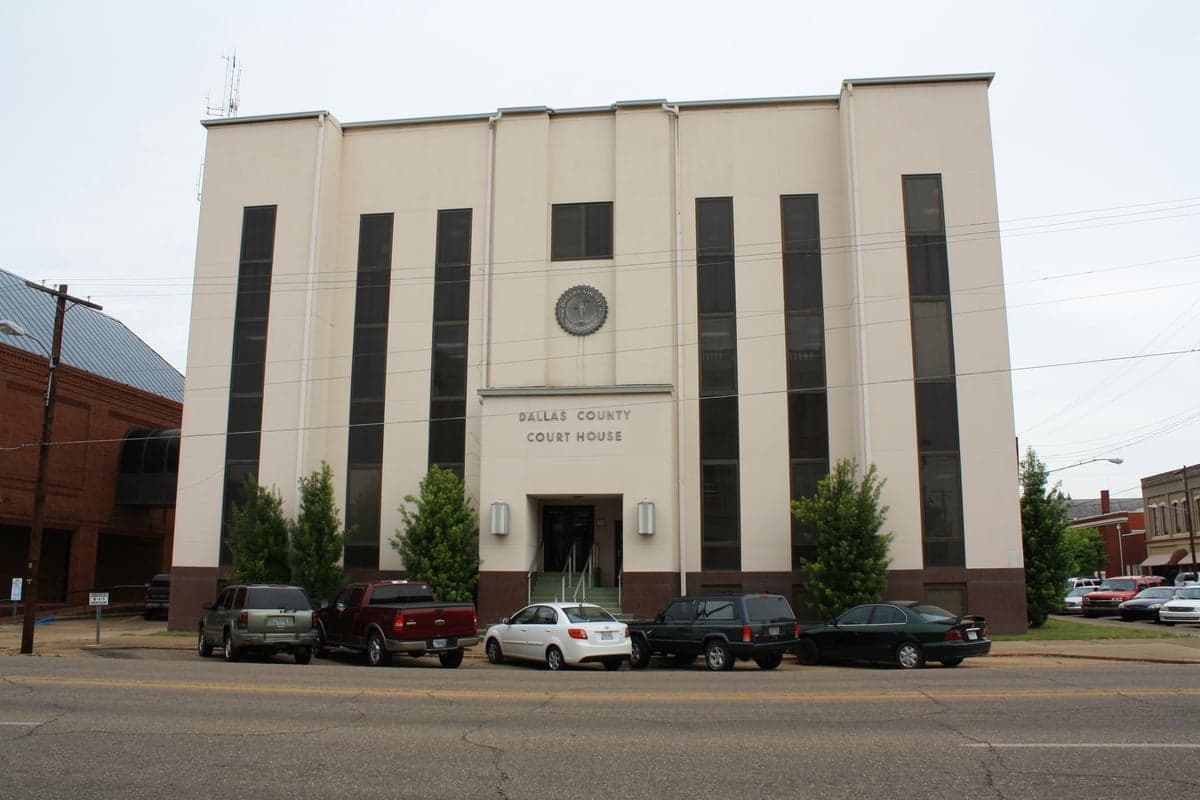
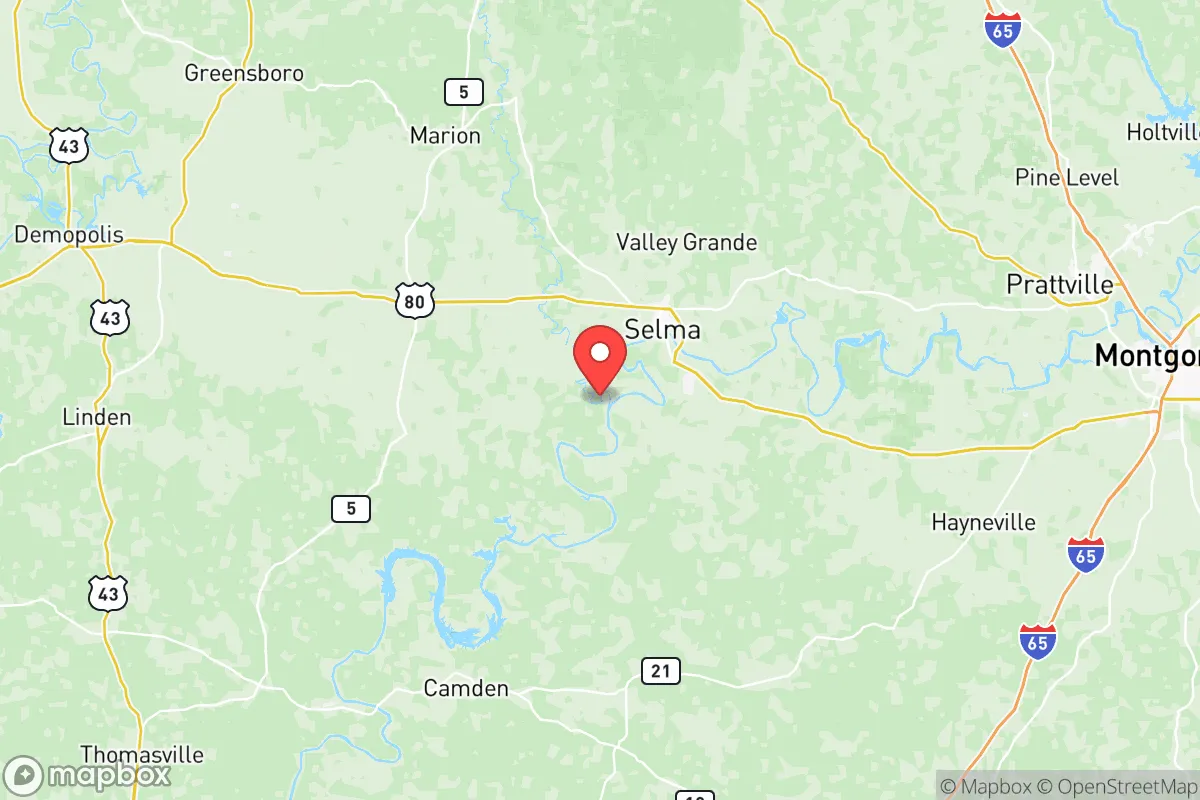
Photo: Wikipedia
Demographics of Dallas County
Affluence Level in Dallas County
A low-income area with significant economic hardship. Household wealth and educational attainment are well below national averages.
People of Dallas County
The people of Dallas County, Alabama, today form a community defined by deep historical roots and a predominantly African American identity, with 70.3% of the 37,536 residents identifying as Black. The county is characterized by a low population density spread across the Black Belt region, anchored by the county seat of Selma, with smaller communities like Orrville, Valley Grande, and Marion Junction shaping the rural landscape. Distinctive markers include a strong connection to the Civil Rights Movement, a legacy of agricultural and industrial labor, and a population that is notably less diverse than the national average, with a foreign-born share of just 1.0% and a college attainment rate of 17.0%.
Settlement & growth (pre-1960)
Before American settlement, the area now known as Dallas County was the homeland of the Choctaw and Creek (Muskogee) peoples, who lived in dispersed villages along the Alabama River. The first Europeans to arrive were French explorers and traders in the early 18th century, establishing small outposts along the river, but significant colonization did not begin until after the United States acquired the region in the 1813 Treaty of Fort Jackson, which forcibly ceded Choctaw and Creek lands. The county was formally established in 1818, named after U.S. Treasury Secretary Alexander Dallas, and the first wave of American settlers—primarily Scots-Irish and English planters from Virginia, Georgia, and the Carolinas—arrived in the 1820s and 1830s, drawn by the fertile, dark soil of the Black Belt for cotton cultivation.
These early settlers established plantations along the Alabama River, founding the town of Selma in 1820 as a river port and trading center. The cotton boom of the antebellum era brought a massive forced migration of enslaved African Americans, who by 1860 constituted over 75% of the county's population. Enslaved people worked the cotton fields on large plantations in areas like Valley Grande and Orrville, and their labor built the wealth that made Selma a regional economic hub. After the Civil War and Emancipation, many freedmen remained in the county as sharecroppers and tenant farmers, establishing independent communities such as the settlement of Marion Junction, which became a center for Black landownership and education.
The post-Reconstruction period saw the imposition of Jim Crow laws and the disenfranchisement of Black voters, but the Black population remained the majority. The early 20th century brought the Great Migration (1910–1970), during which tens of thousands of African Americans left Dallas County for industrial jobs in Northern cities like Chicago, Detroit, and Cleveland, reducing the county's total population from a peak of 53,401 in 1910 to 38,462 by 1960. White settlement during this period was minimal, with the white population concentrated in Selma and a few rural pockets, working in cotton-related industries, small-scale farming, and local government. The county's economy remained tied to agriculture until the mid-20th century, with cotton gins and processing plants in Selma and Orrville providing the primary non-farm employment.
Modern era (post-1965)
The 1965 Voting Rights Act, sparked by the Selma to Montgomery marches, fundamentally reshaped the county's political and social landscape by ending legal disenfranchisement and empowering the Black majority to elect local officials. However, the post-1965 period did not bring the kind of international immigration seen in other parts of the United States. The foreign-born population remains at just 1.0%, with the largest groups being small numbers of Indian (0.4%) and East/Southeast Asian (0.2%) residents, primarily professionals working in healthcare and education in Selma. The Hispanic population is negligible at 0.9%, and there is no significant Arab community.
Domestic migration has been the dominant demographic force since 1965, but it has been largely outward. The county's population has declined steadily from 55,758 in 1970 to 37,536 today, driven by the continued outmigration of Black residents seeking better economic opportunities in Southern cities like Atlanta, Birmingham, and Montgomery, as well as in the broader Sun Belt. This outmigration has been particularly pronounced among younger, college-educated adults, contributing to the low college attainment rate of 17.0%. Suburbanization within the county has been limited, with the town of Valley Grande experiencing modest growth as a bedroom community for Selma and Montgomery, while rural areas like Orrville and Marion Junction have seen population losses. The white population has also declined, from roughly 35% in 1970 to 26.8% today, as many white families moved to larger metropolitan areas or out of state.
The future
The population of Dallas County is projected to continue its slow decline over the next 10–20 years, driven by low birth rates and sustained outmigration of working-age adults. The county is becoming slightly less Black and slightly more white, as the Black outmigration rate exceeds that of whites, but the overall racial composition is expected to remain heavily African American. The foreign-born share is unlikely to rise significantly, given the county's rural character and limited economic opportunities, though a small number of Indian and East/Southeast Asian professionals may continue to settle in Selma for roles at the Vaughan Regional Medical Center or local schools. New residential development is likely to concentrate in Valley Grande and the outskirts of Selma, where land is cheaper and access to Highway 80 provides a commute to Montgomery, but these areas will remain small in scale. The county's cultural identity will remain deeply tied to its Civil Rights history, with the Edmund Pettus Bridge and the Selma Interpretive Center continuing to draw heritage tourism, but the economic base will need to diversify beyond agriculture and government to stem population loss.
For someone moving in now, Dallas County offers a low-cost, historically rich environment with a strong sense of community, but it is a place of demographic stability rather than growth. The population is aging, with a median age of 40.5, and the lack of a large, diverse economy means that newcomers are likely to be retirees, remote workers, or those employed in healthcare, education, or local government. The county is becoming a quieter, more rural version of its former self, where the legacy of the Civil Rights Movement remains the defining feature of its people and their identity.

* Values derived from national, state, county, city and local statistics and may differ in a specific area. Last updated: 2026-07-06T09:38:45.000Z
Narrative content on this page is AI-generated and may contain mistakes. Verify any details that matter before acting on them.
ReloMaps may earn a commission from affiliate links at no extra cost to you.

