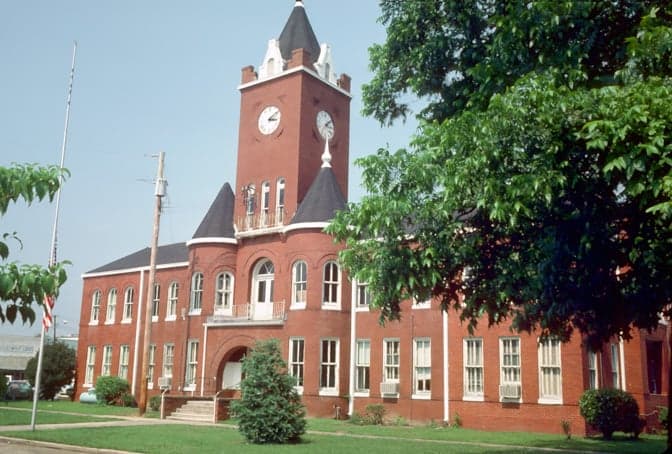
Photo: Wikipedia
Political ClimatePolitical Climate in Coffee County
Showing district-level results — no local-only data available.
Local Political AnalysisPolitical Analysis of Coffee County
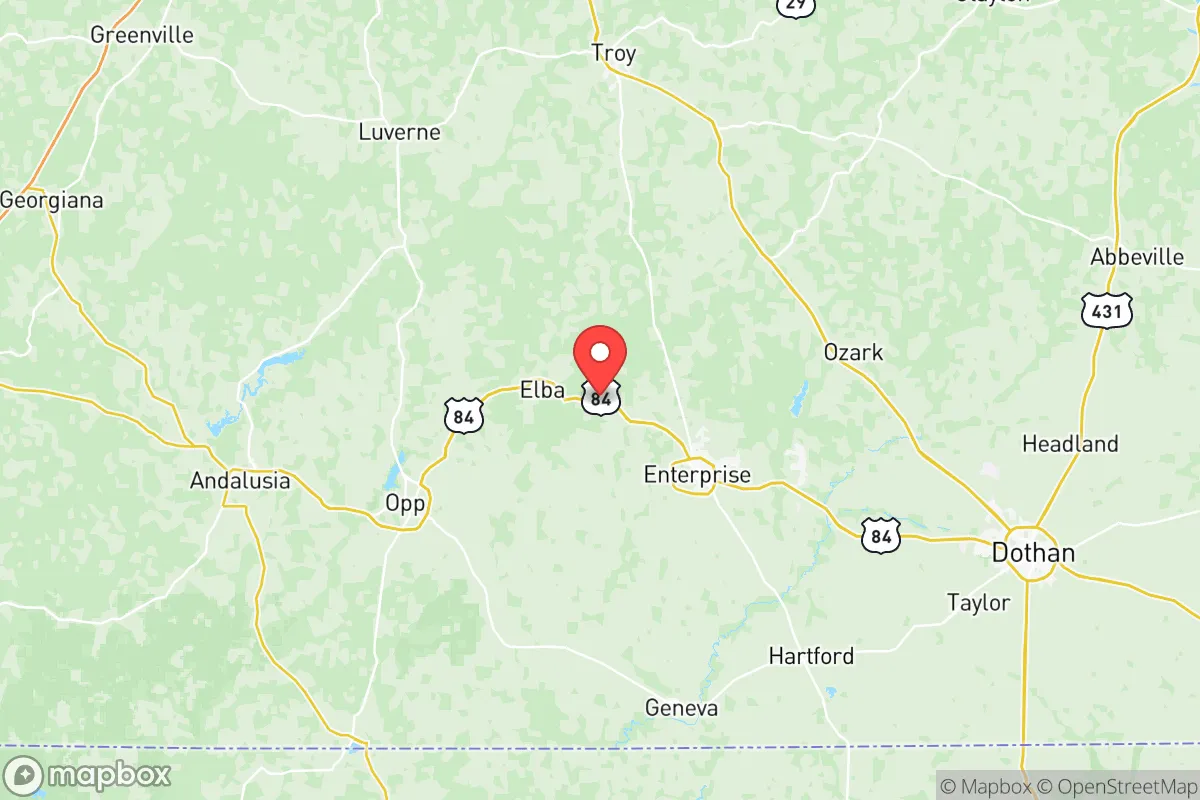
Coffee County, Alabama, is one of the most reliably Republican areas in the state, carrying a Cook Partisan Voting Index (PVI) of R+27 — nearly double the statewide Alabama PVI of R+14. That means the county is about 13 points more conservative than the state average, and in practice, local Republicans rarely face serious competition in general elections. The county has voted for the GOP presidential candidate by margins exceeding 70% in every election since 2000, and that trend shows no sign of softening. If you’re looking at the political map of Alabama, Coffee County sits firmly in the deep-red southeast corner, alongside neighboring Dale and Geneva counties.
How it compares
The R+27 PVI puts Coffee County in the same league as the state’s most conservative rural counties, like Blount or Marshall, but it’s not quite as extreme as the R+30+ areas in the Black Belt’s white-majority precincts or the Tennessee Valley. The key difference from the state as a whole is that Alabama’s R+14 rating is pulled leftward by the reliably Democratic Black Belt counties (e.g., Dallas, Greene, and Lowndes) and by urban centers like Birmingham and Montgomery. Coffee County has no such counterweight. The county seat, Enterprise, is a solidly conservative town of about 30,000, but it does show some variation: the precincts around the downtown area and near the Enterprise campus of Alabama Southern Community College tend to be slightly less Republican — still red, but by 55-60% rather than 75-80%. Elba, the other incorporated city in the county, leans even more conservative, often voting 80%+ Republican, while the rural precincts between the two towns are the most reliably red in the county. There are no swing precincts in the traditional sense; the closest thing to a competitive race in Coffee County is the Republican primary.
What this means for residents
For conservative residents, Coffee County is a comfortable environment where their views are the clear majority. Local elected officials — from the county commission to the school board — are almost uniformly Republican, and policy debates tend to center on how conservative to be, not whether. For liberal residents, the reality is that they are a distinct minority. There is no organized Democratic Party presence in the county, and progressive candidates rarely appear on the ballot outside of presidential primaries. That said, the political climate is not hostile in a personal sense; most people keep politics out of day-to-day interactions, and the county’s small size means that ideological differences are often secondary to personal relationships. The main practical effect for liberals is that they have little influence on local policy — decisions on taxes, zoning, and school funding are made by officials who face no serious electoral challenge from the left.
Culturally, Coffee County’s politics are shaped by its military and agricultural roots. Fort Novosel (formerly Fort Rucker) lies just across the county line in Dale County, and many residents work in defense or related industries, reinforcing a pro-military, fiscally conservative outlook. The county also has a strong evangelical Christian presence, which influences local policy on issues like alcohol sales (Enterprise and Elba are both “wet,” but some rural precincts remain dry). One notable distinction from the rest of Alabama is that Coffee County has a relatively high proportion of out-of-state transplants due to the military base, which brings in some moderate Republicans from other regions but has not shifted the overall lean. Looking ahead, the county’s political trajectory is stable — no demographic or economic shifts are likely to move it leftward in the near term, and the R+27 rating should hold for the foreseeable future.

State Political ClimatePolitical Climate in Alabama
State Political AnalysisPolitical Environment in the State
Alabama is one of the most reliably Republican states in the country, with a Cook Partisan Voting Index of R+14, meaning it votes about 14 points more Republican than the national average in presidential elections. The state has shifted sharply rightward over the past 20 years — in 2004, George W. Bush won it by 25 points, and by 2024, Donald Trump carried it by roughly 30 points, reflecting a deepening conservative consolidation. The dominant coalition is a mix of rural white evangelicals, suburban conservatives in the Birmingham and Mobile metros, and a growing number of culturally conservative working-class voters who have moved away from the Democratic Party since the 2010s. Democrats remain competitive only in the Black Belt counties stretching from the Mississippi border to the Georgia line, and in a handful of urban cores like Jefferson County (Birmingham) and Montgomery County.
Urban vs. rural divide
The political map of Alabama is starkly split. The state’s largest metro, Birmingham (Jefferson County), is a Democratic stronghold — Jefferson County voted for Joe Biden by about 15 points in 2020 — driven by a large Black population and a younger, more diverse professional class. Mobile and Huntsville are more mixed: Mobile County has trended Republican but still has a significant Democratic base in the city proper, while Huntsville (Madison County) is a fast-growing, educated, and increasingly purple area that still leans Republican but with a libertarian streak. The rural Black Belt — places like Greene, Sumter, and Lowndes counties — votes overwhelmingly Democratic (often 70-80% for the Democratic candidate), but these counties have low population and declining turnout. Meanwhile, the rest of the state — the Wiregrass in the southeast, the hill counties in the northeast, and the Gulf Coast suburbs — is deeply Republican. Baldwin County, just east of Mobile, is one of the fastest-growing and most conservative counties in the state, voting for Trump by over 40 points in 2024.
Policy environment
Alabama’s policy environment is among the most conservative in the nation. The state has no state income tax on wages for most residents (though it does tax retirement income and has a flat 5% corporate rate), and its sales tax is among the highest in the country, averaging around 9-10% combined state and local. Property taxes are extremely low — among the lowest in the U.S. — which is a major draw for relocators. The state has a right-to-work law, no minimum wage above the federal floor, and a regulatory climate that is broadly business-friendly. Education policy is dominated by school choice: Alabama has a robust charter school law, a growing Education Savings Account (ESA) program passed in 2024, and a strong homeschooling culture. Healthcare is a persistent challenge — the state has not expanded Medicaid under the Affordable Care Act, leaving roughly 300,000 residents in the coverage gap, and rural hospitals have struggled. Election laws are restrictive by national standards: voter ID is required, early voting is limited (no-excuse absentee voting only), and the state has purged voter rolls aggressively in recent years.
Recent policy direction
Over the past five years, Alabama has moved decisively to the right on a broad set of issues. In 2022, the state passed a near-total abortion ban (the Human Life Protection Act) with no exceptions for rape or incest, and in 2024 it further restricted access to abortion pills. Gun laws have been loosened: Alabama is a constitutional carry state (permitless carry for handguns since 2022), and it has strong Stand Your Ground and castle doctrine protections. On education, the 2024 CHOOSE Act created a universal ESA program that allows families to use state funds for private school tuition, tutoring, or homeschooling expenses. Parental rights have been strengthened with a 2022 law requiring schools to notify parents of any changes to a student’s health or well-being, and a 2023 law banning instruction on sexual orientation and gender identity in K-5 classrooms. On privacy and surveillance, Alabama has no comprehensive data privacy law, but it does have a strict biometric privacy law passed in 2023. Property rights are strong — the state has a conservative eminent domain framework and no state-level rent control. Voting access has tightened: in 2021, the state passed a law banning curbside voting and limiting absentee ballot assistance, and it has been a leader in challenging federal voting rights protections.
Civil unrest & political movements
Alabama has seen relatively little large-scale civil unrest compared to other states, but there are active political movements on both sides. The state has a strong, organized conservative grassroots network, particularly around gun rights (the Alabama Gun Owners Association is influential) and anti-abortion activism. On the left, the Alabama Poor People’s Campaign and local Black Lives Matter chapters have organized around criminal justice reform and voting rights, particularly in Montgomery and Birmingham. Immigration politics are less heated than in border states — Alabama’s foreign-born population is only about 3.5% — but the state passed a strict anti-sanctuary city law in 2019, and there is no sanctuary jurisdiction anywhere in the state. Election integrity has been a flashpoint: after the 2020 election, Alabama Republicans pushed for a forensic audit of results in several counties, and the state has been a battleground over the Voting Rights Act, with the U.S. Supreme Court ruling in Allen v. Milligan (2023) that Alabama’s congressional map likely violated the Voting Rights Act by diluting Black voting power. That case forced the creation of a second majority-Black district in 2024, which flipped a seat from red to blue in the U.S. House.
Projection
Over the next 5-10 years, Alabama is likely to remain deeply Republican, but the margins may narrow slightly in fast-growing metros like Huntsville and Baldwin County, which are attracting a mix of out-of-state transplants and younger professionals. The state’s population is growing slowly (about 0.5% annually), and the demographic trend is toward a slightly more diverse and educated electorate, particularly in the Huntsville area, which is driven by the defense and aerospace sectors. The Black Belt will continue to lose population, reducing Democratic turnout, while the Gulf Coast and suburban Birmingham will grow. The biggest wildcard is the impact of the new congressional map: the second majority-Black district will likely keep a Democratic seat in the delegation for the foreseeable future, but statewide races (governor, Senate) will remain safely Republican. A relocator moving in now should expect a state that is politically stable, with a conservative policy environment that is unlikely to shift leftward, but with growing internal diversity in the suburbs and a more competitive congressional map.
For a new resident, the bottom line is that Alabama offers a low-tax, low-regulation environment with strong protections for gun rights, school choice, and religious liberty. Conservative residents will find a state that aligns closely with their values and where their vote carries weight. Liberal residents will find a state where their political influence is limited to a few urban and Black Belt counties, and where state-level policies on abortion, voting, and education may feel restrictive. The practical takeaway is that Alabama is a place where politics is deeply felt but rarely disruptive to daily life — most people go about their business, and the state’s political lean is stable enough that a relocator can plan around it with confidence.
* Values derived from national, state, county, city and local statistics and may differ in a specific area. Last updated: 2026-06-24T16:04:30.000Z
Narrative content on this page is AI-generated and may contain mistakes. Verify any details that matter before acting on them.
ReloMaps may earn a commission from affiliate links at no extra cost to you.

