Photo: Wikipedia
Demographics of Coffee County
Affluence Level in Coffee County
A middle-class area roughly in line with national averages across income, home values, education, and employment.
People of Coffee County
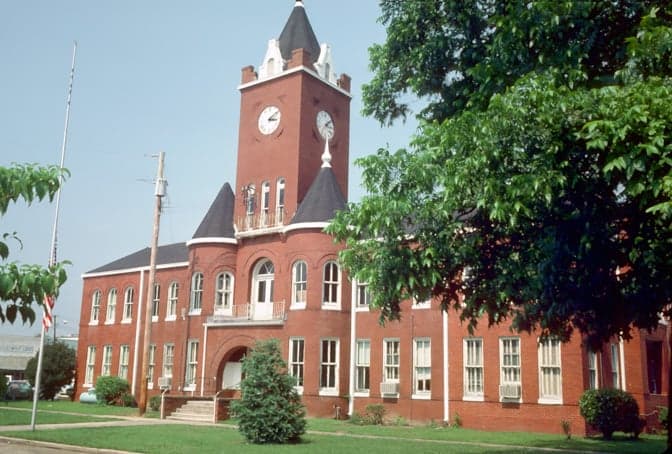
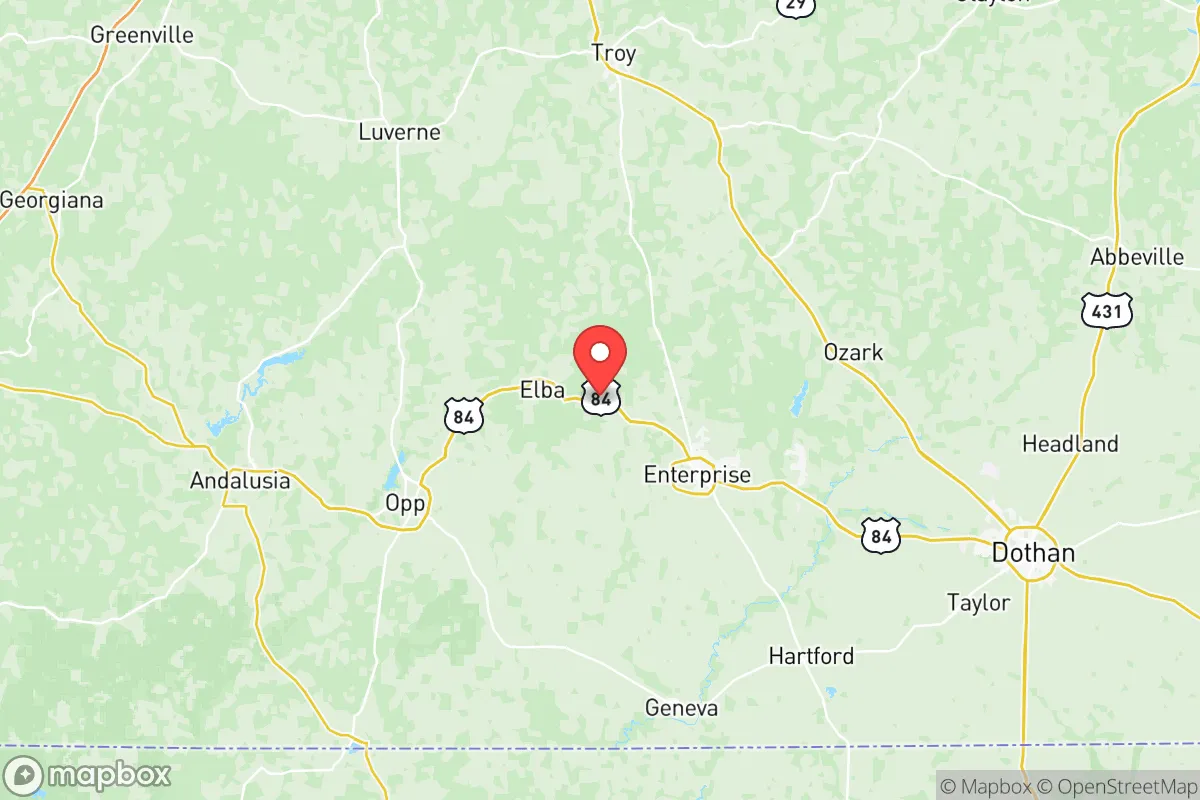
Coffee County, Alabama, is home to 54,231 residents who reflect a deeply rooted Southern identity shaped by waves of agricultural settlement, military influence, and steady, modest growth. The population is predominantly white (67.9%) with a significant Black minority (15.9%) and a growing Hispanic community (9.4%), creating a demographic profile that is more diverse than many of its neighboring Wiregrass counties. The county’s character is defined by its twin hubs—Enterprise, the county seat and a bustling military town, and Elba, the historic river town—along with smaller communities like New Brockton, Kinston, and Coffee Springs that preserve a quieter, rural way of life.
Settlement & growth (pre-1960)
Before American settlement, the area now known as Coffee County was part of the vast Creek Nation homeland, specifically the lower Creek towns along the Pea and Choctawhatchee rivers. The Creeks were forcibly removed in the 1830s following the Indian Removal Act, opening the land to white settlers. Coffee County was created in 1841 from Dale County, named after General John Coffee, a hero of the Creek War and the War of 1812. The earliest American settlers were primarily Scots-Irish and English farmers from Georgia and the Carolinas, drawn by cheap, fertile land for cotton cultivation. They established small farming communities along the rivers, with Elba (originally called "Bridgeville") becoming the first county seat in 1841.
The arrival of the railroad in the late 19th century was transformative. The Central of Georgia Railway and the Louisville and Nashville Railroad pushed through the county, connecting remote farms to regional markets. This spurred the founding of Enterprise in 1896, which quickly grew as a rail hub and agricultural center. Cotton was king, but the boll weevil infestation of the 1910s devastated the crop and forced a dramatic shift. In a remarkable turn, Coffee County farmers led by Enterprise residents diversified into peanuts, corn, and livestock—a pivot so successful that the town erected the world's only monument to the boll weevil in 1919, celebrating the insect that broke the cotton monoculture. This agricultural resilience defined the county's early 20th-century character.
World War II brought the single biggest demographic shock. In 1941, the U.S. Army established Camp Rucker (later Fort Rucker, now Fort Novosel) just west of Enterprise, creating a massive Army aviation training base. Thousands of soldiers and civilian workers poured in, many of whom stayed after the war. This military presence transformed Enterprise from a quiet farm town into a bustling service hub, while Elba, New Brockton, and Kinston remained more agrarian. The post-war period saw steady growth as returning veterans settled in the area, drawn by the base's employment and the region's low cost of living. By 1960, the county's population had reached roughly 30,000, with a heavily native-born, white, and Black population shaped by Jim Crow-era segregation.
Modern era (post-1965)
The 1965 Hart-Cellar Act had a limited direct impact on Coffee County, as the area never attracted large-scale immigration from Asia or Latin America. The foreign-born population today stands at just 2.6%, well below the national average. However, the county has experienced significant domestic demographic shifts. The most notable change is the growth of the Hispanic population, which now makes up 9.4% of residents. This wave began in the 1990s and accelerated in the 2000s, driven by labor demand in poultry processing, agriculture, and construction. Hispanic families, primarily of Mexican origin, have concentrated in Enterprise and, to a lesser extent, Elba, where they work in the Tyson Foods plant and local farms. A small but visible Hispanic business corridor has emerged along U.S. Highway 84 in Enterprise, with tiendas, taquerias, and churches serving the community.
The Black population, at 15.9%, has remained relatively stable since the 1970s, though its geographic distribution has shifted. Historically concentrated in rural areas and the older neighborhoods of Elba and Enterprise, Black residents have increasingly moved into newer subdivisions in Enterprise as the military base brought more diverse personnel. The Asian population is tiny at 0.9%, consisting mostly of military-affiliated families of Filipino, Korean, and Vietnamese origin stationed at Fort Novosel. The Indian subcontinent population is negligible at 0.0%. The county's white population, while still the majority, has declined slightly as a share of the total, from over 75% in 1990 to 67.9% today, as Hispanic growth and military diversity have increased.
The most transformative force in the modern era has been the continued expansion of Fort Novosel (formerly Fort Rucker). The base is the U.S. Army's primary aviation training center, and its presence has made Enterprise a magnet for military retirees and defense contractors. This has created a distinct subculture within the county: a transient, professional, and politically conservative population that contrasts with the older, more rooted farming communities in Kinston, Coffee Springs, and New Brockton. Suburbanization has been modest but visible, with new housing developments spreading along the Highway 84 corridor west of Enterprise toward the base, and along Highway 167 south toward Elba.
The future
Coffee County's population is projected to grow slowly but steadily, driven primarily by the military economy and the broader Sun Belt migration trend. The Hispanic share is likely to continue rising, potentially reaching 12-15% by 2040, as second-generation families grow and new arrivals are drawn to the poultry and construction industries. The Black population share is expected to remain stable, while the white share will continue a gradual decline. The Asian and Indian populations will likely remain small, tied almost entirely to military rotations. The county's cultural identity is evolving from a historically biracial (white-Black) Southern society into a tri-ethnic one, with Hispanic integration proceeding more smoothly than in many parts of the Deep South, partly due to the military's moderating influence.
The biggest wildcard is the future of Fort Novosel. Any significant base realignment or closure would devastate Enterprise and the county's economy, potentially triggering out-migration. Conversely, the Army's continued investment in aviation training could bring more personnel and families. The rural communities—Elba, Kinston, Coffee Springs, and New Brockton—are likely to remain stable or slowly decline, as young people leave for larger cities and the farming population ages. Enterprise will continue to absorb most new growth, becoming more suburban and diverse, while the county's overall character remains conservative, family-oriented, and deeply connected to the military and agriculture.
For someone moving in now, Coffee County offers a low-cost, safe, and community-oriented environment with a strong military presence and a growing Hispanic influence. It is not a place of rapid demographic revolution, but of gradual, manageable change—a Southern county where the old and new are slowly blending, anchored by the steady hum of helicopter rotors over the Wiregrass.

* Values derived from national, state, county, city and local statistics and may differ in a specific area. Last updated: 2026-06-24T16:04:30.000Z
Narrative content on this page is AI-generated and may contain mistakes. Verify any details that matter before acting on them.
ReloMaps may earn a commission from affiliate links at no extra cost to you.

