
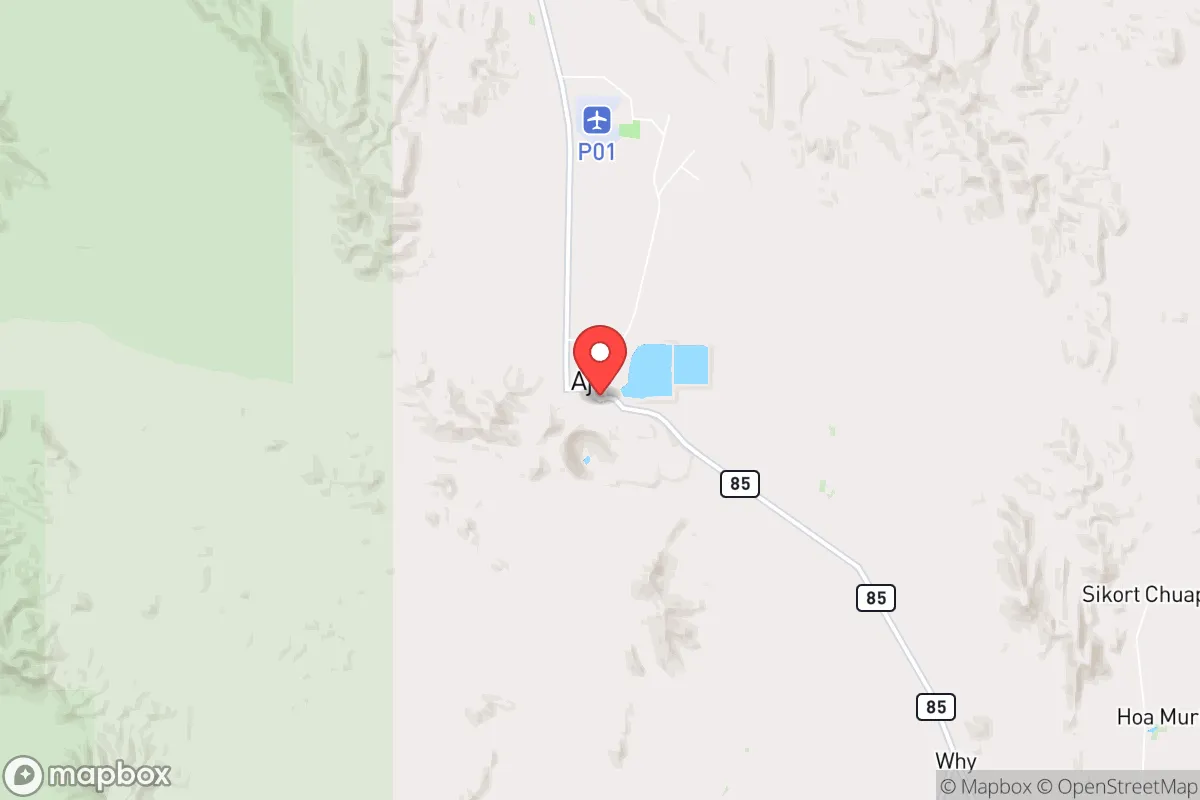
Photo: Wikipedia
Personal Sovereignty in Ajo, AZ
Viable for self-reliance. Generally workable, though some barriers may limit total independence.
What does Personal Sovereignty tell us?
Personal Sovereignty measures your capacity for self-reliance and independence with minimal government friction. Higher scores mean fewer barriers between you and the way you want to live... but it assumes you have the space you need and good neighbors.
What does this tell us?
Personal Sovereignty measures your capacity for self-reliance and independence with minimal government friction. Higher scores mean fewer barriers between you and the way you want to live... but it assumes you have the space you need and good neighbors.
State Policy
Energy independence: Importer (20% of energy produced in-state)
Personal Liberty
Homesteading

Personal Liberty Analysis
Ajo, Arizona, offers a notably high degree of personal sovereignty, rooted in Arizona’s strong state-level preemption laws and the town’s remote, low-density character. For a relocation-minded individual or family prioritizing autonomy, the environment is defined by minimal local government interference, a low tax burden, and a legal framework that broadly supports self-defense, self-reliance, and personal liberties. While Ajo itself is a small, unincorporated community within Pima County, the county’s regulatory posture is generally light-touch outside of the Tucson metro core, and state law provides a powerful shield against many forms of local overreach.
Tax burden and regulatory posture in Ajo and Pima County
Arizona is a low-tax state, and Ajo residents benefit directly. There is no state income tax on wages, and the state’s sales tax rate is 5.6%, with Pima County adding a 0.5% county tax, bringing the total to roughly 6.1% in Ajo. Property taxes are among the lowest in the nation, with an effective rate around 0.62% of assessed value. For a home valued at $150,000, annual property taxes would be approximately $930. The regulatory posture in unincorporated Pima County is relatively permissive. There is no county-level building code for most rural residential construction, though a permit is required for new structures. Zoning is minimal in the Ajo area, with most land zoned as Rural Residential (RR) or General Rural (GR), which allows for a wide range of uses including small-scale agriculture, home businesses, and keeping livestock. The county does enforce a septic system code, but overall, the regulatory burden is light compared to urban or suburban jurisdictions. Arizona’s strong preemption laws also prevent local governments from enacting ordinances that conflict with state law on issues like firearms, short-term rentals, and occupational licensing, which further reduces local regulatory creep.
Self-defense and gun law specifics in Ajo
Arizona is a constitutional carry state, meaning no permit is required to carry a concealed firearm for anyone 21 or older who is legally allowed to possess a firearm. Open carry is also legal without a permit. Ajo, being in Pima County, is subject to no additional local gun restrictions, as state law preempts all firearm regulation. There is no waiting period for firearm purchases, no state-level magazine capacity ban, and no requirement to register firearms. The state also has a “stand your ground” law, with no duty to retreat in any place where a person is lawfully present. Castle doctrine protections extend to vehicles and occupied structures. For a resident prioritizing self-defense, the legal environment is among the most permissive in the country. The nearest gun shops and ranges are in Why (about 30 miles north) or in Gila Bend (about 40 miles east), but online purchases shipped to a local FFL are straightforward. The Ajo Police Department and Pima County Sheriff’s Office both operate in the area, but response times in the more remote parts of the community can be 20-30 minutes, making personal preparedness a practical necessity.
Self-reliance and homesteading viability in Ajo
Ajo’s desert environment presents both challenges and opportunities for self-reliance. Lot sizes in the unincorporated areas around town are typically 1 to 5 acres, with some larger parcels available. Zoning in the RR and GR districts allows for raising chickens, goats, and up to two horses per acre without a special permit. Beekeeping is also permitted. Off-grid living is feasible but requires planning. Pima County does not require a grid connection for new homes, but a septic system permit is mandatory. Solar power is a practical choice, with the area averaging over 300 sunny days per year. Water is the primary constraint: most parcels rely on wells, and drilling depths in the Ajo area typically range from 200 to 600 feet, with costs between $15,000 and $30,000. Rainwater harvesting is legal and encouraged, with no state-level restrictions on collection. The county has no specific ban on composting toilets or greywater systems, but they must meet state health department standards. For those seeking a high degree of self-sufficiency, Ajo offers a realistic path, but the arid climate demands careful water management and a significant upfront investment in infrastructure.
Personal liberties in Ajo: parental rights, medical autonomy, speech, and property
Arizona law provides strong protections for personal liberties that directly affect life in Ajo. Parental rights are explicitly protected under state law, with a 2022 statute affirming that parents have the fundamental right to direct the upbringing, education, and healthcare of their children. This includes the right to opt out of school curricula and to access their child’s medical records. Medical autonomy is similarly robust: Arizona has no state-level vaccine mandate for adults, and while schools require certain immunizations for attendance, broad philosophical and religious exemptions are available. The state also protects the right to refuse any medical treatment. Free speech is protected under the Arizona Constitution, which has its own free speech clause that has been interpreted as at least as protective as the First Amendment. Property rights are strong, with Arizona’s “right to farm” law protecting agricultural operations from nuisance lawsuits, and the state’s eminent domain laws are among the most restrictive in the country, limiting takings primarily to public utilities and transportation projects. Ajo’s small size and low population density mean that these legal protections are rarely tested by local ordinance, and the community’s culture is generally live-and-let-live.
Overall, Ajo ranks among the more sovereignty-friendly locations in the Southwest for a conservative-leaning individual or family. The combination of Arizona’s low tax burden, permissive gun laws, strong parental and medical autonomy protections, and the practical feasibility of off-grid homesteading creates an environment where personal freedom is the default. The trade-offs are real: the remote location means limited access to specialized healthcare, fewer job opportunities, and a long drive to major shopping or entertainment. But for those who prioritize autonomy over convenience, Ajo offers a legal and cultural landscape that is significantly less restrictive than most of the country, with a level of personal sovereignty that rivals rural areas in states like Idaho, Montana, or Wyoming, but with a much lower cost of living and warmer winters.

* Values derived from national, state, county, city and local statistics and may differ in a specific area. Last updated: 2026-09-07T02:05:17.000Z
Narrative content on this page is AI-generated and may contain mistakes. Verify any details that matter before acting on them.
ReloMaps may earn a commission from affiliate links at no extra cost to you.

