Photo: Wikipedia
Demographics of Ajo, AZ
Affluence Level in Ajo, AZ
A middle-class area roughly in line with national averages across income, home values, education, and employment.
People of Ajo, AZ
The people of Ajo, Arizona, today number roughly 3,783, forming a small, tight-knit community with a distinctive character shaped by its remote desert location and a history of boom-and-bust mining. The population is predominantly White (61.0%) with a substantial Hispanic minority (28.2%), a low foreign-born share of just 1.7%, and a modest college attainment rate of 29.2%. This is a place where a historic working-class identity, rooted in copper extraction, still defines the social fabric, and where the population is notably older and more settled than the state average, with little recent in-migration.
How the city was settled and grew
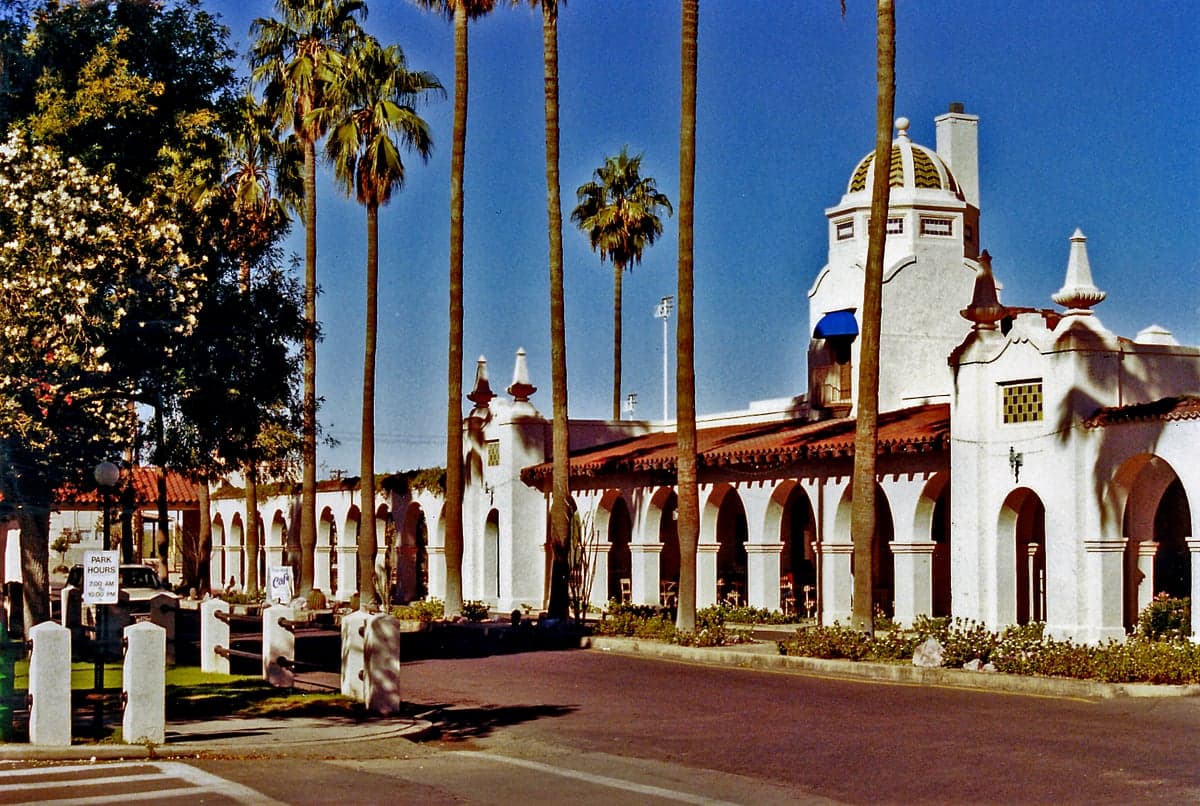
Ajo’s human history is almost entirely a 20th-century story, with no significant colonial-era settlement. The modern town was born from copper. The Spanish had mined the area on a small scale, but the real population wave began after 1911, when the Calumet and Arizona Mining Company built a large-scale operation. The company constructed a planned community, laying out distinct neighborhoods for its workforce. Indian Village, located near the mine, was built for the Tohono O’odham laborers who were the first non-Anglo group to arrive in significant numbers. Mexican Town, south of the railroad tracks, housed the Mexican and Mexican-American workers who formed the backbone of the mining crews. Anglo managers and skilled workers settled in the more spacious Curley School area and the bungalow-lined streets of Smeltertown, named for the nearby smelter. This tripartite settlement pattern—Anglo, Hispanic, and Native American—was rigidly enforced by company policy and remained the demographic reality through the mid-20th century. The population peaked at around 7,000 during World War II, when copper demand surged.
Modern era (post-1965)
The post-1965 era in Ajo is defined not by new immigration but by decline and consolidation. The 1983 closure of the Phelps Dodge mine, the town’s economic lifeline, triggered a massive population exodus, with the town losing roughly half its residents. The post-Hart-Cellar immigration waves that reshaped Phoenix and Tucson largely bypassed Ajo due to its isolated location and lack of jobs. The foreign-born share today (1.7%) is extremely low. The Hispanic population, however, remained stable and even grew slightly as a share of the total, as many Anglo families left. Today, Mexican Town remains the historic heart of the Hispanic community, though the old segregation lines have blurred. Indian Village is now a mix of Tohono O’odham and Anglo residents, as the tribe’s members increasingly live on the nearby reservation. The Curley School area, anchored by the historic school building now converted into artist lofts, has attracted a small number of retirees and remote workers, but this influx is minimal. The Black population is effectively zero (0.0%), and East/Southeast Asian (1.4%) and Indian-subcontinent (0.0%) communities are negligible. The population is aging, with a median age well above the national average.
The future
The demographic future of Ajo appears to be one of slow, modest decline or stagnation, with little change in its racial and ethnic composition. The population is not becoming more diverse in any meaningful sense. The Hispanic share (28.2%) may inch upward gradually as older Anglo residents pass away, but there is no sign of a new wave of immigration or domestic in-migration that would alter the town’s character. The planned redevelopment of the historic mine site and the Curley School arts district could attract a small number of creative-class retirees and second-home buyers, but these newcomers are likely to be predominantly White and older, reinforcing the existing demographic profile. The Tohono O’odham Nation’s growing economic presence in the region, including a new casino and resort, may draw some tribal members back to the area, but this is speculative. The next 10-20 years will likely see Ajo remain a small, predominantly White and Hispanic, working-class retirement community with a strong sense of place but little demographic dynamism.
For someone moving in now, Ajo offers a quiet, affordable, and historically rich environment, but it is not a place of rapid growth or demographic change. The population is stable and aging, the economy is limited, and the community is deeply rooted in its mining and borderlands heritage. New residents will find a welcoming but insular town where the past is still very much present.

* Values derived from national, state, county, city and local statistics and may differ in a specific area. Last updated: 2026-09-07T02:05:17.000Z
Narrative content on this page is AI-generated and may contain mistakes. Verify any details that matter before acting on them.
ReloMaps may earn a commission from affiliate links at no extra cost to you.

