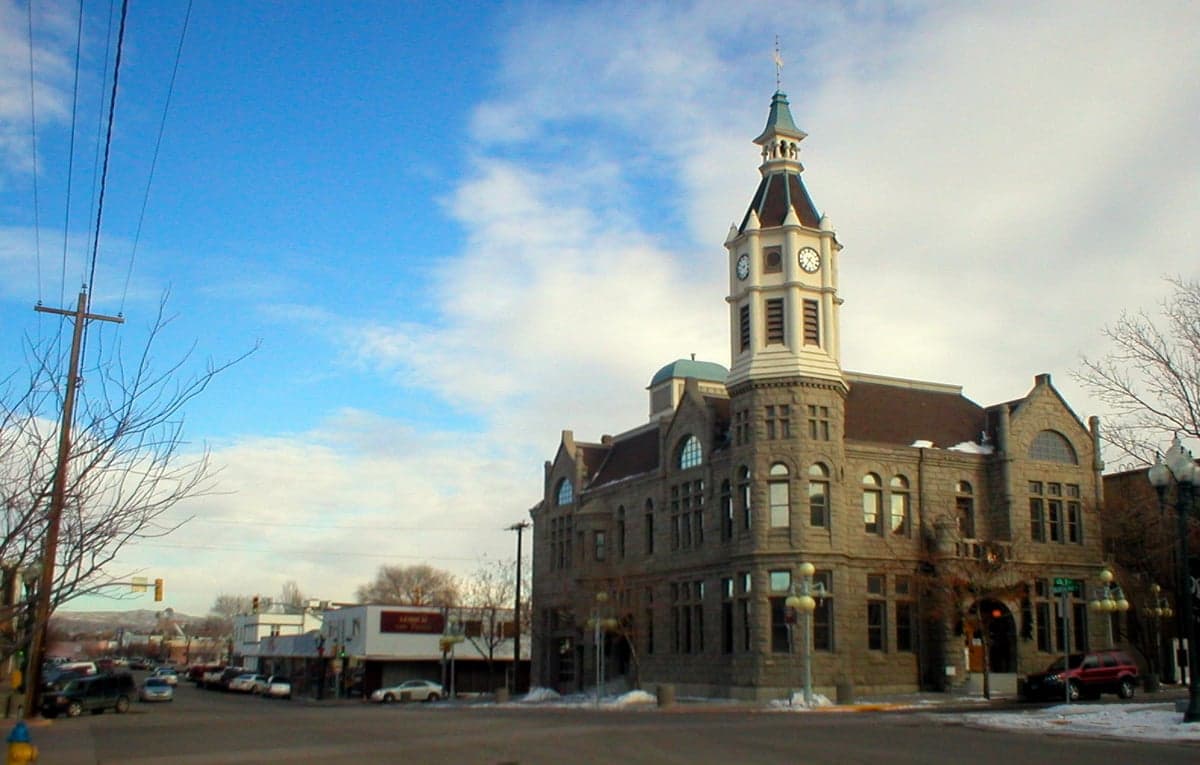
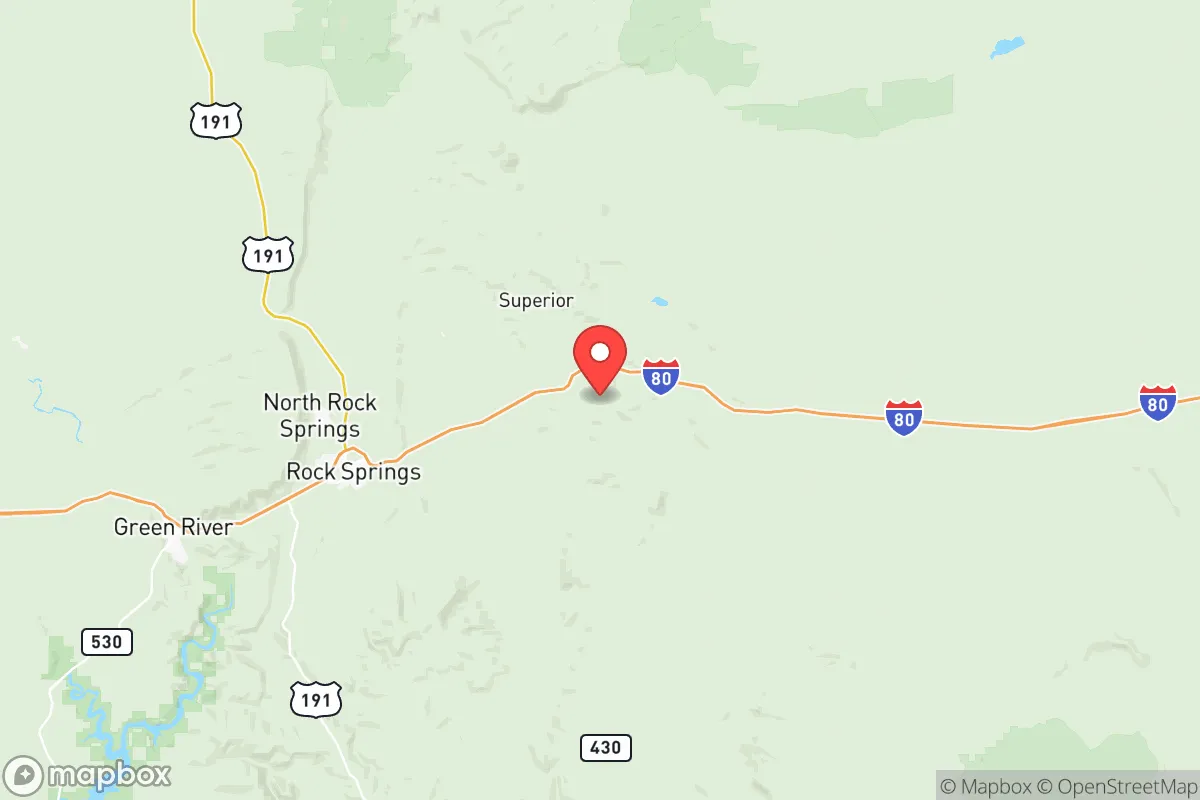
Photo: Wikipedia
Political ClimatePolitical Climate in Sweetwater County
Showing state-level results — no local-only data available.
Local Political AnalysisPolitical Analysis of Sweetwater County
Sweetwater County is a deep-red stronghold in southwestern Wyoming, with a Cook Partisan Voting Index of R+23, making it one of the most reliably Republican counties in the state. This isn't a new development—the area has voted for the GOP presidential candidate by wide margins for decades, though the margins have tightened slightly in recent cycles as the energy economy has shifted. In 2020, Donald Trump carried the county with about 72% of the vote, down from 78% in 2016, a dip driven largely by growing Democratic turnout in Rock Springs and a handful of precincts near the Utah border. The county's political identity is rooted in its extractive industries—coal, trona mining, and oil and gas—where union membership is common but cultural conservatism runs deep.
How it compares
Comparing Sweetwater County to the state of Wyoming as a whole is a bit tricky because the state's Cook PVI isn't formally calculated, but the comparison is still instructive. Wyoming as a whole is R+25, meaning Sweetwater County is slightly less Republican than the statewide average, but still far to the right of the national median. The key difference is internal variation: Wyoming's rural, ranching counties like Sublette and Lincoln are even redder, while Sweetwater's population centers—Rock Springs and Green River—introduce a modest counterweight. Rock Springs, the county seat, has a small but persistent Democratic base, concentrated in precincts around the downtown area and near Western Wyoming Community College. In 2020, these precincts voted for Joe Biden by margins of 5-10 points, a rarity in a county where most precincts went 70-80% for Trump. Green River, the other major town, is more uniformly conservative, with precincts typically voting 75-80% Republican. The swing precincts are in the unincorporated areas along I-80 and near the Jim Bridger Power Plant, where economic anxiety over coal's decline has made voters more receptive to populist messaging from both parties.
What this means for residents
For conservative residents, the political climate is comfortable and affirming. Local offices—county commission, school board, and municipal councils—are dominated by Republicans, and policy debates tend to focus on energy development, property taxes, and Second Amendment rights. The county's Republican Party is active and well-organized, with regular precinct meetings and a strong presence at the state level. For liberal residents, life is more of a balancing act. They are a distinct minority, but not invisible—Rock Springs has a small but vocal Democratic club, and the local chapter of the League of Women Voters is active. Socially, most residents are tolerant of political differences in day-to-day interactions, though open progressive activism is rare outside of a few coffee shops and college events. The practical impact of the county's lean is that state and federal representatives—like Senator John Barrasso and Representative Harriet Hageman—are deeply conservative, and local policy reflects that, from zoning laws that favor mineral extraction to school curricula that emphasize traditional values.
Culturally, Sweetwater County is distinct from the rest of Wyoming in a few ways. The energy industry brings a more transient, working-class population than the ranching communities to the north and east, which gives the area a slightly more pragmatic, less ideological flavor. There's a strong union presence in the mines and plants, which sometimes creates cross-party alliances on issues like worker safety and healthcare. The county also has a notable Hispanic population—around 12%—concentrated in Rock Springs, which adds a layer of cultural diversity that's less common in other parts of the state. Looking ahead, the political trajectory is likely to remain red, but the margin could continue to narrow as the energy transition reshapes the local economy and younger, more diverse residents move in. For now, it's a place where conservative values are the norm, but where a pragmatic, live-and-let-live attitude still prevails in most corners.

State Political ClimatePolitical Climate in Wyoming
State Political AnalysisPolitical Environment in the State
Wyoming is one of the most reliably Republican states in the nation, with a partisan lean that has only deepened over the past two decades. In the 2024 presidential election, Donald Trump carried the state by roughly 46 points, a margin that has grown from about 39 points in 2016 and 37 points in 2008. The dominant coalition is a mix of rural ranchers, energy-sector workers, and conservative-leaning retirees, with the state’s small population—under 600,000—amplifying the influence of its most conservative counties. While Democrats once held a foothold in union-heavy mining towns and the state capital, that presence has eroded significantly, leaving a political landscape where registered Republicans outnumber Democrats by more than 3 to 1.
Urban vs. rural divide
The political map of Wyoming is defined by a stark urban-rural split, though even the “urban” areas are small by national standards. Laramie County, home to the state capital Cheyenne, is the most populous county and leans Republican, but it’s the most competitive ground in the state—Cheyenne itself has a moderate streak, with a mix of state employees, military personnel from F.E. Warren Air Force Base, and a small but active Democratic base. Teton County, anchored by Jackson Hole, is the state’s liberal outlier, driven by a wealthy, outdoorsy, and often out-of-state population; it voted for Hillary Clinton in 2016 and Joe Biden in 2020, making it the only county to flip blue in recent cycles. In contrast, Sublette County and Carbon County are deep red, with Sublette voting over 80% Republican in 2024. The divide is less about cities vs. countryside and more about the energy economy: counties dependent on oil, gas, and coal—like Campbell County (Gillette) and Sweetwater County (Rock Springs)—are the most conservative, while the tourism-driven northwest corner is more purple. The state’s lack of a major metropolitan area means that no single city drives the overall lean; instead, the rural vote in places like Washakie County (Worland) and Fremont County (Lander) consistently overwhelms the small liberal pockets.
Policy environment
Wyoming’s policy environment is shaped by a deep distrust of federal authority and a strong preference for low taxes and limited regulation. The state has no personal or corporate income tax, and sales tax is capped at 4% (with local options pushing it to around 6% in some areas). Property taxes are among the lowest in the nation, with no tax on intangible property like stocks or bonds. The regulatory posture is aggressively pro-energy: the state actively supports coal, oil, and natural gas extraction, and has pushed back against federal methane rules and public lands restrictions. Education policy is locally controlled, with school funding heavily reliant on mineral royalties, though per-pupil spending is below the national average. Healthcare is a mixed bag: the state did not expand Medicaid under the Affordable Care Act, leaving a coverage gap for low-income adults, but telehealth and rural health initiatives are growing. Election laws are straightforward—voter ID is required, same-day registration is not available, and absentee voting is allowed without an excuse. The state has a Republican supermajority in the legislature, and the governor, Mark Gordon (R), has generally aligned with the party’s conservative wing, though he’s shown some independence on budget issues.
Recent policy direction
Wyoming’s recent legislative direction has been toward expanding individual liberties in areas that resonate with conservative relocators, while tightening restrictions in others. On gun and self-defense law, the state is a constitutional carry jurisdiction (permitless carry since 2011), and in 2024 it passed a law prohibiting state enforcement of federal firearm regulations, a direct challenge to ATF rules. Parental and education rights have been a focus: the 2023 “Parents’ Bill of Rights” (SF 117) requires schools to notify parents about curriculum changes and medical services, and a 2024 law bans transgender girls from participating in K-12 girls’ sports. Speech and privacy are protected by a state constitutional amendment that explicitly protects the right to keep and bear arms, but there’s no broad privacy law for digital data. Medical and bodily autonomy is sharply divided: abortion is banned after viability (effectively around 20 weeks) under a 2022 trigger law, with no exceptions for rape or incest, though a 2023 court ruling temporarily blocked enforcement—the issue remains in litigation. Property rights are strongly protected, with a 2022 law (HB 113) requiring compensation for landowners if federal regulations reduce property values by more than 20%. Taxation remains low, but a 2023 bill to phase out the state’s 4% sales tax on groceries failed, so food is still taxed. Voting and ballot access tightened in 2021 with a law requiring a valid ID for all voting, including absentee, and prohibiting ballot drop boxes. The overall direction is toward maximizing personal freedom in economic and gun matters, while restricting it on social issues like abortion and transgender rights.
Civil unrest & political movements
Wyoming has a history of low-level civil unrest tied to federal land management and energy policy. The most visible flashpoint in recent years was the 2014 occupation of the Bureau of Land Management office in Burns by rancher Cliven Bundy’s supporters, though that was more of a Nevada-based movement. In Wyoming, the “sagebrush rebellion” spirit is alive, with local groups like the Wyoming Liberty Group pushing for state control of federal lands. Protests have been small and sporadic: in 2020, Black Lives Matter rallies in Cheyenne and Jackson drew a few hundred participants, while counter-protests by pro-Trump groups were larger. Immigration politics are muted—Wyoming has a tiny foreign-born population (under 3%), and there are no sanctuary cities; the state passed a law in 2019 requiring local law enforcement to cooperate with ICE. Election integrity controversies flared in 2020 and 2022, with the Wyoming GOP passing resolutions questioning the 2020 results, though no major fraud was found. The state’s nullification rhetoric is mostly symbolic: in 2021, the legislature passed a resolution asserting state sovereignty over federal vaccine mandates, but it had no legal force. A new resident would notice that political activism is low-key compared to other states—most people are more concerned with weather and wildlife than protests.
Projection
Over the next 5-10 years, Wyoming’s political trajectory is likely to remain deeply conservative, but with subtle shifts driven by in-migration and demographic change. The influx of remote workers and retirees—especially to Teton County and the Jackson Hole area—is slowly adding a more moderate, environmentally-conscious population, which could make the northwest corner more competitive. However, the state’s overall population is aging and shrinking in rural counties, which reinforces the conservative base. The energy transition away from coal will be a major political fault line: as coal jobs decline in places like Gillette, the state may face pressure to diversify its economy, potentially softening its anti-regulation stance. The legislature’s Republican supermajority is unlikely to crack, but internal divisions between libertarian-leaning “freedom caucus” members and more traditional business conservatives could grow. A relocator moving in now should expect the state to remain a low-tax, gun-friendly, socially conservative environment for the next decade, with the biggest changes coming from the slow erosion of the coal economy and the gradual greening of the tourism corridor.
For a new resident, the bottom line is that Wyoming offers a political environment that is stable, predictable, and overwhelmingly conservative. If you value low taxes, minimal regulation, and strong gun rights, you’ll find a state that actively protects those priorities. If you lean liberal, you’ll be in a small minority, but the state’s small size and live-and-let-live culture mean you won’t face overt hostility—just a lot of lonely voting. The key practical takeaway is that your experience will vary dramatically by location: Jackson is a blue bubble, Cheyenne is a moderate red, and Gillette or Rock Springs are deep red. Choose your town accordingly, and understand that state-level policy will consistently tilt right, regardless of local nuance.
* Values derived from national, state, county, city and local statistics and may differ in a specific area. Last updated: 2026-07-06T23:48:15.000Z
Narrative content on this page is AI-generated and may contain mistakes. Verify any details that matter before acting on them.
ReloMaps may earn a commission from affiliate links at no extra cost to you.

