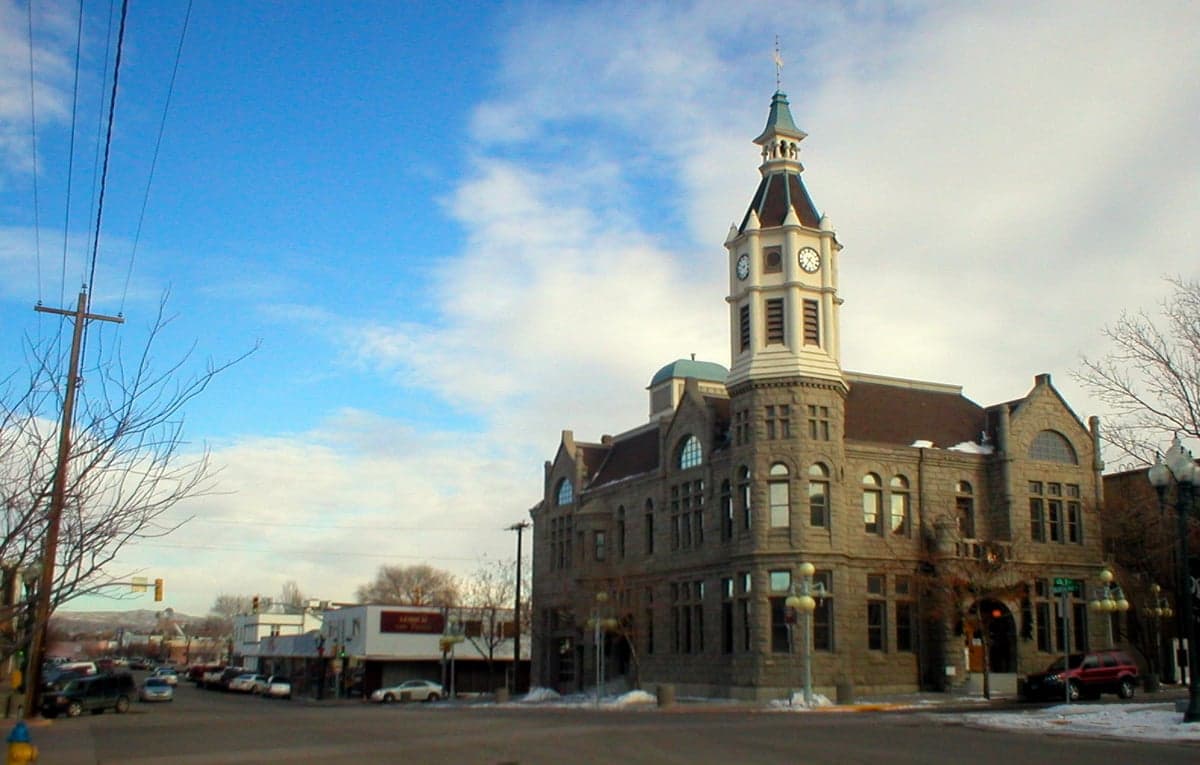
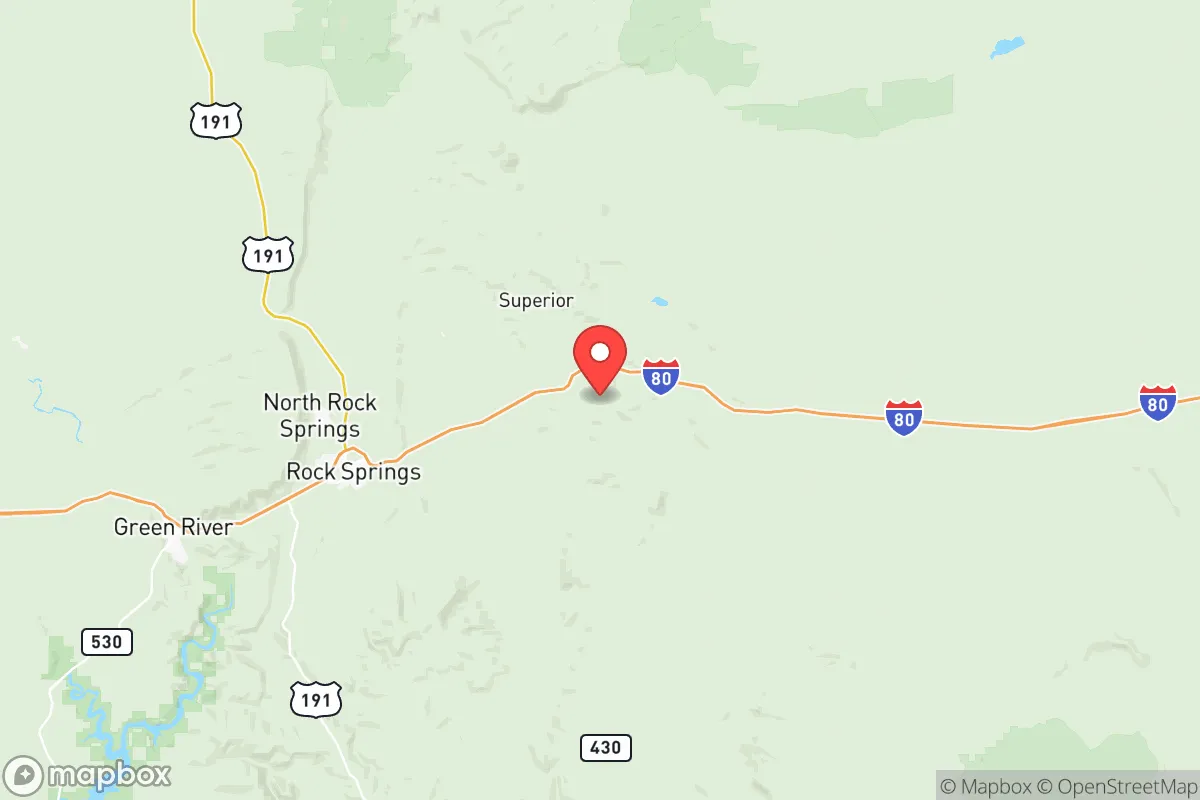
Photo: Wikipedia
Demographics of Sweetwater County
Affluence Level in Sweetwater County
A middle-class area roughly in line with national averages across income, home values, education, and employment.
People of Sweetwater County
Today, Sweetwater County’s 41,786 residents are a predominantly white, working-class population shaped by a century of energy booms and busts, with a growing Hispanic minority that now makes up 16.6% of the county. The population is thinly spread across the high desert of southwestern Wyoming, anchored by the cities of Rock Springs and Green River, where a distinct Western independence and a conservative, resource-driven ethos prevail. With only 20.4% of adults holding a college degree, the county’s identity is rooted in blue-collar labor, outdoor recreation, and a deep-seated skepticism of federal land management. This is a place where the past is never far from the present, and the next chapter is being written by a slowly diversifying, but still overwhelmingly white, populace.
Settlement & growth (pre-1960)
Long before any permanent American settlement, the Shoshone and Ute nations traversed the high plains and river valleys of what is now Sweetwater County, following bison herds and seasonal game. The region’s name itself derives from the Sweetwater River, a tributary of the North Platte, which served as a critical landmark for fur trappers and mountain men in the early 19th century. The first non-Native presence was transient—trappers like Jim Bridger and Jedediah Smith passed through in the 1820s and 1830s, but no permanent settlements took root until the transcontinental railroad arrived.
The true founding wave came with the Union Pacific Railroad in the late 1860s. The railroad pushed westward, establishing coal mines to fuel its steam engines, and the first permanent towns—Rock Springs (founded 1868) and Green River (founded 1868)—were born as railroad division points and coal camps. The railroad actively recruited immigrant labor, creating one of the most ethnically diverse workforces in the Rocky Mountain West at the time. Between 1870 and 1900, waves of Welsh, Irish, Italian, Greek, and Slavic miners arrived, along with a significant number of Chinese laborers who built and maintained the tracks. The Chinese population in Rock Springs was substantial enough that a violent anti-Chinese riot erupted in 1885, driving many out and leaving a lasting scar on the community’s memory. By 1900, the county’s population was a polyglot of European immigrants, with distinct ethnic neighborhoods in Rock Springs—the “Greek Town” and “Italian Town” areas—that persisted for decades.
The early 20th century brought another wave: Japanese immigrants, who arrived to work in the coal mines and on railroad maintenance crews, settling primarily in Rock Springs and the smaller camp of Superior (a company town founded in 1907). The coal industry boomed through World War I and the 1920s, drawing additional workers from the American Midwest and the Dust Bowl states. The Great Depression hit hard, but World War II revived the mines, and the post-war era saw a shift from coal to trona mining—a mineral used in glass and soda ash production—which began in earnest in the 1940s. The town of Point of Rocks, now a ghost town, was a key coal camp that faded as trona took over. By 1960, the county’s population had stabilized around 17,000, overwhelmingly white and native-born, with the European immigrant enclaves slowly assimilating into a broader “Western” identity.
Modern era (post-1965)
The 1965 Hart-Cellar Act had a muted effect on Sweetwater County compared to coastal urban centers. The county’s foreign-born population today stands at just 3.6%, well below the national average. The most significant demographic shift since the 1970s has been the growth of the Hispanic population, driven by domestic migration from the American Southwest and Mexico, drawn by jobs in the trona mines, oil and gas fields, and construction during the energy booms of the 1970s and 2000s. This Hispanic community, now 16.6% of the county, is concentrated in Rock Springs and Green River, with a visible presence in service industries and construction. Unlike the earlier European immigrant waves, this group has maintained a stronger cultural identity, with Spanish-language services and Mexican grocery stores appearing in Rock Springs’ older neighborhoods.
The domestic migration story is more dramatic. The energy crises of the 1970s triggered a massive boom in Sweetwater County, as oil shale, coal, and trona extraction exploded. The population surged from 18,000 in 1970 to over 41,000 by 1980, as workers from the Rust Belt, Texas, and Oklahoma flooded in. This boom-and-bust cycle repeated in the 2000s with the natural gas boom, drawing workers from the Bakken oil fields of North Dakota and the Permian Basin of Texas. The county’s Black population remains tiny at 1.1%, largely concentrated in Rock Springs and tied to transient energy-sector employment. East/Southeast Asian communities (0.5%) are a small but stable presence, mostly in Rock Springs, with roots in the earlier Japanese and Chinese populations. The Indian (subcontinent) population is negligible at 0.1%.
Suburbanization has been limited by the county’s geography and economy. The primary residential growth has been in the White Mountain area north of Rock Springs, a newer subdivision of single-family homes built during the 2000s boom, and in the South Green River area, where newer housing developments cater to trona mine workers. The county’s small towns—Wamsutter (a natural gas hub), Farson (a ranching community), and Bairoil (a trona mining town)—remain overwhelmingly white and older, with little demographic change.
The future
Sweetwater County’s population is projected to remain stable or decline slightly over the next decade, as the energy sector faces long-term uncertainty from decarbonization and automation. The county is becoming slightly more diverse, driven by the Hispanic population’s higher birth rates and continued migration for construction and service jobs. The white population, which is 77.2% today, is aging and shrinking, while the Hispanic share is expected to approach 20% by 2035. The East/Southeast Asian and Black populations are likely to remain small, as the county lacks the urban amenities and diversity infrastructure that attract these groups. New communities are not forming distinct enclaves; instead, Hispanic families are dispersing into existing neighborhoods in Rock Springs and Green River, gradually integrating into the broader working-class culture.
The cultural identity is evolving slowly. The old European ethnic identities—Welsh, Italian, Greek—have largely faded into a generic Western conservatism. The Hispanic community is increasingly visible in local politics and business, but the county remains a deeply conservative, Republican stronghold. The next 10-20 years will likely see a continuation of the boom-bust cycle, with population tied to global commodity prices. If trona mining remains viable and natural gas finds new markets, the county may hold steady. If not, out-migration could accelerate, leaving an older, whiter, and poorer population.
For someone moving in now, Sweetwater County offers a stable, low-cost, and safe environment with a strong sense of community, but it is not a place of rapid demographic change or cultural dynamism. The people here are resilient, independent, and shaped by the land and the mines. The future is uncertain, but the character—hardworking, conservative, and rooted in the high desert—is likely to endure.

* Values derived from national, state, county, city and local statistics and may differ in a specific area. Last updated: 2026-07-06T23:48:15.000Z
Narrative content on this page is AI-generated and may contain mistakes. Verify any details that matter before acting on them.
ReloMaps may earn a commission from affiliate links at no extra cost to you.

