
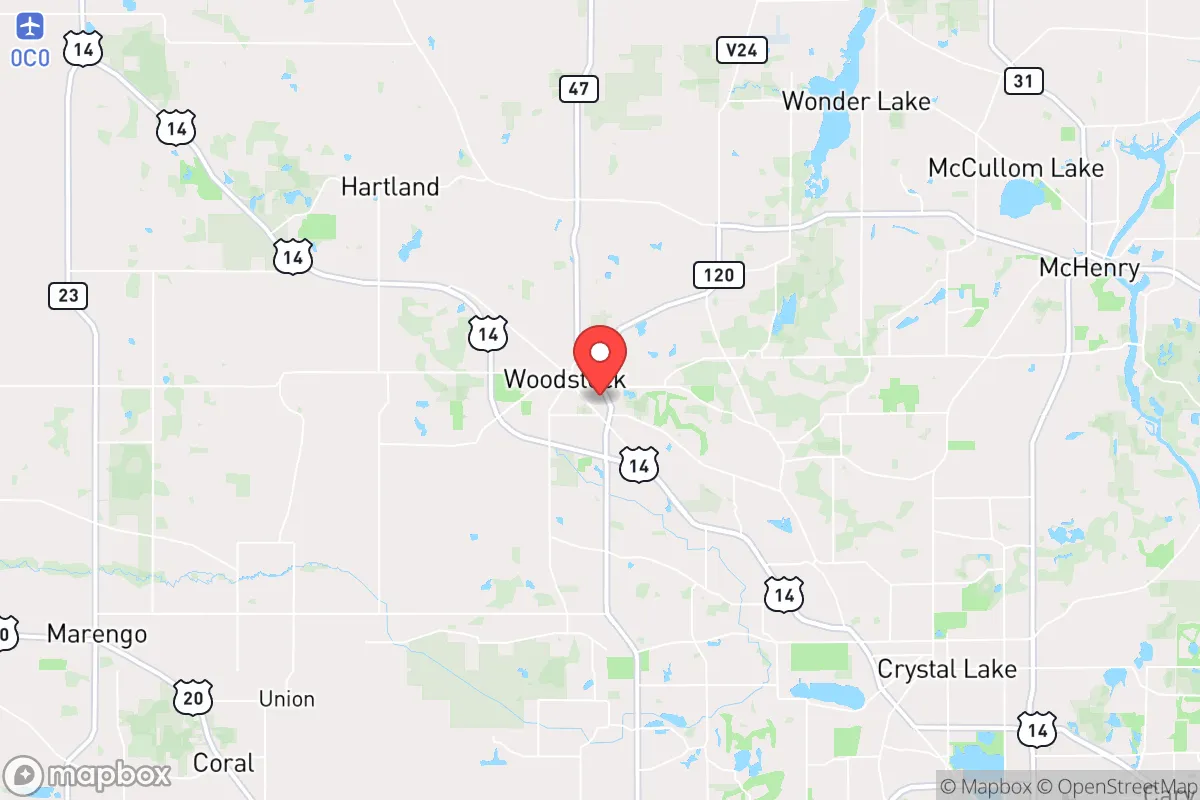
Photo: Wikipedia
Personal Sovereignty in Woodstock, IL
Viable for self-reliance. Generally workable, though some barriers may limit total independence.
What does Personal Sovereignty tell us?
Personal Sovereignty measures your capacity for self-reliance and independence with minimal government friction. Higher scores mean fewer barriers between you and the way you want to live... but it assumes you have the space you need and good neighbors.
What does this tell us?
Personal Sovereignty measures your capacity for self-reliance and independence with minimal government friction. Higher scores mean fewer barriers between you and the way you want to live... but it assumes you have the space you need and good neighbors.
State Policy
Energy independence: Importer (45% of energy produced in-state)
Personal Liberty
Homesteading

Personal Liberty Analysis
Woodstock, Illinois, offers a personal sovereignty environment that is a study in contrasts: the state of Illinois imposes some of the nation's highest tax burdens and most restrictive gun laws, yet McHenry County—where Woodstock sits—provides a notably more conservative, hands-off local culture that pushes back against state overreach. For a relocation-minded individual or family prioritizing autonomy, the key question is whether the county's local ethos can sufficiently offset the state-level constraints. The answer depends heavily on which freedoms you value most—taxes, self-defense, or the ability to live self-sufficiently on your own land.
Tax burden and regulatory posture in McHenry County
Illinois ranks among the highest in the nation for combined state and local tax burden, and Woodstock residents feel this acutely. The state's flat income tax rate of 4.95% is paired with a sales tax rate in McHenry County that totals 7.25% (state 6.25% plus county 1.0%). Property taxes are the real weight: McHenry County's effective property tax rate averages around 2.2% of assessed home value, one of the highest in the U.S. For a $350,000 home, that's roughly $7,700 annually—a figure that directly impacts household sovereignty by reducing disposable income and savings capacity. However, the local regulatory posture is markedly lighter than in Cook County or Chicago. McHenry County government is known for a pro-business, limited-government approach: zoning variances are handled pragmatically, building permits are processed efficiently, and there is no county-level assault weapons ban or local rent control. The county board has consistently opposed state-level mandates on everything from energy codes to firearm restrictions. For a reader weighing tax burden, the trade-off is clear: you pay high property taxes, but you get a local government that largely stays out of your way on day-to-day property use and business operations.
Self-defense and gun law specifics in Illinois
Illinois is a shall-issue state for concealed carry, but the process is among the most onerous in the Midwest. To obtain a Firearm Owner's Identification (FOID) card and a Concealed Carry License (CCL), residents must complete 16 hours of certified training, pass a live-fire qualification, submit fingerprints (optional but speeds processing), and pay combined fees exceeding $300. The state also maintains a registry of FOID cardholders, and private firearm transfers must go through a licensed dealer (background check required). McHenry County's sheriff and local law enforcement are notably pro-Second Amendment: the sheriff's office processes CCL applications efficiently, and the county has been a vocal opponent of the 2023 state ban on "assault weapons" and high-capacity magazines. Woodstock itself has no local ordinances restricting firearm possession beyond state law. For the self-defense-minded individual, the practical reality is that carrying a concealed handgun in Woodstock is legal but administratively burdensome. The state ban on certain semi-automatic rifles (including AR-15s) and magazines over 10 rounds (rifle) or 15 rounds (handgun) is in effect countywide, though enforcement varies and legal challenges continue. Home defense with a handgun or shotgun remains fully legal. The local culture strongly supports the right to self-defense, but the state framework imposes significant friction.
Self-reliance and homesteading viability in Woodstock
Woodstock's zoning and land-use policies offer genuine opportunities for self-reliance, especially compared to denser suburbs. The city's zoning code allows for backyard chickens, beekeeping, and small-scale livestock on lots as small as one-quarter acre, with a permit. Larger parcels—common in the surrounding unincorporated areas of McHenry County—can support goats, sheep, and even horses under agricultural zoning. Minimum lot sizes in the county's rural districts start at 1 acre, with many properties ranging from 2 to 10 acres. Off-grid feasibility is limited by state building codes: all habitable structures must be connected to the electrical grid or have an approved alternative (solar with battery storage is permitted, but net metering rules apply). Rainwater collection is legal for outdoor use, but potable water must come from a well or municipal supply. Composting toilets are allowed with a septic system permit. The county's building department is known for being reasonable—inspections are thorough but not punitive. For a family wanting to grow a substantial garden, keep laying hens, and reduce reliance on grocery stores, Woodstock's rural-urban fringe is viable. The local farmers' market and strong agricultural extension office (University of Illinois) provide resources. The main constraint is the property tax burden, which makes large-acreage homesteading expensive to hold long-term.
Personal liberties: parental rights, medical autonomy, speech, and property
Illinois law is generally protective of parental rights in education: parents have the right to review curriculum, opt children out of sex education, and access school records. McHenry County school districts (Woodstock Community Unit School District 200, among others) have been responsive to parental concerns, with school boards that lean conservative and have resisted state-level pushes on critical race theory and gender identity policies. Medical autonomy is more constrained: Illinois has broad vaccine mandates for school attendance (including COVID-19 for K-12 during the emergency period, though now lapsed), and the state's Reproductive Health Act (2019) enshrines a right to abortion that some conservative families find objectionable. There is no state-level religious exemption for vaccine requirements, though medical exemptions are available. Free speech is robustly protected in public spaces; Woodstock's historic square is a common venue for political demonstrations and religious expression. Property rights are strong at the county level: McHenry County has no countywide rent control, no inclusionary zoning mandates, and no short-term rental bans (though Woodstock city limits have some Airbnb regulations). The state's eminent domain authority is limited to public projects with just compensation, and the county has not pursued aggressive land-use controls. For a family prioritizing parental control over education and medical decisions, Woodstock offers a local environment that respects those choices, even as state law creates some friction.
Overall, Woodstock presents a sovereignty profile that is best described as "high local autonomy within a high-tax, moderate-restriction state." Compared to areas like rural Texas or Florida, the tax burden and gun laws are significantly heavier. But compared to Cook County or the West Coast, McHenry County offers a much lighter touch on property use, homeschooling, and local governance. For the relocation-minded conservative, Woodstock is a viable choice if you are willing to pay for local freedom—the property taxes fund well-regarded schools and infrastructure, and the county's political culture actively resists further state encroachment. The key is understanding that personal sovereignty here is not absolute; it is a negotiated balance between state-level mandates and a county that consistently votes to minimize their impact.

* Values derived from national, state, county, city and local statistics and may differ in a specific area. Last updated: 2026-09-03T21:01:44.000Z
Narrative content on this page is AI-generated and may contain mistakes. Verify any details that matter before acting on them.
ReloMaps may earn a commission from affiliate links at no extra cost to you.

