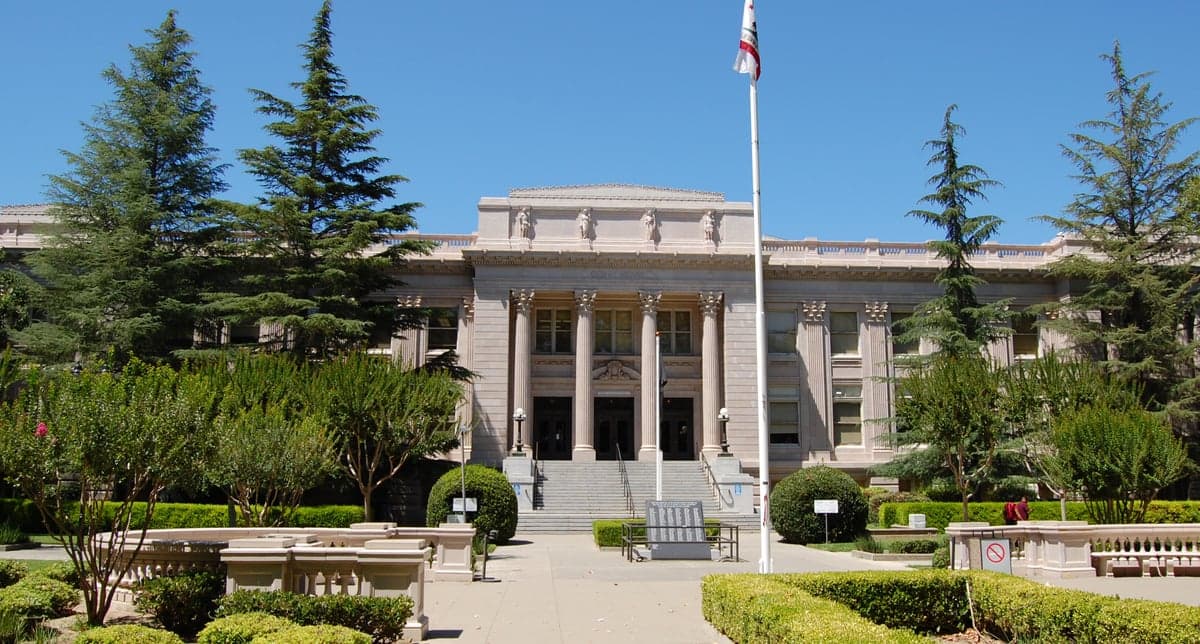
Photo: Wikipedia
Political ClimatePolitical Climate in Woodland, CA
District shown is the primary district for this city’s centroid. Cities may span multiple districts.
Inherited from parent county — no local data available.
* Lean and PVI are calculated from the surrounding county’s 2020 and 2024 presidential results, Cook-style — a finer measure here than its congressional district (CA-4).
Political rankings in California
- Most Conservative Cities in California
- Most Liberal Cities in California
- Best Conservative-Leaning Towns on the West Coast
- Affordable Small Towns for Conservatives
- Most Affordable Liberal-Leaning Small Towns in the U.S.
- Safest Liberal-Leaning Cities in the U.S.
- Most Conservative Counties in California
- Most Liberal Counties in California
Local Political AnalysisPolitical Analysis of Woodland, CA
Woodland, California, is a reliably Democratic stronghold in Yolo County, with a Cook Partisan Voting Index (PVI) of D+19, meaning it votes about 19 points more Democratic than the national average. This lean has been consistent for decades, driven by a mix of agricultural workers, university-affiliated professionals from nearby UC Davis, and a growing Latino population that tends to favor progressive candidates. The city has trended slightly more Democratic since 2016, mirroring the broader shift in California’s Central Valley suburbs, though it remains more moderate than the ultra-progressive enclaves of Berkeley or San Francisco.
How it compares
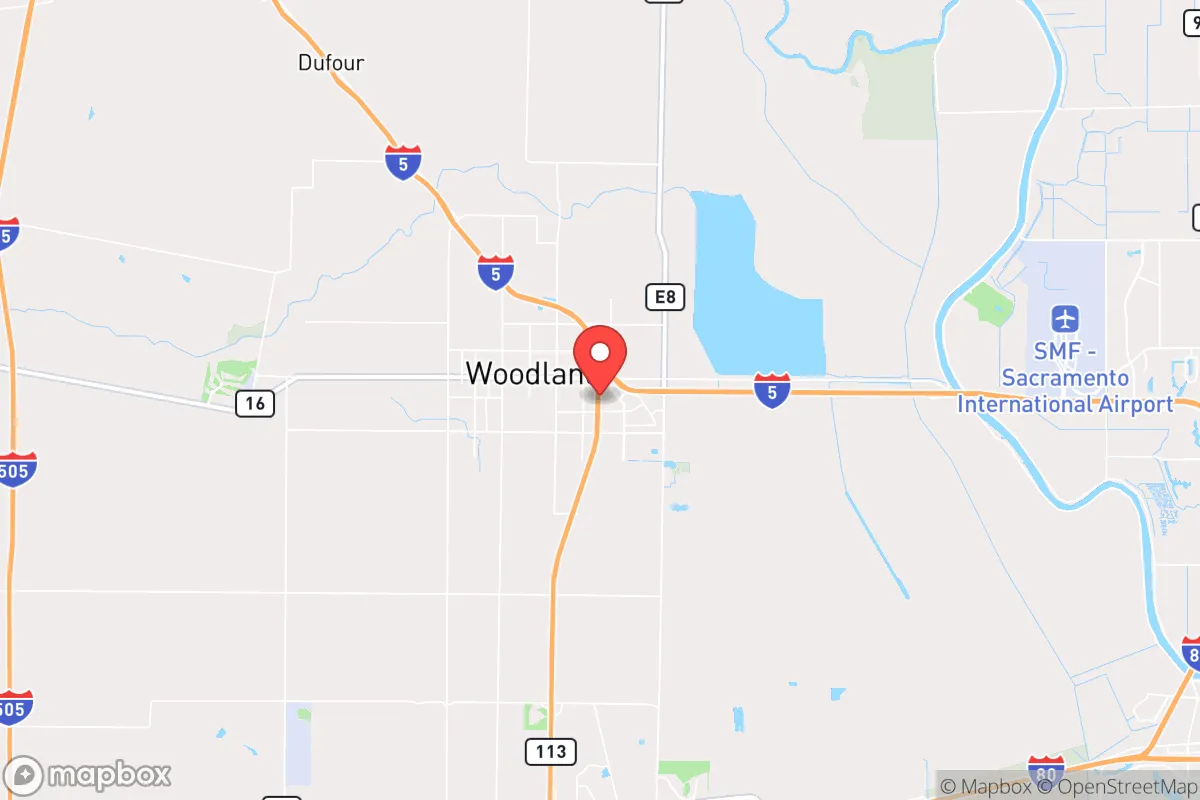
Woodland’s D+19 rating places it firmly to the left of most of California’s Central Valley, where many rural and exurban areas lean Republican. For example, just 15 miles north, the city of Yuba City is in Sutter County, which voted +15 Republican in the 2024 presidential election, while Woodland’s own Yolo County voted +30 Democratic. The contrast is stark: drive 20 minutes east to the town of Dunnigan, and you’ll find Trump signs still dotting farm fences, while Woodland’s downtown has “Hate Has No Home Here” banners in English and Spanish. Compared to California as a whole—which has a statewide PVI of roughly D+13—Woodland is about 6 points more Democratic, reflecting its status as a college-adjacent, union-heavy community. The state’s overall PVI is unknown in official Cook reports, but historical voting patterns show California leans D+13 to D+15, making Woodland slightly more progressive than the average Golden State city.
What this means for residents
For liberal residents, Woodland offers a comfortable environment where local policies align with their values—city council meetings routinely discuss affordable housing initiatives, climate resilience plans, and immigrant protections. The city’s sanctuary ordinance, passed in 2017, means local police don’t cooperate with federal immigration enforcement, a practical reality for the many farmworker families in the area. Conservative residents, however, aren’t silenced or isolated. You’ll find a vocal minority at county board meetings, especially on issues like water rights and property taxes, and the Yolo County Republican Party maintains a small but active presence. In practice, the D+19 lean means that Democratic candidates win most local races by 10-20 points, but Republicans can still win seats in more rural parts of the county, like the town of Esparto. The political climate is less intense than in Sacramento (15 miles south), where partisan clashes are louder; Woodland feels more like a place where neighbors disagree without hostility, at least for now.
A key cultural distinction is Woodland’s agricultural identity, which tempers some of the progressive impulses seen in coastal California. The city’s economy relies heavily on tomato and almond farming, so even liberal residents tend to support pragmatic water policies and oppose extreme environmental regulations that could hurt local jobs. This creates a unique blend: a Democratic stronghold that votes for higher taxes for schools but pushes back on bans on gas-powered farm equipment. If you’re moving here, expect a community where politics matter less than whether your kid’s soccer team wins or the tamale stand on Main Street is open. The trajectory is likely to stay D+19 or shift slightly left as UC Davis expands its influence, but don’t expect Woodland to become Berkeley anytime soon—the farm roots run too deep.

State Political ClimatePolitical Climate in California
State Political AnalysisPolitical Environment in the State
California is a deeply blue state where Democrats hold every statewide office and supermajorities in both legislative chambers, but its reputation as a monolithic liberal stronghold overshadows a far more complex reality. The state hasn't voted Republican in a presidential race since George W. Bush in 2004, and the Democratic share of the vote has crept from about 55% in 2008 to over 60% in 2024. However, that top-line number masks a 20-year trajectory where the state's political center of gravity has shifted—not leftward uniformly, but toward a coastal, urban, and college-educated coalition that has grown increasingly estranged from the vast interior and the Central Valley.
Urban vs. rural divide
The political map of California is essentially a tale of two states. The coastal metros—Los Angeles, the San Francisco Bay Area, San Diego, and Sacramento—generate the vast majority of Democratic votes. Los Angeles County alone casts about a quarter of the state's ballots and reliably goes +30 to +40 points Democratic. The Bay Area is even more lopsided: San Francisco County votes about +70 Democratic, while Santa Clara County (San Jose) runs about +40. These regions are powered by tech, entertainment, and professional services economies that attract a highly educated, socially liberal workforce. In contrast, the Central Valley—places like Bakersfield, Fresno, and Modesto—votes reliably Republican, often by double digits. The same goes for most of the inland mountain and desert counties: El Dorado County (east of Sacramento) voted +12 Republican in 2024, while Shasta County (Redding) went +30 Republican. The Inland Empire, including Riverside and San Bernardino, has been a genuine battleground—these counties voted for Obama in 2008 and 2012, then flipped to Trump in 2016 and 2020, and stayed narrowly Republican in 2024. That flip is one of the most telling shifts in the state: working-class Latino and white voters in these exurban communities have moved right on economic and cultural issues, even as the coastal core has hardened its progressive identity.
Policy environment
California's policy environment is defined by high taxes, heavy regulation, and a robust social safety net. The state has a progressive income tax with a top marginal rate of 13.3% (the highest in the nation), a state sales tax that averages around 8.5% with local add-ons, and property taxes capped at 1% of assessed value under Proposition 13 (though reassessment on sale can be steep). The regulatory posture is famously strict: California sets its own vehicle emissions standards (followed by over a dozen other states), has the nation's most aggressive climate change laws (SB 32, AB 398), and mandates a $16.00 minimum wage (rising with inflation). Education policy leans heavily into public school funding—California spends about $23,000 per pupil, among the highest in the nation—but outcomes are middling, with only about half of students proficient in reading and math. Healthcare is near-universal through Medi-Cal expansion (covering about one-third of the state's population) and a robust individual mandate. Election laws are among the most accessible in the country: universal mail-in voting (every registered voter gets a ballot), same-day registration, and automatic voter registration at the DMV. For a conservative relocator, the practical takeaway is that California's policy environment is designed to maximize government services and environmental protection, which comes with a high cost of living and a thicket of compliance requirements for businesses and homeowners.
Recent policy direction
Over the past five years, California has accelerated its progressive agenda across multiple fronts. On gun and self-defense law, the state has passed some of the nation's strictest measures: SB 2 (2023) bans carrying firearms in most public places, including parks and hospitals, and requires a "good cause" permit standard that effectively eliminates concealed carry for most people. AB 1598 (2024) further restricted firearm purchases. On parental and education rights, AB 1955 (2024) prohibits school districts from requiring parental notification when a child changes their gender identity, a direct response to conservative school board movements. On speech and privacy, the California Age-Appropriate Design Code (AB 2273) imposes strict data privacy rules on platforms used by minors, while AB 587 (2023) requires social media companies to report their content moderation policies—a transparency measure that critics call compelled speech. On medical and bodily autonomy, California has become a "sanctuary state" for abortion access (SB 245, 2022, eliminates cost-sharing for abortions) and gender-affirming care (AB 2098, 2022, protects providers from out-of-state lawsuits). On property rights, rent control was tightened under AB 1482 (2019), capping annual rent increases at 5% plus inflation, and the state has aggressively pursued housing mandates (SB 9, 2021, allows duplexes on single-family lots). On taxation, Proposition 19 (2020) eliminated the parent-child property tax transfer exemption for non-primary residences, increasing tax burdens on inherited property. On voting and ballot access, AB 1802 (2023) expanded mail-in ballot drop boxes and prohibited voter ID requirements. For a relocator weighing liberties, the direction is clear: California is expanding government regulation of firearms, parental rights, and property, while maximizing personal autonomy on medical decisions and voting access.
Civil unrest & political movements
California has been a flashpoint for political movements on both sides. The 2020 George Floyd protests in Los Angeles and Oakland were among the largest and most destructive in the nation, with property damage exceeding $1 billion in Los Angeles alone. The "defund the police" movement had real policy impact: Los Angeles cut $150 million from the LAPD budget in 2020 (though most was later restored), and Oakland reduced its police force by about 10%. On the right, the "Recall Gavin Newsom" movement in 2021 gathered over 1.7 million signatures and came within 4 points of ousting the governor—a sign of deep dissatisfaction in the Central Valley and inland counties. Immigration politics are a constant flashpoint: California is a "sanctuary state" under SB 54 (2017), which limits local law enforcement cooperation with federal immigration authorities. This has led to ongoing tensions with the Trump administration and periodic standoffs in cities like San Francisco and Los Angeles, where ICE operations are publicly protested. Secession rhetoric is mostly a fringe phenomenon—the "Calexit" movement failed to get on the ballot in 2018—but the "State of Jefferson" movement in far northern counties (Shasta, Siskiyou, Modoc) continues to advocate for splitting off into a separate, more conservative state. Election integrity controversies have been less intense than in swing states, but the 2020 and 2024 elections saw scattered protests at county election offices in Orange County and San Diego, where Republican activists challenged ballot drop box security. A new resident would notice the political polarization most visibly in bumper stickers, yard signs, and the stark contrast between coastal and inland news coverage.
Projection
Over the next 5-10 years, California's political trajectory points toward a continued consolidation of Democratic power at the state level, but with growing internal fractures. Demographic trends are working against the coastal progressive coalition: the state's population has declined for three consecutive years (2020-2023), driven by out-migration of lower-income and middle-class families to Texas, Arizona, and Nevada. Those leaving tend to be more moderate or conservative, while the state continues to attract highly educated, left-leaning immigrants from abroad and from other states. This self-selection will likely make the state's politics even more lopsided in presidential elections—think +65 Democratic by 2032—but it also creates a growing tension between the coastal elite and the remaining working-class population in the Central Valley and Inland Empire. The housing crisis is the wild card: if the state's aggressive housing mandates (SB 9, SB 10) actually produce significant new construction in suburban and rural areas, it could bring in new residents who shift local politics. But if the cost of living continues to squeeze out the middle class, the state could become a "blue island" of wealthy progressives surrounded by a red interior that feels increasingly disenfranchised. For someone moving in now, expect to see the same basic policy direction—higher taxes, stricter gun laws, expanded social services—but with more internal conflict over housing, water, and energy policy as the state tries to balance environmental goals with economic reality.
For a new resident, the bottom line is that California offers a predictable political environment if you align with the coastal progressive consensus, but a frustrating one if you don't. Conservatives will find their votes largely irrelevant in statewide elections, but they can still find like-minded communities in places like Bakersfield, Huntington Beach (Orange County's conservative beach town), or the Sierra foothills around Placerville. The practical trade-offs are clear: you get world-class natural beauty, a dynamic economy, and strong legal protections for personal medical choices, but you pay for it with the highest taxes in the nation, a heavy regulatory hand in daily life, and a political culture that can feel hostile to traditional values. If you're moving for a job or family, the politics are manageable—just know that your vote for president won't matter, but your local school board and city council races might be surprisingly competitive.
* Values derived from national, state, county, city and local statistics and may differ in a specific area. Last updated: 2026-11-25T15:38:32.000Z
Narrative content on this page is AI-generated and may contain mistakes. Verify any details that matter before acting on them.
ReloMaps may earn a commission from affiliate links at no extra cost to you.

