Photo: Wikipedia
Demographics of Woodland, CA
Affluence Level in Woodland, CA
A middle-class area roughly in line with national averages across income, home values, education, and employment.
People of Woodland, CA
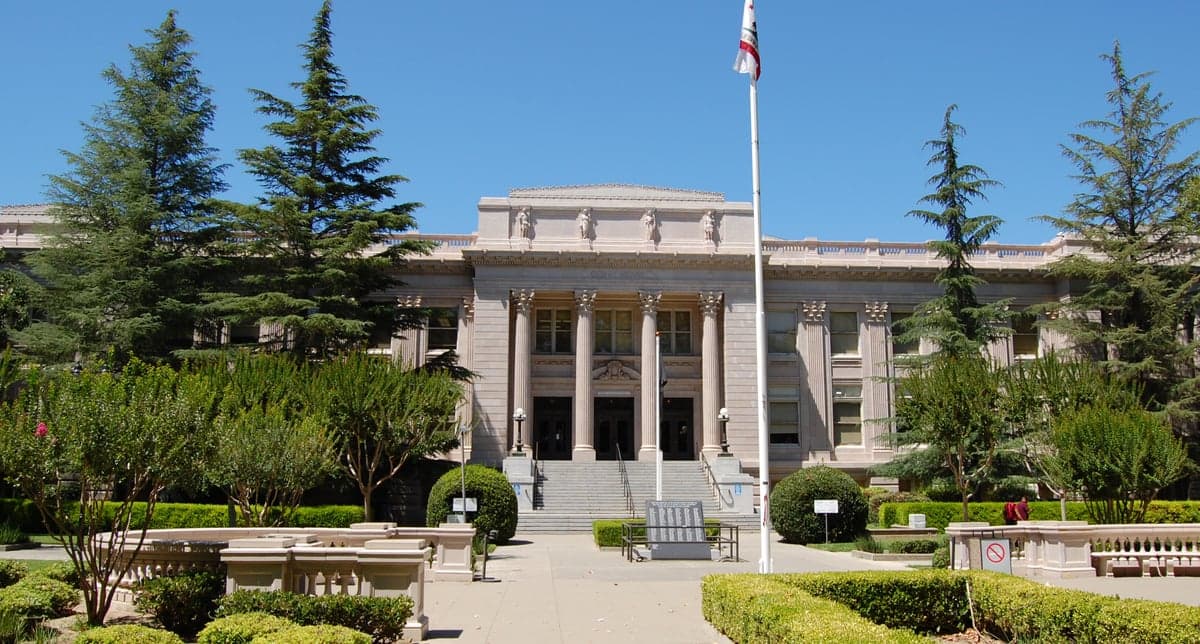
The people of Woodland, California today form a majority-Hispanic community of 61,256 residents, with a distinctive blend of long-standing agricultural roots and newer professional and commuter populations. The city’s character is shaped by its role as the Yolo County seat, a position that brings a stable government-employee base, and by its proximity to Sacramento, which draws white-collar workers seeking more affordable housing. With a foreign-born share of 9.1% and a college attainment rate of 30.2%, Woodland is less diverse and less educated than the Sacramento metro average, but it retains a strong sense of local identity rooted in its farming and ranching heritage.
How the city was settled and grew
Woodland’s population history begins with the Patwin people, who inhabited the banks of Cache Creek for centuries before European contact. The first permanent non-Native settlers arrived in the 1850s, drawn by the Mexican land grant of Rancho Rio de los Putos and the promise of fertile soil for wheat and barley. By 1861, the California Pacific Railroad reached the area, and the town was formally platted in 1870. The original Anglo-American settlers—largely from the Midwest and the East Coast—built their homes in what is now the Woodland Historic District, a grid of Victorian and Craftsman houses centered on Main Street and Court Street. These early residents were merchants, lawyers, and farmers who established the county seat in 1862, cementing Woodland’s role as a regional administrative hub.
Through the early 20th century, the population grew slowly, reaching about 5,000 by 1920. The Bracero Program (1942–1964) brought the first significant wave of Mexican laborers to work the tomato, rice, and almond fields surrounding the city. These workers settled in the Southwood neighborhood, a working-class area south of Main Street that became the city’s first Hispanic enclave. By 1960, Woodland’s population had climbed to 13,000, with a white majority of roughly 85% and a Hispanic share of about 12%.
Modern era (post-1965)
The 1965 Hart-Cellar Act ended the Bracero Program and opened family-based immigration from Mexico, dramatically reshaping Woodland’s demographics. Between 1970 and 2000, the Hispanic share of the population rose from 15% to 45%, driven by both direct immigration and the natural growth of established families. These newer arrivals concentrated in the Elkhorn Village area, a cluster of post-war tract homes and apartment complexes near the intersection of County Road 102 and Gibson Road, and in the West Woodland district west of Highway 113, where affordable housing stock attracted young families. Meanwhile, the city’s white population began a slow suburban drift eastward into the East Woodland neighborhoods around Pioneer High School, where larger lots and newer construction appealed to commuters working in Sacramento and Davis.
Domestic in-migration from the Bay Area accelerated after 2000, as rising housing costs pushed families into the Sacramento Valley. This wave brought a modest increase in Asian (East/Southeast Asian) residents, now at 3.9%, and Indian-subcontinent residents, now at 4.1%, who settled primarily in the newer subdivisions of Spring Lake and Evergreen on the city’s northern edge. The Black population remains small at 1.7%, concentrated in the older central neighborhoods near the historic downtown. Today, Woodland is 49.7% Hispanic, 34.8% white, and 8% Asian and Indian combined—a shift from a predominantly white agricultural town to a majority-minority city with a strong Mexican-American cultural core.
The future
Woodland’s population is projected to grow to roughly 75,000 by 2040, driven by continued spillover from the Sacramento metro and by new housing developments on the city’s northern and western edges. The Hispanic share is expected to stabilize or increase slightly, as the existing community is younger (median age 33) and has higher fertility rates than the white population. The Asian and Indian shares are likely to grow modestly, as the Spring Lake and Evergreen areas attract tech and healthcare workers priced out of Davis and Sacramento. The white share will continue to decline, though the absolute number of white residents may hold steady due to in-migration from the Bay Area. The city’s cultural identity is evolving from a quiet farm town into a more diverse, commuter-oriented suburb, but the agricultural economy—and the seasonal labor force that supports it—remains a defining feature. Newcomers will find a community where Spanish is heard as often as English in grocery stores and schools, and where the annual Stroll Through History event celebrates the city’s Victorian past even as its future becomes increasingly Latino.
For someone moving in now, Woodland offers a middle ground: a slower-paced, family-oriented city with a strong sense of place, affordable housing relative to the Sacramento region, and a population that is becoming more diverse and more connected to the broader metro economy. The city is not a boomtown, but it is a steady, growing community where the old agricultural roots and the new commuter culture are gradually blending into a distinct Yolo County identity.

* Values derived from national, state, county, city and local statistics and may differ in a specific area. Last updated: 2026-11-25T15:38:32.000Z
Narrative content on this page is AI-generated and may contain mistakes. Verify any details that matter before acting on them.
ReloMaps may earn a commission from affiliate links at no extra cost to you.

