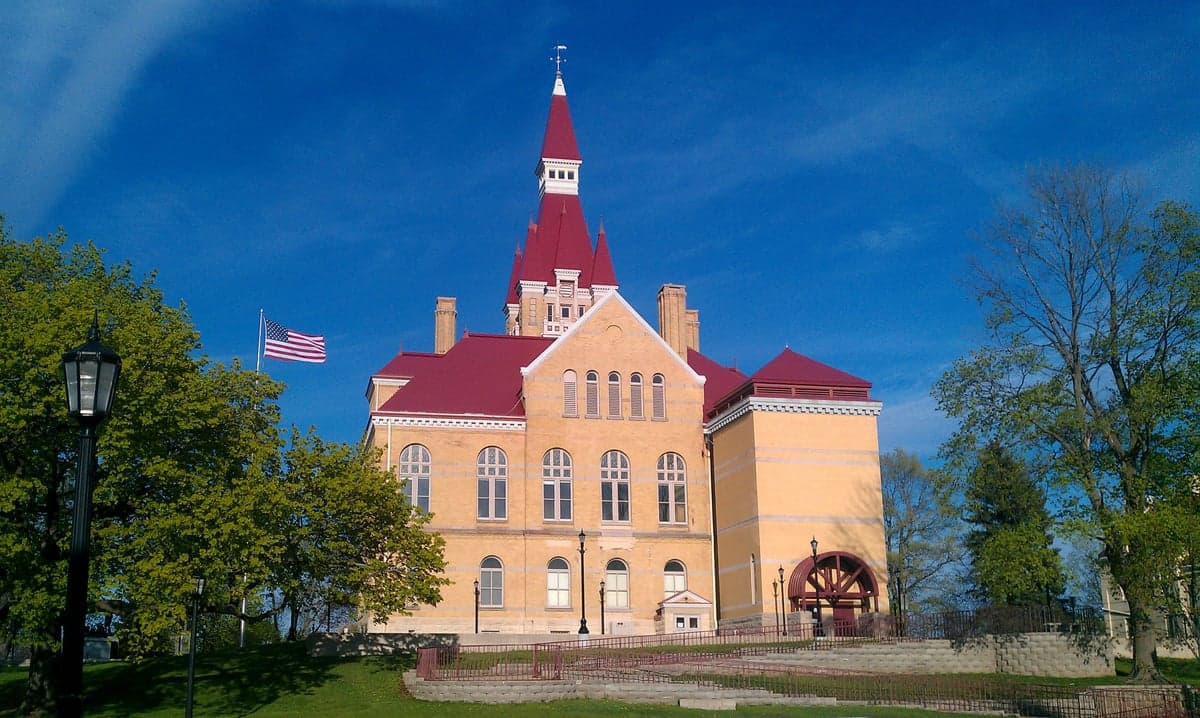
Photo: Wikipedia
Political ClimatePolitical Climate in Washington County
Showing district-level results — no local-only data available.
Local Political AnalysisPolitical Analysis of Washington County
Washington County, Wisconsin, is one of the most reliably Republican corners of the state, carrying a Cook Partisan Voting Index of R+11. That’s a solid 11 points more conservative than the nation as a whole, and a stark contrast to the statewide Wisconsin PVI of EVEN. The county hasn’t voted for a Democratic presidential candidate since Lyndon Johnson in 1964, and the margin has only widened since 2016. In 2024, Donald Trump carried Washington County by roughly 25 points, a shift that reflects a deeper cultural and political realignment happening in the suburban and exurban rings around Milwaukee.
How it compares
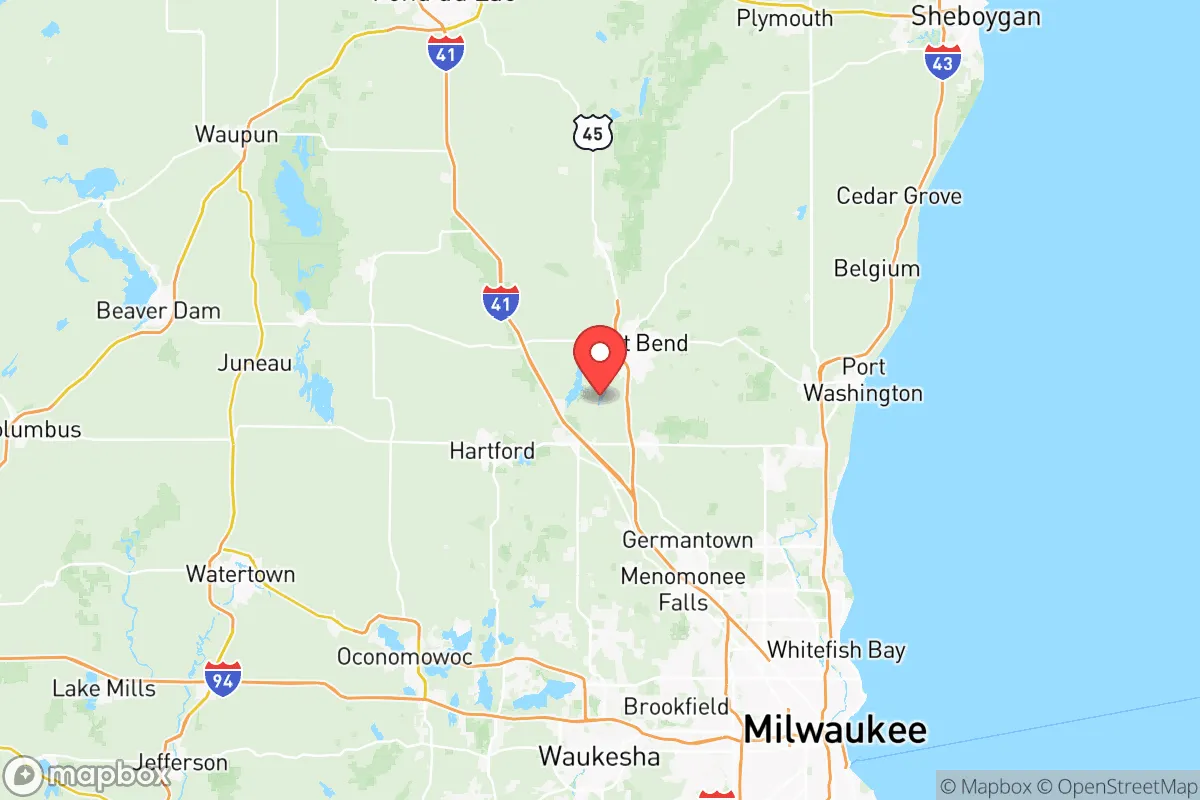
To understand how Washington County differs from the rest of Wisconsin, look at the map. The state as a whole is a perfect toss-up — EVEN — because Milwaukee and Madison generate huge Democratic margins while the rural north and western counties lean red. Washington County, by contrast, is a deep red anchor in the southeastern part of the state. It’s not a swing county; it’s a base. The closest comparison is Waukesha County to the south (R+14), but Washington County is more rural and less affluent. Within the county itself, there’s variation. The city of West Bend, the county seat, is reliably conservative but has a small cluster of Democratic-leaning precincts near the downtown and the UW–Washington County campus. The village of Germantown, which borders Milwaukee County, is slightly more moderate — still red, but with a visible minority of Democratic voters. Meanwhile, towns like Hartford, Slinger, and Kewaskum are deeply conservative, often voting 70% or more for Republican candidates. The only real blue spot in the county is the town of Erin, a wealthy exurban enclave where some voters split tickets, but even there, Republicans hold a comfortable edge.
What this means for residents
For conservative residents, Washington County feels like home. Local elected offices — county board, school boards, municipal councils — are overwhelmingly held by Republicans. The county GOP is well-organized and active, and conservative candidates rarely face serious primary challenges. For liberal residents, the reality is more isolating. There’s no organized Democratic infrastructure to speak of; the county Democratic Party is small and struggles to field candidates. Socially, it can be difficult to find like-minded neighbors, especially in the smaller towns. That said, the county is not hostile. People are generally polite, and political disagreements rarely turn into personal conflicts. The bigger practical effect is on policy: the county has resisted state-level Democratic initiatives on things like expanded Medicaid and renewable energy mandates, and local zoning tends to favor development over conservation.
Culturally, Washington County is distinct from both Milwaukee and the rural north. It’s a place where the Catholic and Lutheran traditions run deep, where the county fair is a big deal, and where the local paper still runs letters to the editor about property taxes and school funding. The biggest political flashpoints in recent years have been around school board elections — particularly over COVID-19 masking policies and library book challenges — and around development pressure from the Milwaukee suburbs creeping north. The county’s trajectory is toward becoming more conservative, not less, as the remaining moderate Democrats age out and younger families move in from Waukesha and Ozaukee counties. If you’re moving here, know that the politics are baked in, but the people are genuine. It’s a place where your vote may not matter much in a general election, but your voice still carries weight at the town hall.

State Political ClimatePolitical Climate in Wisconsin
State Political AnalysisPolitical Environment in the State
Wisconsin is the quintessential battleground state, with a Cook PVI of EVEN that perfectly captures its knife-edge political balance. Over the past 20 years, the state has swung from reliably blue in presidential elections (voting for Democrats from 1988 to 2012) to a pure toss-up, decided by fewer than 25,000 votes in both 2016 and 2020. The dominant coalition is a stark urban-rural split: Milwaukee and Madison deliver massive Democratic margins, while the WOW counties (Waukesha, Ozaukee, Washington) and vast stretches of the Northwoods and Driftless Area supply equally large Republican votes. The result is a state where control of the legislature, the governorship, and the courts has seesawed constantly, making it a laboratory for how polarized America governs itself.
Urban vs. rural divide
The political map of Wisconsin is essentially two states. The southeastern corner, anchored by Milwaukee, is the Democratic stronghold, producing margins of 70% or more in the city proper. Madison, home to the University of Wisconsin, is even more liberal, routinely delivering 80%+ Democratic votes. These two metros alone account for roughly a third of the state's population and are the engine of the blue vote. In contrast, the WOW counties surrounding Milwaukee — Waukesha, Ozaukee, and Washington — are among the most reliably Republican suburbs in the nation, often giving GOP candidates 60-65% of the vote. The rest of the state is a patchwork: the Fox Valley (Appleton, Green Bay, Oshkosh) leans Republican but has pockets of swing voters, while the Northwoods and Driftless Area (La Crosse, Eau Claire) are deeply red outside of a few college towns. The key battlegrounds are the suburban and exurban counties like Brown (Green Bay), Outagamie (Appleton), and Racine, which have trended toward Democrats in recent cycles but remain competitive.
Policy environment
Wisconsin's policy environment reflects its divided government. The state has a flat income tax rate of 4.4% (as of 2026), with a sales tax of 5% that local municipalities can add to (Milwaukee County adds 0.5%, for example). Property taxes are relatively high, ranking in the top third nationally, but the state offers a homestead credit for low-income homeowners and renters. The regulatory posture is generally business-friendly, with a right-to-work law (passed in 2015) and a relatively low corporate tax rate of 7.9%. Education policy is a flashpoint: the state has a robust school choice program (the Milwaukee Parental Choice Program, the oldest in the nation) and a voucher system that has expanded under Republican legislatures, but public school funding remains a perennial issue. Healthcare is mixed — Wisconsin expanded Medicaid under the Affordable Care Act (BadgerCare Plus) in 2014, but the state has not adopted a state-based exchange. Election laws are moderately restrictive: voters must show a photo ID at the polls, absentee voting is available without an excuse, and same-day voter registration is allowed — a feature that has made Wisconsin a national outlier and a frequent target of legislative debate.
Recent policy direction
The last five years have seen a flurry of legislation that signals where the state is headed. On gun rights, Wisconsin is a shall-issue state for concealed carry (passed in 2011) and has a Castle Doctrine law, but it does not have a permitless carry law as of 2026. A 2023 law expanded the definition of "self-defense" to include the use of deadly force in a vehicle, a nod to the state's strong hunting culture. On education, the 2023-25 state budget included a $1 billion increase in K-12 funding, but also expanded the voucher program to include all school districts, not just Milwaukee and Racine. Parental rights were bolstered by a 2024 law requiring school districts to notify parents of any changes to a student's health or emotional well-being, a direct response to debates over transgender policies. On medical and bodily autonomy, Wisconsin has a 1849 abortion ban that was unenforceable after Roe v. Wade but was re-activated in 2022; a 2023 court ruling (Planned Parenthood v. Kaul) temporarily blocked enforcement, but the law remains on the books and is the subject of ongoing litigation. Property rights are generally strong, with no statewide rent control and a relatively low property tax levy limit for municipalities. On voting, the 2020 election triggered a wave of legislation: the Republican-controlled legislature passed a bill in 2021 that would have restricted absentee drop boxes and limited early voting, but it was vetoed by Governor Tony Evers. A 2024 law did tighten voter ID requirements for absentee ballots, requiring the ID number to match the voter registration record. The overall direction is a tug-of-war: the legislature pushes conservative policies on guns, education, and election integrity, while the governor's veto pen and the state Supreme Court (which flipped to a 4-3 liberal majority in 2023) act as brakes.
Civil unrest & political movements
Wisconsin has a history of intense political activism. The 2011 Act 10 protests against public sector union bargaining rights drew over 100,000 people to the Capitol in Madison and sparked a statewide recall effort against Governor Scott Walker (which he survived in 2012). The 2020 Kenosha unrest, following the shooting of Jacob Blake, saw two nights of rioting and the killing of two protesters by a 17-year-old from Illinois, Kyle Rittenhouse, who was later acquitted on self-defense grounds. That event remains a flashpoint, with the Rittenhouse case cited by both gun rights advocates and racial justice activists. Immigration politics are less heated than in border states, but there are sanctuary city debates: Milwaukee and Madison have declared themselves "welcoming cities" and limit cooperation with ICE, while the state legislature has passed bills (vetoed by Evers) to ban such policies. Election integrity is a constant theme: the 2020 election in Wisconsin was subject to a partial recount (in Dane and Milwaukee counties) and a nonpartisan audit that found no widespread fraud, but the issue remains a rallying cry for conservative activists. The "People's Maps Commission," a nonpartisan redistricting effort, was created in 2020 to counter the Republican-drawn maps, but the legislature has not adopted its proposals. A new resident would notice the omnipresence of political yard signs, the frequency of town hall meetings, and the intensity of local news coverage of state politics — Wisconsinites are engaged.
Projection
Over the next 5-10 years, Wisconsin is likely to remain a battleground, but the demographic trends favor Democrats. The state is aging (it has one of the oldest populations in the Midwest), and the growing Hispanic population in Milwaukee and the Fox Valley is leaning Democratic. The suburbs of Milwaukee and Madison are becoming more diverse and more liberal, as seen in the 2023 state Supreme Court election, where liberal candidate Janet Protasiewicz won by 11 points in a race dominated by abortion rights messaging. However, the rural areas are becoming more Republican, and the state's population growth is slow, meaning the overall balance may shift only slightly. The key unknown is the state Supreme Court: with a liberal majority until at least 2028, the court is likely to strike down the current Republican-drawn legislative maps, which could lead to a more competitive state legislature and a shift in policy. A relocator moving in now should expect a state where the political climate is volatile but the underlying trends point toward a slow blue shift, especially on social issues like abortion and education. The practical reality is that Wisconsin will continue to be a place where your vote matters more than almost anywhere else in the country.
For a new resident, the bottom line is that Wisconsin offers a genuine swing-state experience. If you're conservative, you'll find a state where your vote is competitive and where the legislature has been a bulwark against progressive policies, but you'll also face a governor and a court that can block those priorities. If you're liberal, you'll find strong urban bases and a court that is now friendly to your causes, but you'll also face a legislature that is structurally tilted toward rural conservatives. The practical takeaway is that Wisconsin is not a place where you can take the political environment for granted — it demands engagement. Whether you're moving to the suburbs of Waukesha, the urban core of Milwaukee, or the college town of Madison, you'll find a community that is deeply invested in the state's direction, and your vote will be one of the most consequential in the nation.
* Values derived from national, state, county, city and local statistics and may differ in a specific area. Last updated: 2026-07-10T13:04:43.000Z
Narrative content on this page is AI-generated and may contain mistakes. Verify any details that matter before acting on them.
ReloMaps may earn a commission from affiliate links at no extra cost to you.

