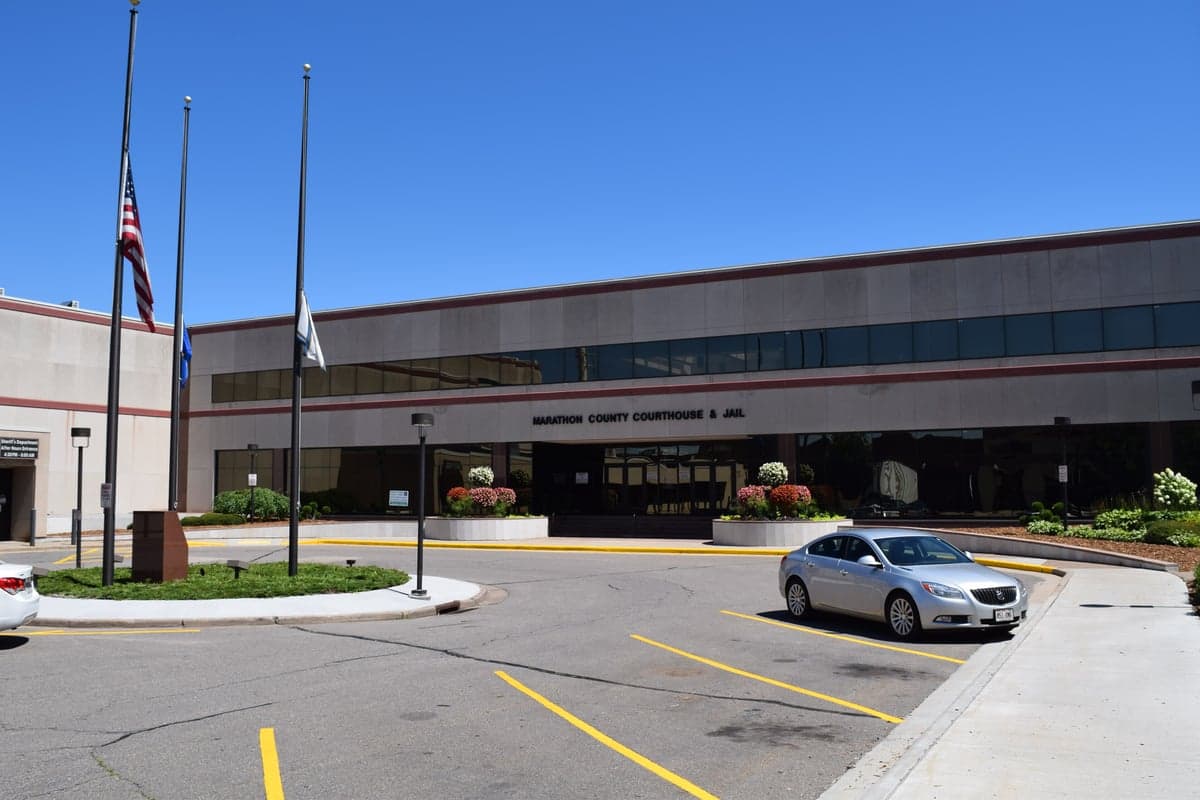
Photo: Wikipedia
Demographics of Marathon County
Affluence Level in Marathon County
A middle-class area roughly in line with national averages across income, home values, education, and employment.
People of Marathon County
The people of Marathon County, Wisconsin, today number 138,067, forming a predominantly white (86.8%) and culturally rooted population with a distinctly Central European character. The county is less diverse than the national average, with a foreign-born share of just 1.9%, and its identity is deeply tied to its rural and small-town heritage, centered on the city of Wausau. Residents often describe the area as a place where hard work, family, and community institutions—particularly churches and local festivals—remain central to daily life, creating a stable but slowly evolving social fabric.
Settlement & growth (pre-1960)
Before European settlement, the region now known as Marathon County was the homeland of the Ojibwe (Chippewa) and Menominee nations, who used the Wisconsin River and its tributaries for fishing, trade, and transportation. French fur traders and missionaries passed through in the 17th and 18th centuries, but no permanent European settlements took hold until the mid-19th century. The area was formally ceded by the Ojibwe in the 1837 Treaty of St. Peters, opening the land for American settlement.
The first major wave of settlers arrived in the 1840s and 1850s, primarily Yankees from New England and New York, who established the earliest communities along the Wisconsin River. They founded the city of Wausau (originally called Big Bull Falls) in 1839 as a logging camp, drawn by the vast white pine forests. These early settlers built sawmills and gristmills, and the town quickly became a regional hub for the timber industry. By the 1860s, the county's population had grown to roughly 10,000, almost entirely native-born Americans of British descent.
The second and far more transformative wave began in the 1870s and continued through the 1910s: mass immigration from Central and Eastern Europe. German farmers and laborers arrived first, settling in the fertile townships around Mosinee and Schofield, where they established dairy farms and small businesses. They were soon followed by Polish immigrants, who concentrated in Polonia (a community named for their homeland) and the southern part of Wausau, building St. Mary's Catholic Church as a cultural anchor. Czech and Bohemian immigrants settled in Athens and Edgar, while Norwegian and Swedish families established themselves in the northern townships like Rib Mountain and Marathon City. By 1900, Marathon County's population had surged to 43,256, with roughly one-third of residents foreign-born.
The timber industry drove this growth, but by the 1910s, the forests were depleted, and the economy shifted to dairy farming and paper manufacturing. The Marathon Paper Mills Company (later part of Wausau Paper) opened in Wausau in 1909, drawing workers from the existing immigrant communities and creating a stable industrial base. The 1920s and 1930s saw a slowdown in immigration due to restrictive national quotas, but internal migration from rural Wisconsin kept the population growing. By 1950, the county reached 80,337 residents, with the population still overwhelmingly white and of German, Polish, and Scandinavian descent. The post-World War II era brought a modest influx of returning veterans and their families, who settled in new suburban developments around Wausau, particularly in the Weston and Rothschild areas.
Modern era (post-1965)
The 1965 Hart-Cellar Act, which abolished national-origin quotas, had a limited immediate impact on Marathon County. Unlike major metropolitan areas, the county did not experience large-scale immigration from Asia or Latin America during the 1970s and 1980s. Instead, the most significant demographic shift was domestic: a slow but steady outflow of young adults to larger cities in Wisconsin and beyond, balanced by in-migration of retirees and families seeking lower costs and a quieter lifestyle from the Milwaukee and Chicago metropolitan areas.
The most notable change since the 1990s has been the growth of the Hmong community. Following the end of the Vietnam War, Hmong refugees from Laos began resettling in Wisconsin, with a significant number arriving in Wausau through church-sponsored refugee programs. By 2020, the Hmong population in Marathon County was estimated at roughly 6,000 to 7,000 people, concentrated in Wausau's east side and the village of Kronenwetter. This community has established its own businesses, churches, and cultural organizations, and Hmong New Year celebrations are now a major annual event. The county's Asian population (East/Southeast Asian, excluding Indian subcontinent) stands at 4.9%, driven almost entirely by this Hmong community.
Hispanic population growth has been more modest, rising to 3.4% of the total, with families primarily working in dairy farming, meatpacking, and construction. The largest concentrations are in Wausau and the rural townships of Berlin and Stettin, where a small number of Mexican-American families have settled since the 2000s. The Black population remains very small at 0.5%, and the Indian subcontinent population is 0.6%, mostly professionals employed at Aspirus Health and local manufacturing firms. Suburbanization has continued, with the villages of Weston and Rothschild absorbing much of the new residential development, while the city of Wausau itself has seen modest population decline since its 1970 peak of 32,806.
The future
Marathon County's population is projected to remain relatively stable over the next 10 to 20 years, with slow growth driven primarily by natural increase and modest in-migration from other parts of Wisconsin. The county is becoming slightly more diverse, but at a pace far slower than the national average. The Hmong community is expected to continue growing through higher birth rates and secondary migration from other states, potentially reaching 8-10% of the county's population by 2040. Hispanic and Indian subcontinent populations will likely see incremental increases, but will remain small shares of the total.
The most significant demographic challenge is aging. Marathon County's median age is 42.3, several years above the national median, and the 65-and-over population is growing rapidly as younger residents leave for college and careers in Madison, Minneapolis, and Milwaukee. This trend is most pronounced in the rural townships, where school enrollments are declining. The county's cultural identity is likely to remain strongly rooted in its German and Polish heritage, with annual events like Wausau's Hmong New Year and the Wisconsin Valley Fair reflecting a slowly broadening character. New residents are most likely to settle in the Wausau-Weston-Rothschild corridor, where jobs in healthcare, manufacturing, and education are concentrated.
For someone moving in now, Marathon County offers a stable, safe, and affordable environment with strong community ties and a pace of change that many find reassuring. The population is becoming more diverse, but the county will remain predominantly white and culturally conservative for the foreseeable future. The key trade-off is between the low cost of living and strong social fabric on one hand, and limited economic opportunity and demographic stagnation on the other. It is a place where the past is still very present, and where newcomers who respect that heritage will find a welcoming, if cautious, reception.

* Values derived from national, state, county, city and local statistics and may differ in a specific area. Last updated: 2026-06-17T00:48:27.000Z
Narrative content on this page is AI-generated and may contain mistakes. Verify any details that matter before acting on them.
ReloMaps may earn a commission from affiliate links at no extra cost to you.

