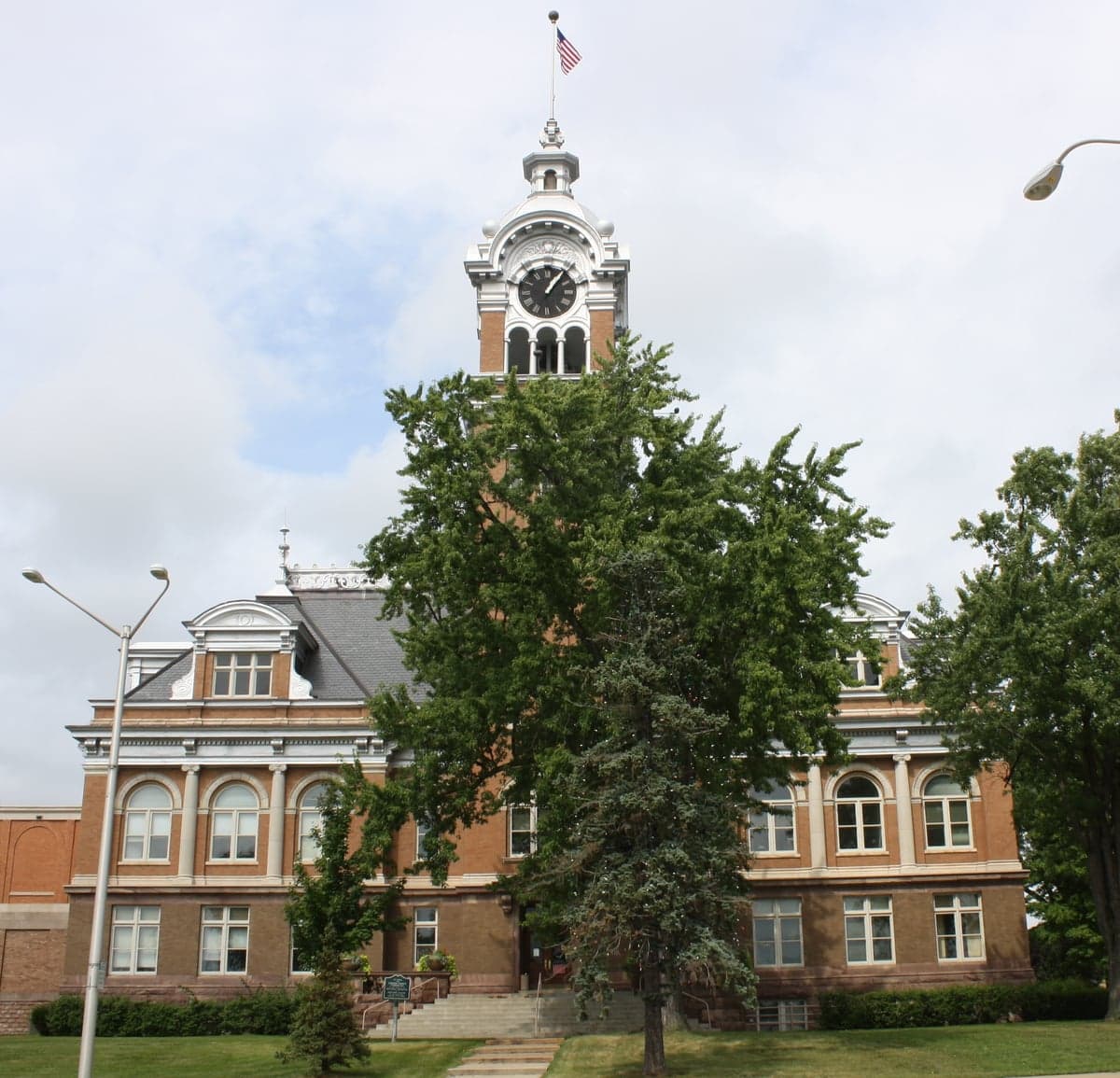
Photo: Wikipedia
Political ClimatePolitical Climate in Lincoln County
Showing county-level results — no local-only data available.
Lean and PVI are calculated from this county’s 2020 and 2024 presidential results, Cook-style.
Political rankings in Wisconsin
- Most Conservative Cities in Wisconsin
- Most Liberal Cities in Wisconsin
- Best Liberal-Leaning Towns in the Midwest
- Safest Liberal-Leaning Towns in the Midwest
- Safest Conservative-Leaning Towns in the Midwest
- Affordable Small Towns for Conservatives
- Most Affordable Liberal-Leaning Small Towns in the U.S.
- Safest Conservative-Leaning Cities in the U.S.
- Most Conservative Counties in Wisconsin
- Most Liberal Counties in Wisconsin
Local Political AnalysisPolitical Analysis of Lincoln County
Lincoln County, Wisconsin, is a reliably Republican area with a Cook Partisan Voting Index (PVI) of R+13, meaning it votes about 13 points more Republican than the nation as a whole. This puts it well to the right of the state of Wisconsin, which sits at EVEN on the PVI, reflecting its status as a perennial battleground. The county’s political trajectory has been steadily redder over the past decade, driven by rural-urban polarization and the out-migration of younger, more liberal voters from the county’s smaller towns. While the county as a whole is solidly conservative, there are notable pockets of blue, particularly in the city of Merrill, the county seat, and the village of Tomahawk, where local issues and union ties can shift the needle.
How it compares
Compared to Wisconsin as a whole, Lincoln County is a Republican stronghold. In the 2024 presidential election, the county backed Donald Trump by roughly 20 points, while the state overall was decided by less than a single point. This gap has widened since 2016, when Trump won the county by about 15 points. The biggest political divide within the county is between the more populated areas and the rural townships. Merrill, home to about 9,000 people, is the most competitive area—its 1st and 2nd wards have swung Democratic in recent state-level races, thanks to a mix of union households (paper mill and manufacturing workers) and a small but active college-town vibe from the local technical college. In contrast, the towns of Birch, Bradley, and Corning are deep red, often voting 70% or more Republican. The village of Tomahawk is a bit of a bellwether: it leans Republican but has a strong independent streak, with local school board and county board races often decided by single-digit margins. The key swing precincts are in the unincorporated areas around Merrill and Tomahawk, where the balance of rural conservatives and a handful of lake-home transplants from the Chicago area can tip a close race.
What this means for residents
For conservative residents, Lincoln County is a comfortable place to live politically. Local government, from the county board to the sheriff’s office, is dominated by Republicans, and conservative values are reflected in everything from zoning decisions to school curriculum debates. Gun rights are broadly supported, and property taxes are kept relatively low compared to neighboring Marathon County. For liberal residents, the reality is more nuanced. While they are a clear minority, they are not isolated—Merrill and Tomahawk have active Democratic Party chapters, and the county’s strong union history means labor issues can sometimes cross party lines. Progressive candidates can win local office, especially in Merrill’s city council or the county board’s more competitive districts, but they face an uphill battle in countywide races. Socially, the area is generally live-and-let-live, though political bumper stickers and yard signs can be a flashpoint during election season. The biggest practical impact for both sides is in state-level representation: Lincoln County is part of the 12th Senate District and the 35th Assembly District, both held by Republicans, meaning the county’s voice in Madison is reliably conservative.
Culturally, Lincoln County is distinct from the more liberal cities of the state like Madison or Milwaukee. The area’s identity is tied to the Northwoods—hunting, fishing, snowmobiling, and the paper industry. This shapes policy priorities: there is strong support for Second Amendment rights, resistance to statewide land-use regulations, and a preference for local control over education. The county’s largest employer, Krause and Sons (a paper mill in Merrill), and the Tomahawk mill (owned by Packaging Corporation of America) anchor a working-class ethos that values job stability over social experimentation. That said, the influx of seasonal residents and retirees from Illinois and Minnesota has brought a slight moderating influence, especially around the county’s many lakes. These newcomers often vote Republican but are more likely to support environmental conservation and public land access, creating a subtle but real tension with the old-guard logging and manufacturing interests. Overall, Lincoln County is a place where the political climate is stable, predictable, and deeply rooted in its rural, industrial heritage—a contrast to the swing-state drama that defines Wisconsin as a whole.

State Political ClimatePolitical Climate in Wisconsin
State Political AnalysisPolitical Environment in the State
Wisconsin is the ultimate swing state, and if you’re moving here, you need to understand that the political climate is a knife-edge battle between two roughly equal coalitions. The state’s Cook PVI is EVEN, meaning it votes almost exactly with the national average, but that masks a brutal internal war: the Democratic stronghold of Milwaukee and the liberal college towns of Madison and La Crosse are pitted against a deeply Republican rural and exurban countryside, plus the reliably red WOW counties (Waukesha, Ozaukee, Washington) that ring Milwaukee. Over the last 20 years, the state has flipped from a reliably blue-leaning state (voting for Gore in 2000) to a pure toss-up, with Trump winning it by less than a point in 2016 and 2024, and Biden flipping it back by a similarly razor-thin margin in 2020. The result is a state that is perpetually contested, with policy swinging hard depending on which party controls the governor’s mansion or the legislature.
Urban vs. rural divide
The political map of Wisconsin is a study in stark contrasts. The state’s two major population centers drive the Democratic vote: Milwaukee County (home to the city of Milwaukee) routinely delivers 65-70% of its vote to Democrats, while Dane County (Madison) is even more lopsided, often hitting 75%+ Democratic. These two counties alone account for roughly a quarter of the state’s total vote. Meanwhile, the WOW counties (Waukesha, Ozaukee, Washington) are the Republican firewall, regularly voting 60-65% Republican and providing the margin that keeps statewide races competitive. The rest of the state is a patchwork: the Driftless Region in the southwest (around La Crosse and Prairie du Chien) leans Democratic but is trending purple, while the northern and central forested counties (like Vilas, Oneida, and Marathon) are solidly Republican. The key battlegrounds are the suburban and exurban counties that have been shifting: Brown County (Green Bay) and Outagamie County (Appleton) are now true swing counties, having voted for Obama, then Trump, then Biden, then Trump again. If you’re moving to a place like Waukesha, expect a conservative environment; if you’re moving to Madison, expect a liberal one. The suburbs of Kenosha and Racine are also increasingly competitive, reflecting the broader national trend of college-educated voters shifting left.
Policy environment
Wisconsin’s policy environment is a product of divided government and a long history of moderate-to-conservative governance. The state has a flat income tax (currently 4.4% as of 2025, down from 7.65% a decade ago) and a state sales tax of 5%, though local municipalities can add up to 1.5% more. Property taxes are above the national average, but the state’s levy limits keep them from skyrocketing. The regulatory posture is business-friendly: Wisconsin is a right-to-work state (passed in 2015), and Act 10 (2011) effectively ended collective bargaining for most public employees, a move that remains deeply controversial. Education policy is a flashpoint: the state has a robust school choice program (vouchers for private and religious schools) that is popular in Milwaukee and the WOW counties, but opposed by teachers’ unions and Madison liberals. Healthcare is mixed: the state expanded Medicaid under the Affordable Care Act in 2014, but the legislature has resisted a full public option. Election laws are a perennial battleground: Wisconsin has no-excuse absentee voting (passed in 2011), but also strict voter ID requirements (enacted in 2011 and upheld in court). The state uses paper ballots for all elections, a point of pride for both parties after 2020.
Recent policy direction
The last five years have seen Wisconsin lurch between conservative and moderate policies, depending on who holds the governor’s office. Under Democratic Governor Tony Evers (elected 2018, re-elected 2022), the state has seen a partial repeal of the state’s 1849 abortion ban (a 2023 court ruling effectively restored abortion access up to 20 weeks), but the Republican legislature has blocked further expansion. On gun rights, Wisconsin is a shall-issue concealed carry state (since 2011) with no permit required for open carry, and the legislature has passed preemption laws preventing local governments from enacting their own gun restrictions. Parental rights have been a hot topic: in 2023, the legislature passed a bill requiring schools to notify parents if a student requests a name or pronoun change, though Evers vetoed it. On property rights, the state has strong eminent domain protections and a right-to-farm law that shields agricultural operations from nuisance lawsuits. Privacy and surveillance are less regulated than in blue states: there is no state-level data privacy law, and law enforcement can access cell phone location data with a warrant. Voting access remains a flashpoint: the state’s bipartisan Elections Commission has been under constant attack from both sides, with Republicans pushing for stricter ID laws and Democrats pushing for automatic voter registration. The net effect is a state that is moderately conservative on fiscal and gun issues, but more mixed on social and education policy.
Civil unrest & political movements
Wisconsin has been a national flashpoint for political unrest. The 2020 Kenosha protests (following the shooting of Jacob Blake) saw nights of rioting, arson, and the killing of two protesters by Kyle Rittenhouse, who was later acquitted on self-defense grounds. The event polarized the state and nation, with Kenosha becoming a symbol of the broader debate over policing and protest. The 2020 election integrity controversy was particularly intense here: Trump’s legal challenges focused on Milwaukee and Green Bay, and the state’s Republican-controlled legislature launched a taxpayer-funded investigation (the “Michael Gableman probe”) that found no evidence of widespread fraud but fueled ongoing distrust. On the left, the Wisconsin Alliance for Retired Americans and the Service Employees International Union (SEIU) remain active, particularly in Milwaukee and Madison. Immigration politics are less heated than in border states, but there is a sanctuary city debate: Milwaukee has a “welcoming city” ordinance that limits cooperation with ICE, while the legislature has passed bills (vetoed by Evers) to ban such policies. The John Doe investigations (2010-2014) into coordination between conservative groups and Scott Walker’s campaign remain a sore spot for the right, while the left still seethes over Act 10. A new resident in Waukesha will see a very different political culture than someone in Madison—the former is a hub of conservative activism, the latter of progressive organizing.
Projection
Over the next 5-10 years, Wisconsin is likely to remain a toss-up, but the demographic trends favor a slow shift toward the Democrats. The state is aging faster than the national average, and the rural counties that vote Republican are losing population, while the urban and suburban counties (Milwaukee, Dane, Brown, Outagamie) are growing. In-migration is modest but tilts toward the Madison and Milwaukee suburbs, bringing in college-educated workers who tend to vote Democratic. The WOW counties are still solidly red, but their margins are shrinking as younger residents move to Milwaukee or out of state. The 2024 election showed that Trump can still win Wisconsin by a hair, but the state’s new legislative maps (drawn by the state Supreme Court in 2024 after a liberal majority took control) will make the state Assembly more competitive, potentially giving Democrats a chance to break the Republican supermajority. The wild card is the U.S. Senate race in 2026 (Ron Johnson’s seat) and the governor’s race in 2026 (Evers is term-limited). If a Republican wins the governorship, expect a push for more restrictive voting laws, a flat tax cut, and a ban on abortion after 14 weeks. If a Democrat wins, expect expanded Medicaid, a state-level data privacy law, and a repeal of the right-to-work law. Either way, the state will remain a battleground, and new residents should expect constant political advertising, high turnout, and a polarized media environment.
For a new resident, the bottom line is that Wisconsin’s political climate is highly localized. If you’re a conservative moving to Waukesha or Green Bay, you’ll find a community that shares your values and a state government that is generally friendly to your views on taxes, guns, and school choice. If you’re a liberal moving to Madison or Milwaukee, you’ll find a vibrant progressive culture and a city government that protects your rights, even if the state legislature is often hostile. The key is to understand that your local experience will be shaped more by your city and county than by the state as a whole. Wisconsin is not a place where one party dominates—it’s a place where you have to pick your community carefully, and where your vote will always matter. The state’s political future is uncertain, but one thing is sure: it will remain one of the most closely watched and fiercely contested states in the country.
* Values derived from national, state, county, city and local statistics and may differ in a specific area. Last updated: 2026-11-23T04:50:00.000Z
Narrative content on this page is AI-generated and may contain mistakes. Verify any details that matter before acting on them.
ReloMaps may earn a commission from affiliate links at no extra cost to you.

