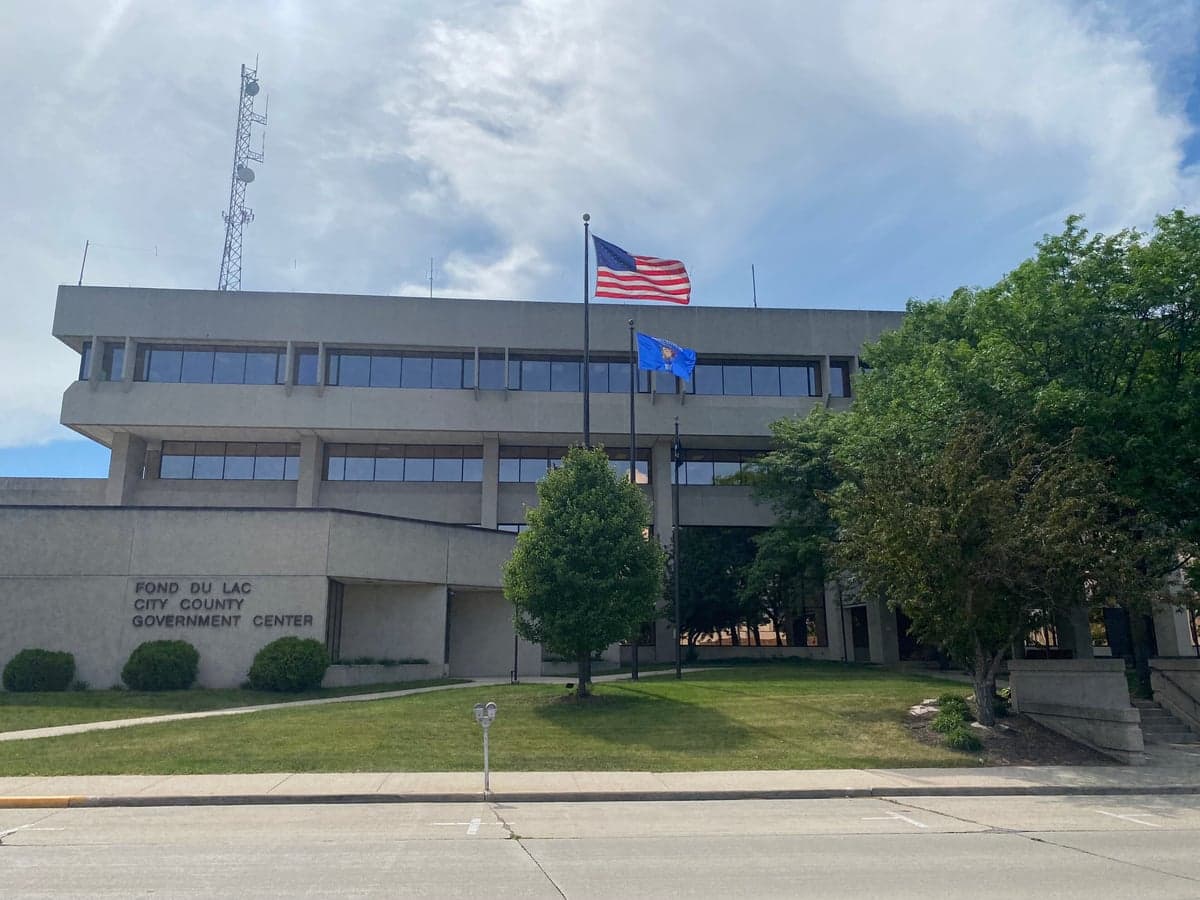
Photo: Wikipedia
Political ClimatePolitical Climate in Fond Du Lac County
Showing district-level results — no local-only data available.
Local Political AnalysisPolitical Analysis of Fond Du Lac County
Fond du Lac County has been a reliable Republican stronghold for decades, and that hasn't changed much. The county's Cook Partisan Voting Index (PVI) sits at R+8, meaning it consistently votes about eight points more Republican than the national average. In the 2024 presidential election, Donald Trump carried the county by roughly 18 points, a margin that has held steady or widened slightly since 2016. The city of Fond du Lac itself is the main Democratic-leaning pocket, but it's not enough to offset the deep-red rural townships and exurbs that dominate the county's vote totals.
How it compares to Wisconsin as a whole
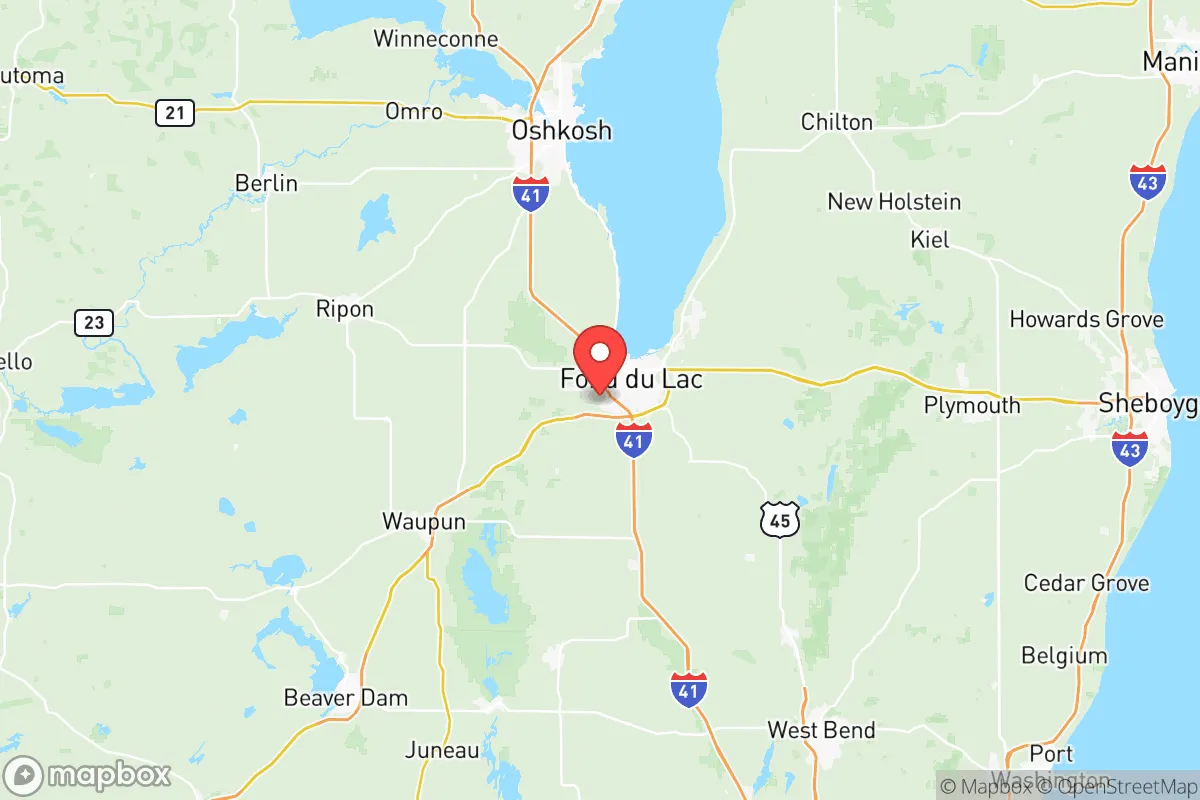
Wisconsin statewide has a Cook PVI of EVEN, making it one of the most competitive swing states in the country. Fond du Lac County's R+8 lean is significantly more conservative than the state average. To put it in perspective, while Wisconsin as a whole flipped from Trump in 2016 to Biden in 2020 by about 20,000 votes, Fond du Lac County went for Trump by over 15,000 votes in both elections. The county's politics align more closely with neighboring rural counties like Sheboygan (R+10) and Winnebago (R+9) than with the Milwaukee or Madison metros. Within the county, the city of Fond du Lac (population ~44,000) is the only place where Democrats consistently win precincts, especially around the Lakeside Park area and near Marian University. In contrast, towns like Oakfield, Rosendale, and Campbellsport routinely deliver 65-70% Republican margins. The swing precincts are in the suburban fringe of the city—places like the Town of Fond du Lac and North Fond du Lac—where growth and new residents have made races slightly more competitive, but still lean red overall.
What this means for residents
For conservative residents, Fond du Lac County feels like a safe bet. Local elections are dominated by Republicans, from the county board to the sheriff's office, and policy debates tend to focus on tax cuts, agricultural regulations, and Second Amendment rights. The county's Republican Party is well-organized, with active precinct committees and a strong presence at the county fair and local parades. For liberal residents, the political reality is more isolating. While the city of Fond du Lac has a small but active Democratic Party group, progressive candidates rarely win countywide office. Social issues like abortion access and LGBTQ+ rights are hot-button topics, with conservative majorities on the county board often passing resolutions opposing state-level Democratic initiatives. That said, the city itself has a more moderate vibe—the Fond du Lac Public Library and the local farmers market are generally non-political gathering spots where people from both sides interact without much friction.
Culturally, Fond du Lac County is more traditional and church-oriented than the state as a whole. The county has a higher percentage of residents who attend religious services regularly, and local policy often reflects that—Sunday alcohol sales restrictions were only loosened in the last decade, for example. The county's economy is heavily tied to manufacturing (Mercury Marine, J.F. Ahern Co.) and agriculture (dairy and cranberries), which shapes the political conversation around trade, labor, and environmental regulations. Looking ahead, the county's political trajectory seems stable: the rural areas are getting redder, while the city of Fond du Lac is slowly diversifying and trending slightly bluer, but not enough to flip the county anytime soon. For anyone moving here, the political climate is predictable—you'll know exactly where you stand, and so will your neighbors.

State Political ClimatePolitical Climate in Wisconsin
State Political AnalysisPolitical Environment in the State
Wisconsin is the quintessential swing state, with a Cook PVI of EVEN that tells you exactly what you’ll find on the ground: elections here are decided by a percentage point or two, every cycle. Over the past 15 years, the state has flipped twice—Obama won in 2012, Trump in 2016, Biden in 2020, and Trump again in 2024—driven by a razor-thin margin that rarely exceeds one point. The dominant coalitions are a deeply Democratic urban corridor (Milwaukee, Madison, and college towns) versus a sprawling Republican stronghold of rural counties and the exurban WOW counties (Waukesha, Ozaukee, Washington) west and north of Milwaukee. The state’s political trajectory is less a trend and more a tightrope: demographic shifts favor Democrats in growing Madison and some Fox Valley cities, but rural areas are shrinking and voting even more Republican, keeping the state locked in a dead heat.
Urban vs. rural divide
The political map of Wisconsin is essentially two states. The southeast corner—Milwaukee County and Dane County (Madison)—generates massive Democratic margins. Milwaukee itself is a reliably blue machine, turning out 70-75% Democratic, while Madison, home to the University of Wisconsin, routinely hits 80%+ for Democrats. Their combined vote is usually enough to offset the rest of the state, but barely. The rest of the map is Republican: the WOW counties (Waukesha, Ozaukee, Washington) vote 60-65% Republican and are growing in population; Waukesha County alone often delivers a 70,000-vote margin for the GOP, the single biggest Republican-edge county in the Upper Midwest. The Fox Valley cities—Appleton, Green Bay, Oshkosh—are swing territory that leans slightly Republican but can tip Democratic in a close race, especially if local turnout in Green Bay’s Brown County is high. Farther north, the rural counties from Wausau up through Rhinelander vote 65-70% Republican. The real battleground is the “Blue Wall” of counties along Lake Michigan—Kenosha, Racine, and Door County in some years—where working-class voters of all races split tickets. Kenosha County voted for Trump in 2016, then Biden in 2020, then Trump again in 2024, perfectly mirroring the state’s volatility.
Policy environment
State-level policy in Wisconsin is split-party, which produces gridlock but also some enduring compromises. Taxes lean conservative: the state income tax was flattened in 2023 to a single rate of 4.75% (with lower brackets phasing out), and property taxes are relatively high, funding local schools heavily through referenda. The state’s regulatory posture is moderate—no major permitting bottlenecks, but environmental rules from the DNR can be strict in the Driftless Area and along the Great Lakes. Education is a bright spot for conservative-leaning families: Wisconsin has one of the oldest and most expansive school voucher programs in the country, covering Milwaukee, Racine, and the state-wide “Choice” system, plus a robust charter school sector. Parental rights in education have been strengthened by recent legislation requiring school boards to notify parents of gender-related curriculum changes. Healthcare policy trends libertarian—Wisconsin did not expand Medicaid under the Affordable Care Act until 2019, and the state runs its own marketplace with moderate premiums. Election law is a constant tug-of-war: voter ID has been in effect since 2011, drop boxes were banned by the state Supreme Court after the 2020 election, and clerks must now strictly conform to ballot-handling rules. Liberal-leaning residents in Dane and Milwaukee counties often feel the rules are restrictive; rural conservatives see them as necessary integrity measures.
Recent policy direction
The last three years have seen Wisconsin shift in multiple directions at once. On guns: in 2023, Wisconsin passed constitutional carry, removing the permit requirement for concealed carry, making it a Shall-Issue state with no permit necessary. Self-defense laws are strong—the Castle Doctrine is in effect, and there is no duty to retreat. On abortion: the 2023 election of liberal Justice Janet Protasiewicz flipped the state Supreme Court, and in 2024 the court struck down the 1849 near-total abortion ban, restoring access to about 20 weeks. However, a 20-week ban remains on the books for later abortions. Parental rights saw wins: a 2023 law requires schools to adopt policies that notify parents if a student requests a name or pronoun change. On education, a 2024 budget expanded school choice statewide with no income cap. Property rights are generally strong; Wisconsin has no statewide rent control and allows local zoning, but most rural areas have very limited regulation—you can build a pole barn on your land in Wausau without planning board approval. Privacy and surveillance: the state has a biometric privacy law but no comprehensive consumer data privacy law yet. Voting access remains contested: a 2025 Republican bill requiring citizenship checks for voter registration passed, but the governor vetoed it; the new maps drawn in 2024 by the Supreme Court are fairer but still competitive. Taxation is trending lower: the 2023 flat tax is scheduled to drop to 3.5% by 2027, pending revenue. Overall, the direction is a mixed bag: rightward on guns and taxes, leftward on abortion and judicial reform, and status-quo on everything else.
Civil unrest & political movements
Wisconsin has been a flashpoint for national protests and local tensions. The 2020 Kenosha unrest—sparked by the shooting of Jacob Blake and resulting in several days of riots and arson—was a pivot point. The Kyle Rittenhouse trial further polarized the state, with conservatives feeling the system worked against the defendant and liberals decrying vigilantism. The Waukesha Christmas parade attack in 2021, where a driver killed six people, is still a raw memory; the driver was a felon out on bail, galvanizing conservative anger over bail reform. Election integrity remains a live wire: the 2020 election produced lawsuits and an audit from the nonpartisan Legislative Audit Bureau that found no fraud but many administrative recommendations. Conservative activist groups like the Wisconsin Institute for Law & Liberty (WILL) file frequent lawsuits on parental rights and election rules. On the left, Black Lives Matter protests in Milwaukee are common, and some organizers in Madison have called for defunding the police—though the city council has largely rejected that. Immigration politics are subdued compared to border states, but Dane County has declared itself a “welcoming community” and limits cooperation with ICE, while Waukesha and other conservative suburbs fully cooperate. No serious secession or nullification movements exist, though some rural counties have discussed “constitutional sheriffs” movements emphasizing local control.
Projection
Over the next 5-10 years, Wisconsin’s EVEN status is likely to persist, with a slight tilt toward competitiveness driven by two countervailing forces. In-migration from Illinois, mostly into the suburbs of Kenosha and Racine and the Madison metro, brings moderate Democratic votes but also conservative-leaning retirees drawn to the Fox Valley’s lower taxes. Madison continues to grow fast—adding 30,000 residents in the last decade—while rural counties like Langlade and Rusk are losing population. However, those rural counties vote ever-more-Republican and are over-weighted in the state legislature (though the 2024 maps reduce that). The state Supreme Court will be a battleground: three seats up by 2028, likely determining the long-term legality of abortion and gerrymandering. On policy, expect continued pressure to cut income taxes further and expand school choice, while liberals push for a consumer privacy law and expanded Medicaid-for-working-poor. A relocator moving in now should expect politics to stay intensely close—every two years you’ll be canvassed, called, and canvassed again. The state will remain a live laboratory for the national partisan divide, with no party likely to consolidate control for a generation.
Bottom line for a new resident: if you’re conservative, you’ll live in a political environment where your vote matters hugely—your suburban Milwaukee or Fox Valley community will likely be Republican, but you’ll see blue signs in Madison and Milwaukee. If you’re liberal, you’ll find strongholds in the cities but will need to accept that statewide elections are coin flips. The practical takeaway is that Wisconsin’s politics are high-intensity and low-predictability; the policy mix gives both sides enough wins to keep fighting. You won’t feel any overbearing ideological monopoly, but you’ll also never feel fully at ease—that’s Wisconsin in a nutshell.
* Values derived from national, state, county, city and local statistics and may differ in a specific area. Last updated: 2026-06-20T14:57:53.000Z
Narrative content on this page is AI-generated and may contain mistakes. Verify any details that matter before acting on them.
ReloMaps may earn a commission from affiliate links at no extra cost to you.

