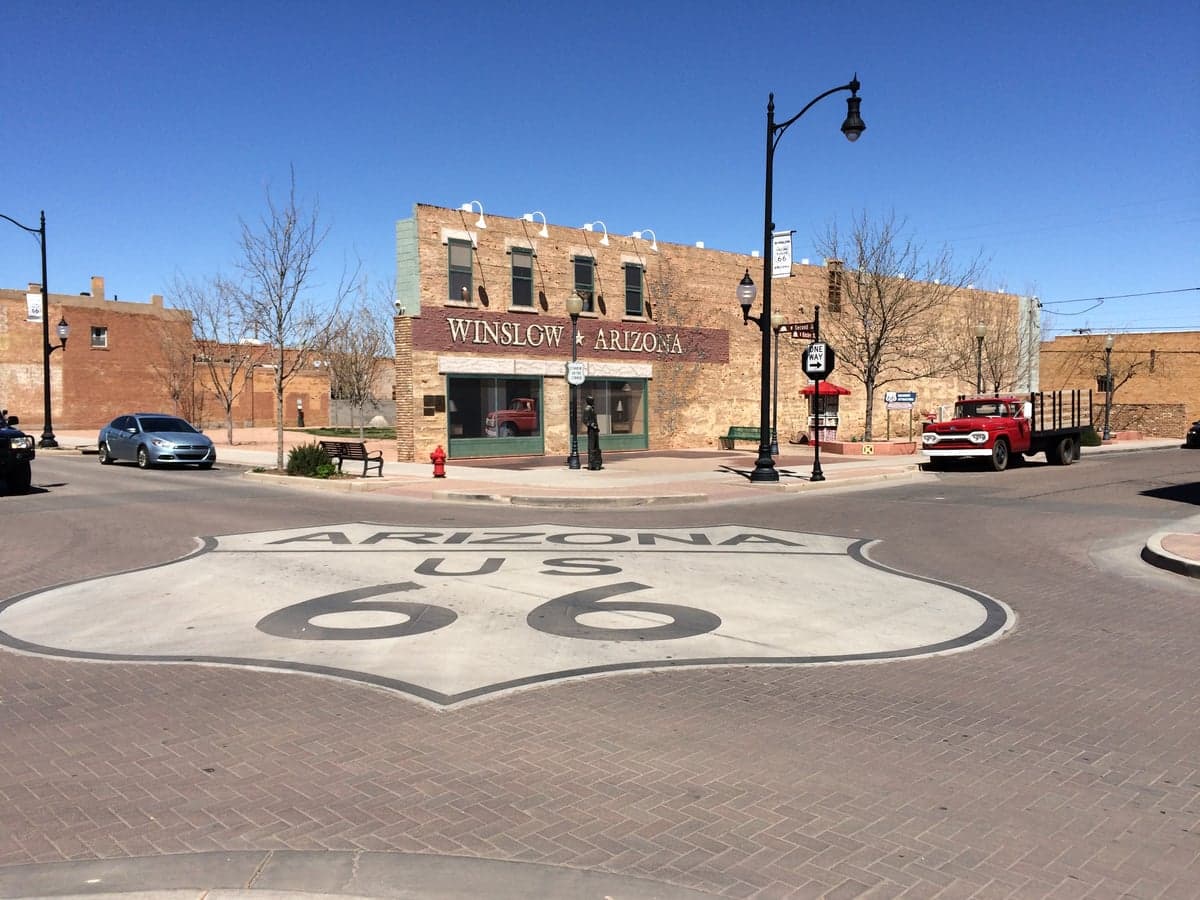
Photo: Wikipedia
Political ClimatePolitical Climate in Winslow, AZ
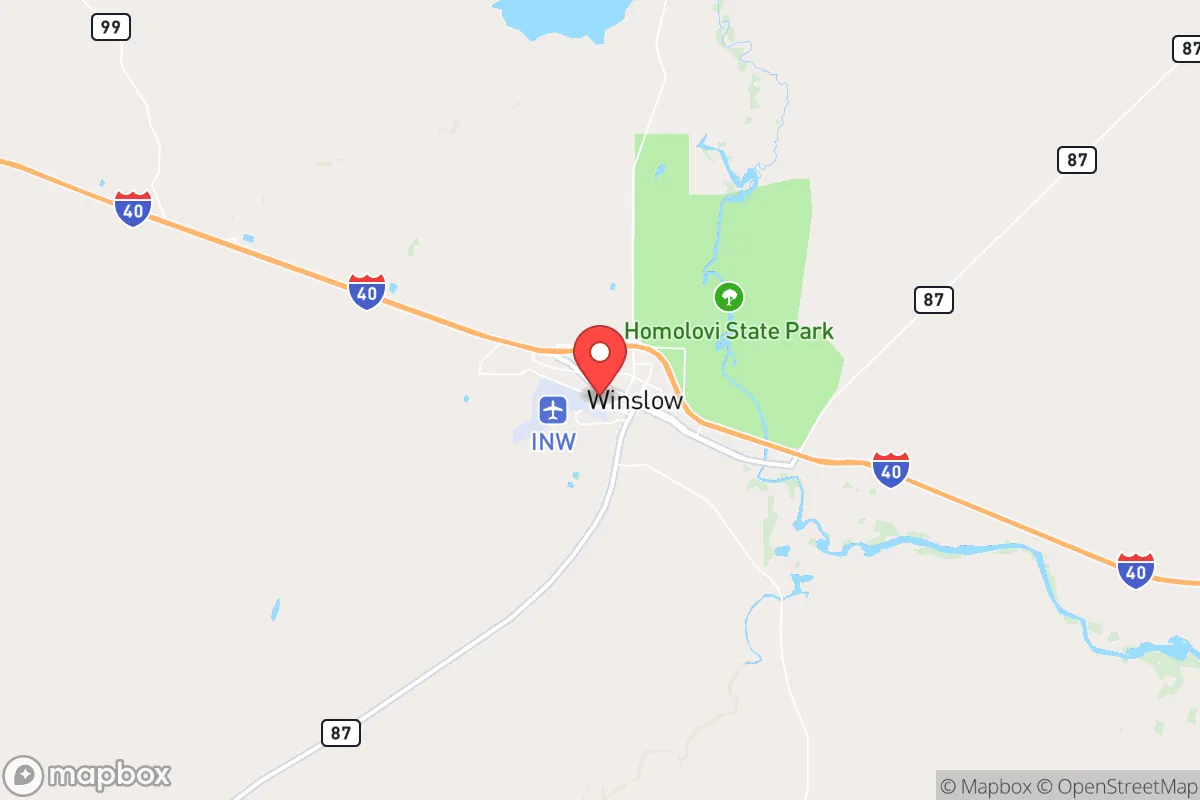
District shown is the primary district for this city’s centroid. Cities may span multiple districts.
Local Political AnalysisPolitical Analysis of Winslow, AZ
Winslow, Arizona, leans solidly Republican, with a Cook Partisan Voting Index (PVI) of R+7, meaning it votes about seven points more conservative than the national average. This stands in stark contrast to the state of Arizona as a whole, which has a Cook PVI of EVEN, reflecting its status as a true swing state. While Arizona flipped blue for President in 2020 and remains highly competitive, Winslow and the surrounding Navajo County have consistently trended red, a dynamic that has only become more pronounced in recent election cycles.
How it compares
The political gap between Winslow and the broader state is significant. While Arizona's EVEN rating means statewide races are often decided by razor-thin margins—think the 2020 Presidential election or the 2022 Senate race—Winslow's R+7 lean creates a much more predictable environment. In practice, this means Republican candidates routinely carry the city by double digits, even when Democrats win statewide. For context, Flagstaff, about an hour west, is a liberal stronghold in Coconino County, while Holbrook and Snowflake to the east are even more conservative than Winslow. The contrast is stark: you can drive from a reliably blue college town to a deep red rural community in under 90 minutes. This makes Winslow a microcosm of the urban-rural divide that defines Arizona politics, but with the city itself firmly on the rural, conservative side of that line.
What this means for residents
For conservative residents, Winslow feels like a comfortable fit. Local elections, school board races, and county commission seats are typically decided in Republican primaries, and the general election is often a formality. You'll find that local policy—from zoning to law enforcement priorities—tends to reflect small-government, pro-business values. For liberal residents, the reality is different. While you won't face hostility in daily life, you'll likely be in the minority in most civic conversations. Statewide ballot measures, like the 2020 proposition to legalize recreational marijuana, passed in Arizona but failed in Navajo County, so your vote on certain issues may not carry the day locally. That said, Winslow is not a place of political extremism; it's a working-class town where people tend to judge you by your character and your work ethic, not your bumper stickers.
Cultural and policy distinctions
One of the most notable cultural distinctions is the relationship with the Navajo Nation, which surrounds Winslow to the north and east. Tribal politics are a separate but deeply intertwined layer, often creating a more complex political landscape than a simple red-blue map suggests. Many Navajo voters lean Democratic, but turnout can be inconsistent, and local issues like water rights, land use, and economic development on the reservation don't always align with party lines. In terms of policy, you'll see this play out in debates over sales tax revenue sharing and infrastructure projects that serve both the city and the Nation. The bottom line is that Winslow's R+7 lean is real and stable, but it exists within a state that is anything but predictable, and a local culture that values neighborliness over partisanship.

State Political ClimatePolitical Climate in Arizona
State Political AnalysisPolitical Environment in the State
Arizona has transformed from a reliably Republican stronghold into the nation’s premier political battleground, currently rated EVEN on the Cook Partisan Voting Index. Over the past two decades, the state has shifted from a solid red base—where George W. Bush won by 11 points in 2004—to a dead-even toss-up, with Joe Biden carrying it by just 0.3% in 2020 and Donald Trump flipping it back by a similarly narrow margin in 2024. This trajectory is driven by explosive growth in Maricopa County (home to Phoenix and 60% of the state’s voters), a surge of out-of-state transplants from California and the Midwest, and a growing Latino electorate that now makes up nearly a quarter of voters. The result is a state where no single coalition dominates, and where control of the legislature, governor’s office, and congressional delegation can flip from cycle to cycle.
Urban vs. rural divide
The political map of Arizona is defined by a stark urban-rural split, with Maricopa County acting as the state’s ultimate swing region. Phoenix and its sprawling suburbs—including Chandler, Gilbert, and Scottsdale—have shifted leftward as tech and finance workers move in, while exurban and rural areas remain deeply conservative. Tucson (Pima County) is the state’s other Democratic anchor, reliably blue but with a smaller population share than Phoenix. Meanwhile, the rural counties tell a different story: Yavapai County (Prescott) and Mohave County (Lake Havasu City, Kingman) are among the most Republican in the nation, routinely delivering 70-75% of their votes to GOP candidates. The real action is in the suburban “donut” around Phoenix—places like Mesa, Peoria, and Surprise—where moderate Republicans and independent voters decide every close race. In 2024, Trump won Maricopa by just over 1 point, while Democrats held their ground in Tucson and lost ground in rural areas, keeping the state in the toss-up column.
Policy environment
Arizona’s policy environment reflects its competitive politics: a mix of conservative structural features and periodic progressive wins at the ballot box. The state has a flat 2.5% income tax (down from 4.5% in 2022 after a phased reduction) and a relatively low property tax burden, making it attractive for cost-conscious relocators. There is no estate tax and no tax on Social Security benefits. The regulatory posture is generally business-friendly, with right-to-work laws and limited union influence. Education policy is a flashpoint: the state pioneered universal school vouchers (Empowerment Scholarship Accounts) in 2022, allowing any family to use public funds for private or homeschool expenses—a major draw for conservative parents. However, teacher pay and school funding remain perennial issues, with Arizona ranking near the bottom nationally in per-pupil spending. Healthcare policy is mixed: the state expanded Medicaid under the Affordable Care Act in 2013, but abortion access has been a rollercoaster. A near-total ban from 1864 was repealed in 2024 after public backlash, leaving a 15-week ban in place. Election laws have been a central battleground: the state has no-excuse mail voting (used by 80% of voters), but a 2022 law added stricter ID requirements and purged inactive voters from the rolls.
Recent policy direction
The last three years have seen Arizona lurch between conservative and moderate policy directions, often driven by narrow legislative majorities and veto battles. On gun and self-defense law, Arizona is a constitutional carry state (no permit needed to carry concealed) and preempts local gun ordinances—a stable feature that hasn’t changed recently. On parental and education rights, the 2022 universal school voucher expansion was the biggest shift, alongside a 2023 law requiring schools to post curriculum materials online and a ban on teaching “divisive concepts” about race. Speech and privacy saw a 2024 law restricting social media platforms from “censoring” political speech, though it faces legal challenges. On medical and bodily autonomy, the 1864 abortion ban repeal was the most dramatic reversal, but a 15-week limit remains, and a 2024 ballot initiative to enshrine abortion rights in the state constitution narrowly failed. Property rights are generally strong, with no statewide rent control and limited eminent domain use. Taxation has moved decisively lower: the 2021 tax cut package reduced the top rate from 4.5% to 2.5% over three years. Voting and ballot access remains a tug-of-war: the 2022 law added voter ID requirements for mail ballots, but same-day registration and automatic voter registration were rejected by the legislature. The net effect is a state that is conservative on fiscal and education policy, moderate on gun rights, and volatile on social issues.
Civil unrest & political movements
Arizona has been a focal point for political activism on both sides, often centered on immigration and election integrity. The state’s border with Mexico—particularly around Nogales and Yuma—makes immigration a constant live issue. In 2024, the legislature passed a bill (modeled on Texas’s SB 4) allowing state police to arrest suspected border crossers, though it was blocked by the courts. Activist groups on the right, including the Arizona Freedom Caucus and local “election integrity” organizations, have been highly visible, pushing for hand-counting of ballots and challenging the state’s widespread mail voting system. On the left, groups like Living United for Change in Arizona (LUCHA) and Mi Familia Vota have mobilized Latino voters and protested the 2022 election law. The 2020 election aftermath was particularly intense in Maricopa County, where the “Cyber Ninjas” audit—a partisan review of ballots—became a national flashpoint. Protests have been frequent but generally peaceful, with the state capitol in Phoenix hosting dueling rallies on issues from abortion to school vouchers. A new resident would notice the omnipresence of border politics in local news and the strong presence of activist organizations on both sides, but daily life in most suburbs is unaffected by these tensions.
Projection
Over the next 5-10 years, Arizona is likely to remain a competitive swing state, but the demographic trends favor a slow leftward drift. The state is adding about 100,000 new residents per year, many from California and other blue states, and the Latino population—which leans Democratic but is not monolithic—continues to grow as a share of the electorate. Maricopa County’s suburbs are becoming more diverse and more moderate, while rural counties are aging and shrinking. However, the Republican Party retains structural advantages: the state’s legislative districts are gerrymandered to favor GOP control of the legislature, and the rural vote is efficiently distributed. The most likely scenario is a state that stays within a 2-3 point margin in presidential elections, with occasional flips in both directions. The policy direction will depend on which party controls the governor’s office and legislature in any given cycle—expect continued volatility on abortion, voting laws, and education funding. A relocator moving in now should expect a state where their vote truly matters, where policy can swing sharply with each election, and where the political conversation is dominated by immigration, education choice, and the future of the suburbs.
For a new resident, the bottom line is that Arizona offers a genuinely competitive political environment where your vote carries weight, but also where policy stability is not guaranteed. Conservative relocators will find a low-tax, school-choice-friendly state with strong gun rights and a growing conservative infrastructure in the exurbs. Liberal relocators will find a state where their votes can swing elections, where organized progressive movements are active, and where cities like Phoenix and Tucson provide a blue counterweight. The practical takeaway: if you want a state where your political views are in the majority and policy is predictable, Arizona is not that place. If you want a state where the political climate is dynamic, where your engagement can make a difference, and where the cost of living is reasonable, Arizona is one of the most interesting places to land in 2026.
* Values derived from national, state, county, city and local statistics and may differ in a specific area. Last updated: 2026-10-24T16:23:51.000Z
Narrative content on this page is AI-generated and may contain mistakes. Verify any details that matter before acting on them.
ReloMaps may earn a commission from affiliate links at no extra cost to you.

