Photo: Wikipedia
Demographics of Wilmington, VT
Affluence Level in Wilmington, VT
A middle-class area roughly in line with national averages across income, home values, education, and employment.
People of Wilmington, VT
The people of Wilmington, Vermont, today form a small, tightly-knit community of roughly 370 residents, characterized by a high degree of racial and ethnic homogeneity. The population is 97.6% white, with no recorded foreign-born residents, and a notably high educational attainment level—57.8% hold a college degree. This creates a distinctive identity: a highly educated, predominantly native-born population in a rural village setting, where community life centers around the historic downtown and the seasonal rhythms of the nearby Mount Snow ski resort.
How the city was settled and grew
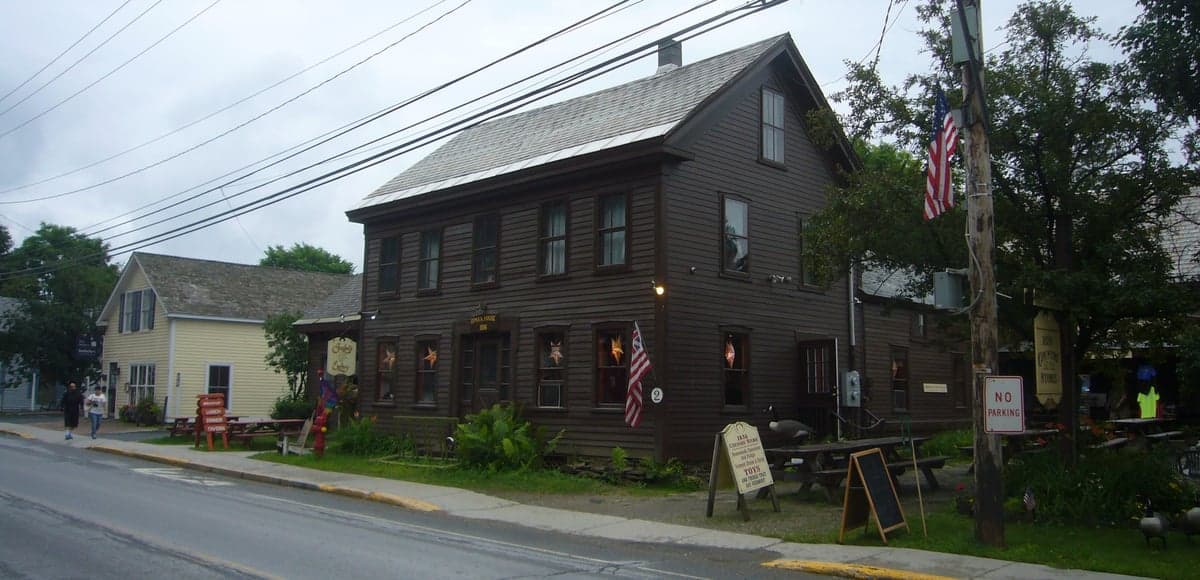
Wilmington’s human history begins with its 1753 land grant from New Hampshire Governor Benning Wentworth, part of the New Hampshire Grants that spurred settlement in the Green Mountains. The first permanent settlers, primarily of English and Scottish descent, arrived in the late 1760s and early 1770s, drawn by the promise of fertile valley land along the Deerfield River. These early families established homesteads in what is now the Historic Downtown Wilmington district, centered around the village green, and along the river flats. The town’s early economy was driven by subsistence farming, small gristmills, and sawmills, with the population growing slowly through the 19th century. A notable wave of Irish immigrants arrived in the 1840s and 1850s, many working on the construction of the Wilmington and Deerfield River Railroad, which connected the town to broader markets. These Irish families settled in the West End neighborhood, near the rail depot, and their descendants remain a visible part of the community today. The population peaked around 1,200 in the late 1800s before declining as agriculture gave way to industry and younger generations moved to cities.
Modern era (post-1965)
The post-1965 era brought a fundamental shift in Wilmington’s population, driven not by international immigration but by domestic in-migration tied to the rise of the ski industry. The opening of Mount Snow in 1954 and its expansion through the 1960s and 1970s transformed Wilmington from a fading mill town into a seasonal resort community. This drew a wave of second-home owners and service workers from the Boston and New York metropolitan areas, many of whom were white and college-educated. These newcomers concentrated in the Mount Snow Access Road corridor and the Haystack neighborhood, where condominium developments and vacation homes proliferated. The town’s racial composition remained overwhelmingly white—97.6% today—with no recorded Black, Asian, or Indian subcontinent populations. The 0.8% Hispanic population is a very recent and small addition, likely tied to seasonal hospitality workers. The foreign-born share of 0.0% underscores that Wilmington has not been a destination for international migration, unlike larger Vermont cities. The high college-educated rate (57.8%) reflects the influx of affluent, educated second-home owners and remote workers, who have reshaped the town’s cultural identity toward an outdoors-oriented, environmentally conscious, and politically moderate-to-liberal character.
The future
Wilmington’s population is projected to remain small and demographically stable, with modest growth driven by continued domestic in-migration of remote workers and retirees seeking a rural lifestyle near ski resorts. The town is not becoming more diverse in racial or ethnic terms; the 0.0% foreign-born share and near-total white population are likely to persist, as there are no major employers or housing developments attracting international migrants. The Lake Raponda area and the North Wilmington district are seeing new single-family home construction, primarily attracting white, college-educated families from out of state. The cultural identity is evolving from a traditional Yankee farming community to a more cosmopolitan resort town, with tensions between long-term residents and newcomers over development and property taxes. For someone moving in now, Wilmington offers a safe, highly educated, and homogeneous community with strong social cohesion, but little racial or ethnic diversity—a place where the population is stable, affluent, and deeply connected to the outdoor recreation economy.
In summary, Wilmington is becoming a haven for educated, white, domestic migrants drawn by the ski industry and remote work, with no meaningful racial or ethnic diversification on the horizon. For a conservative-leaning family or individual, this means a community with low crime, high educational standards, and a shared cultural baseline, but also one where property values and taxes are rising due to demand from out-of-state buyers.

* Values derived from national, state, county, city and local statistics and may differ in a specific area. Last updated: 2026-10-16T23:54:53.000Z
Narrative content on this page is AI-generated and may contain mistakes. Verify any details that matter before acting on them.
ReloMaps may earn a commission from affiliate links at no extra cost to you.

