
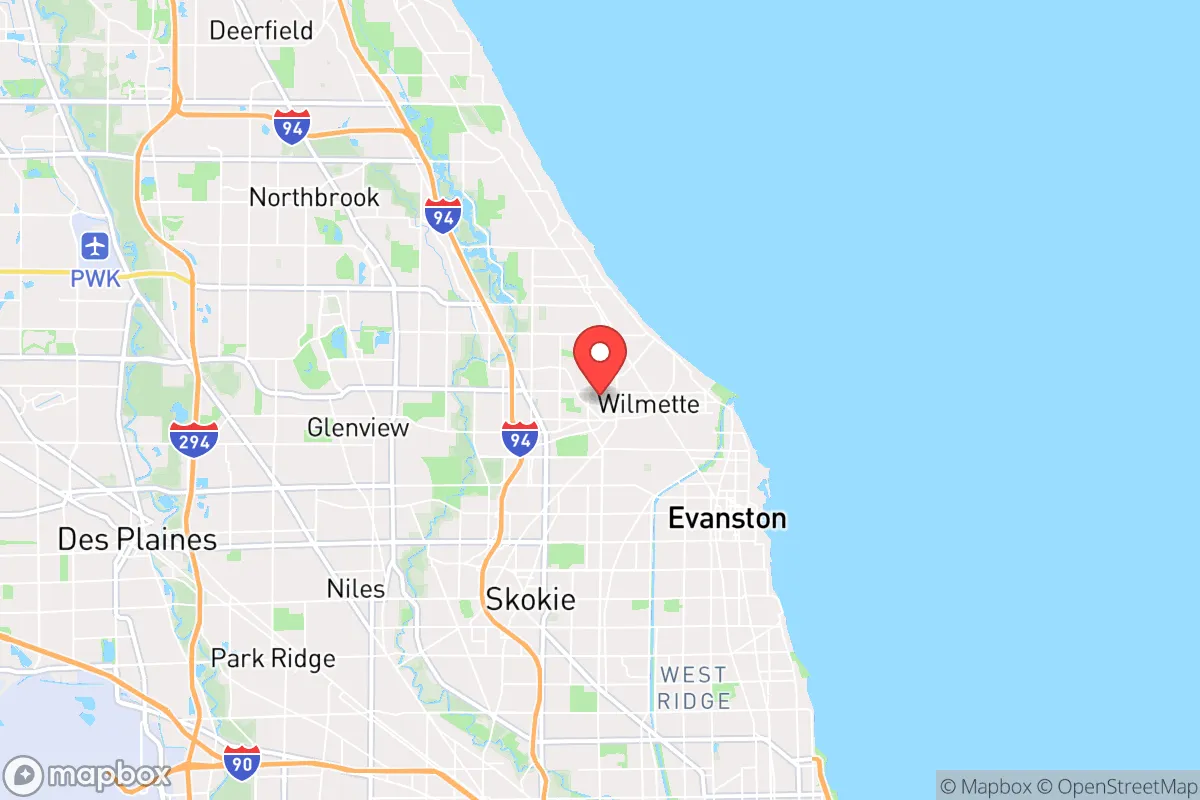
Photo: Wikipedia
Political ClimatePolitical Climate in Wilmette, IL
District shown is the primary district for this city’s centroid. Cities may span multiple districts.
Local Political AnalysisPolitical Analysis of Wilmette, IL
Wilmette has long been one of the most reliably Democratic communities in Illinois, and that reputation has only solidified over the past decade. The Cook Partisan Voting Index (PVI) for the area sits at D+19, meaning the village votes about 19 points more Democratic than the national average. That’s a full 12 points bluer than the state of Illinois as a whole, which has a Cook PVI of D+7. In practical terms, you can expect Democratic presidential candidates to carry Wilmette by margins of 65-70% or more, and local offices like state representative and county commissioner have been held by Democrats for years without serious Republican challenges. The trajectory is toward even deeper blue territory, driven by an influx of highly educated professionals from Chicago and a younger generation of families who prioritize progressive policies on climate, schools, and social equity.
How it compares
Wilmette’s D+19 PVI makes it one of the most Democratic suburbs in the entire Chicago metro area, but it’s not an outlier. Neighboring communities like Winnetka (D+18) and Kenilworth (D+16) are similarly liberal, while Glencoe and Highland Park to the north also lean heavily Democratic. The real contrast comes when you drive just a few miles west or south. For example, Northbrook and Glenview are still blue but closer to D+10 or D+12, and once you hit Arlington Heights or Mount Prospect, the numbers drop into the D+5 to D+8 range. Head further out to places like Barrington or Lake Zurich, and you’ll find Republican-leaning pockets. Even within Cook County, Wilmette stands out: the county as a whole is D+15, so Wilmette is actually a bit more Democratic than the county average. Compared to Illinois as a whole, which is D+7, Wilmette is in a different political universe—more like Evanston (D+22) or Oak Park (D+20) than the rest of the state.
What this means for residents
For liberal residents, Wilmette’s political climate means their values are reflected in local governance. The village board, school board, and library board are all reliably progressive, which translates into policies like robust funding for public schools, sustainability initiatives (Wilmette has a Climate Action Plan targeting net-zero emissions by 2050), and inclusive community programs. Conservative residents, meanwhile, are a distinct minority but not invisible. You’ll find them in local Republican clubs and at village board meetings where they often raise concerns about property taxes—which are high, even by Illinois standards—and push back on what they see as overreach in zoning or spending. In practice, being a conservative in Wilmette means you’re unlikely to see your preferred candidates win local elections, but you’re also not marginalized; the community is generally civil and respectful, and many issues like school quality and public safety enjoy broad bipartisan support. The real tension isn’t between left and right so much as between different factions of the Democratic coalition—for instance, between newer residents who want denser, more walkable development and longtime homeowners who prize the village’s quiet, suburban character.
Culturally, Wilmette’s political lean shows up in everyday life. The village is home to the Baháʼí House of Worship, a symbol of interfaith unity that draws visitors from around the world, and the local library and park district regularly host events on diversity and inclusion. You’ll see more “Black Lives Matter” signs than “Thin Blue Line” flags, and the farmers market is a hub for organic, locally sourced goods. That said, Wilmette is still a wealthy, predominantly white suburb, and its progressive politics sometimes clash with the realities of economic privilege. The school district, New Trier Township High School, is one of the best in the state but also one of the most expensive to fund, and debates over equity in admissions and resource allocation are ongoing. Looking ahead, Wilmette’s political trajectory seems set: as the Chicago metro area continues to diversify and the national Democratic Party shifts left, the village will likely remain a stronghold of liberal suburban politics, with occasional internal debates over how far and how fast to push change.

State Political ClimatePolitical Climate in Illinois
State Political AnalysisPolitical Environment in the State
Illinois is a solidly Democratic state with a Cook PVI of D+7, meaning it leans about 7 points more Democratic than the national average in presidential elections. The state’s political trajectory over the last 10-20 years has been a steady march leftward, driven overwhelmingly by the Chicago metropolitan area, while downstate regions have become increasingly Republican and resentful of Springfield’s one-party control. For a conservative relocator, the reality is a state where your vote in statewide races is effectively canceled out by Cook County, but where local control in many counties still offers a very different political experience.
Urban vs. rural divide
The political map of Illinois is a tale of two states. The Chicago metro area—Cook County and the collar counties of DuPage, Lake, Kane, and Will—generates the vast majority of Democratic votes. Chicago itself is a deep-blue stronghold, with wards like the 49th on the North Side routinely delivering 80%+ margins for Democrats. The collar counties have been trending blue for a decade; DuPage County, once a Republican bastion, voted for Joe Biden in 2020 and has a Democratic county board chair. Meanwhile, downstate Illinois is overwhelmingly red. Counties like Effingham, Macon, and Williamson routinely vote 70%+ Republican. The divide is stark: drive 90 minutes southwest of Chicago to a town like Morris in Grundy County, and you’ll find a conservative farming community that feels completely disconnected from the politics of the state capital. The I-55 corridor is a living political gradient, with the blue fading to purple around Bloomington-Normal (home to Illinois State University and State Farm) and turning solid red by the time you hit Decatur or Carbondale.
Policy environment
Illinois’s policy environment is defined by a progressive tax structure (a flat income tax rate of 4.95% after a failed 2020 graduated-rate amendment), high property taxes (second-highest in the nation, averaging over 2% of home value), and a regulatory posture that leans heavily toward labor and environmental interests. The state has a $15 minimum wage, strong collective bargaining protections, and a “clean energy” law mandating 100% carbon-free electricity by 2050. On education, Illinois spends heavily per pupil (top 10 nationally), but the system is deeply unequal: wealthy suburban districts like New Trier Township (Winnetka) spend over $25,000 per student, while rural districts like Galena struggle with declining enrollment and underfunded pensions. Healthcare policy is expansive: Illinois expanded Medicaid under the ACA, has a state-based health insurance exchange, and passed a law protecting abortion access and gender-affirming care for out-of-state patients. Election laws are among the most liberal in the country: automatic voter registration, no-excuse mail-in voting, and same-day registration are all in place. For conservatives, the policy environment feels like a one-party progressive agenda, with little room for dissent in Springfield.
Recent policy direction
The last five years have seen a flurry of legislation that signals where Illinois is headed. On gun and self-defense law, Illinois passed a ban on assault weapons and high-capacity magazines in 2023 (the Protect Illinois Communities Act), which is currently being challenged in court but remains in effect. The state also has a Firearm Owners Identification (FOID) card system and a 72-hour waiting period for handgun purchases. On parental and education rights, Illinois has moved in the opposite direction of many red states: it passed a law requiring schools to teach LGBTQ+ history, and it prohibits school boards from banning books based on “partisan or ideological” grounds. Speech and privacy are protected under the state constitution, but the state has also expanded surveillance through automatic license plate readers and a statewide crime intelligence database. Medical and bodily autonomy is fully protected: abortion is legal up to viability, and Illinois has become a regional haven for women from neighboring states like Missouri and Indiana. Property rights are constrained by high property taxes and a strong eminent domain framework, but there is no statewide rent control. Voting and ballot access have been expanded: Illinois now has automatic voter registration at DMVs, same-day registration, and no-excuse mail-in voting. The overall direction is a state that is doubling down on progressive governance, with little appetite for compromise on cultural or economic issues.
Civil unrest & political movements
Illinois has seen its share of political flashpoints. The 2020 George Floyd protests in Chicago were among the largest and most destructive in the country, with looting and property damage in the Loop and along the Magnificent Mile. Since then, organized activist movements on the left have focused on police reform (Illinois passed a sweeping police reform bill in 2021 that banned chokeholds and required body cameras) and immigrant rights. Illinois is a sanctuary state, with the Trust Act prohibiting local law enforcement from cooperating with federal immigration authorities except in limited circumstances. On the right, there is a growing “secession” movement in downstate counties—Effingham County and Moultrie County have passed symbolic resolutions calling for a new state of “Illinois” to be formed from the 46 counties outside Cook. These are non-binding and have no legal force, but they reflect deep frustration. Election integrity controversies have been minimal compared to states like Arizona or Georgia, but conservative activists have raised concerns about the state’s mail-in voting system and the lack of voter ID requirements. A new resident in a downstate town like Quincy will see “Let’s Go Brandon” flags and Trump signs, while a resident in Oak Park will see Black Lives Matter and Pride flags. The two Illinoises coexist, but they don’t mix.
Projection
Over the next 5-10 years, Illinois is likely to become even more Democratic at the statewide level. The Chicago metro area continues to grow in population and political influence, while downstate counties are losing residents to out-migration. The 2020 census cost Illinois one congressional seat, and the next reapportionment could cost another. In-migration from blue states like California and New York is modest, but the people who do move to Illinois tend to settle in the Chicago suburbs, reinforcing the existing political balance. The state’s fiscal challenges—a massive unfunded pension liability ($140 billion and growing) and high property taxes—will likely force some kind of tax reform, but don’t expect a shift to a more conservative fiscal policy. The Democratic supermajority in Springfield is entrenched, and the state’s political culture is one of one-party rule. For a conservative moving in now, the realistic expectation is that you will be a permanent minority in statewide elections, but you can find like-minded communities in places like Edwardsville (Madison County) or Moline (Rock Island County), where local government is still Republican-controlled and the culture is more traditional.
For a new resident, the bottom line is this: Illinois offers a high level of personal freedom on social issues (abortion, LGBTQ+ rights, drug decriminalization) but a heavy hand on economic and regulatory matters (high taxes, strong unions, strict gun laws). If you’re a conservative who values low taxes and gun rights, you will find Illinois frustrating at the state level but livable in many downstate or exurban communities. If you’re a liberal, you’ll find a state that largely aligns with your values, especially in the Chicago area. The key is to choose your location carefully—the political reality of Naperville is very different from that of Harrisburg, even though they’re in the same state. Know which Illinois you’re moving to before you sign the lease.
* Values derived from national, state, county, city and local statistics and may differ in a specific area. Last updated: 2026-10-08T15:03:45.000Z
Narrative content on this page is AI-generated and may contain mistakes. Verify any details that matter before acting on them.
ReloMaps may earn a commission from affiliate links at no extra cost to you.

