
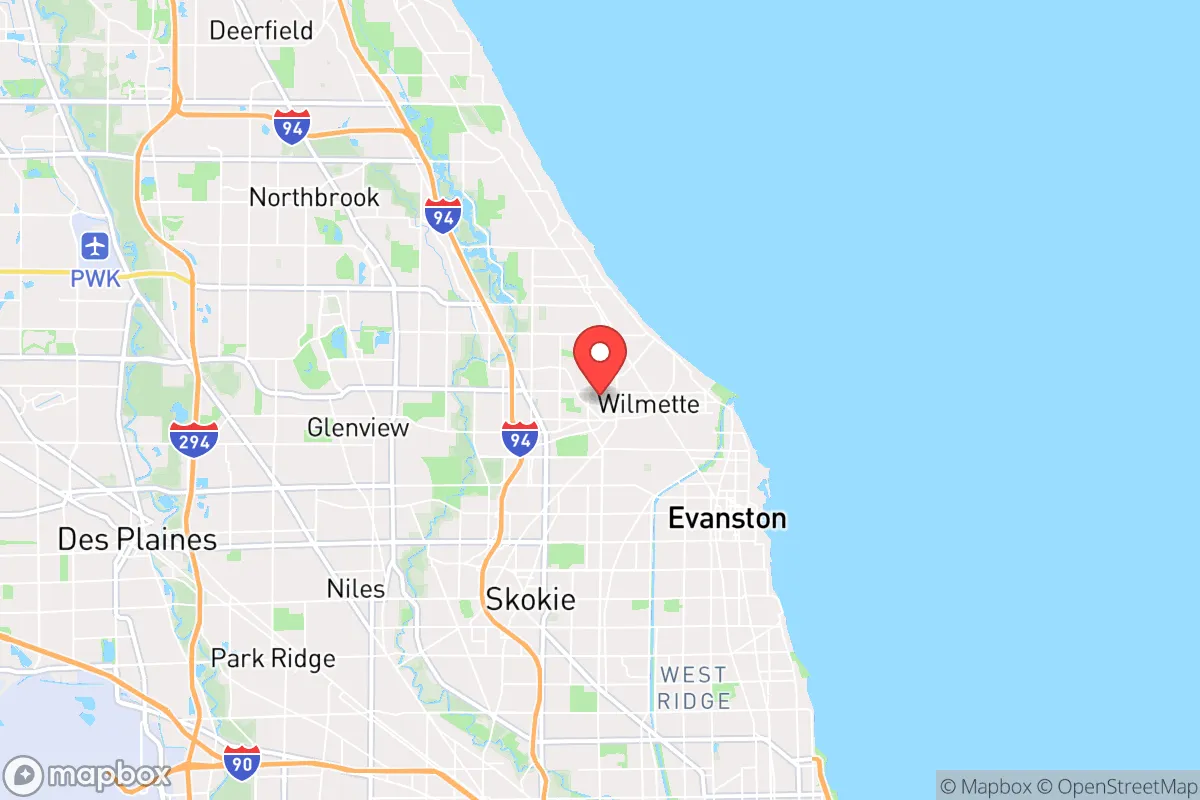
Photo: Wikipedia
Personal Sovereignty in Wilmette, IL
Viable for self-reliance. Generally workable, though some barriers may limit total independence.
What does Personal Sovereignty tell us?
Personal Sovereignty measures your capacity for self-reliance and independence with minimal government friction. Higher scores mean fewer barriers between you and the way you want to live... but it assumes you have the space you need and good neighbors.
What does this tell us?
Personal Sovereignty measures your capacity for self-reliance and independence with minimal government friction. Higher scores mean fewer barriers between you and the way you want to live... but it assumes you have the space you need and good neighbors.
State Policy
Energy independence: Importer (45% of energy produced in-state)
Personal Liberty
Homesteading

Personal Liberty Analysis
Wilmette, Illinois, presents a complex personal sovereignty landscape where high property taxes and dense state-level regulation coexist with strong local property rights and a deeply engaged civic culture. For a conservative-leaning individual or family prioritizing autonomy, the village offers excellent public services and a stable community, but the financial and regulatory costs of that stability are significant. The trade-off is clear: you gain a high degree of personal security and local control over your immediate property, but you surrender a substantial portion of your income to state and local government, and your ability to live entirely outside the system is severely limited.
Tax burden and regulatory posture in Wilmette
The single largest constraint on personal sovereignty in Wilmette is the property tax burden. Cook County, combined with Wilmette’s top-rated school districts (New Trier Township High School District 203 and Wilmette School District 39), produces effective property tax rates that often exceed 2.0% of a home’s assessed value annually. On a median home value of roughly $700,000–$900,000, this translates to an annual tax bill of $14,000–$18,000 or more. This is a direct, recurring claim on your financial autonomy. The state income tax, a flat 4.95%, adds another layer, and Illinois’s overall tax burden ranks among the highest in the nation. For a freedom-oriented individual, this means a significant portion of your labor is pre-committed to government services before you can allocate it to your own priorities.
Regulatory posture in Wilmette is best described as "highly managed." The village operates under a strict zoning code that governs everything from fence heights and setback requirements to the color of your front door in historic districts. Home-based businesses are permitted but subject to limitations on signage, traffic, and employees. The permitting process for major renovations or new construction is thorough and can be slow, reflecting a community that values aesthetic consistency and neighborly input over individual expedience. This is not a "do what you want" environment; it is a "do what the community agrees upon" environment, enforced by a professional village staff and an active zoning board of appeals. For someone who values the right to modify their property without bureaucratic oversight, this will feel restrictive.
Self-defense and gun law specifics in Illinois
Illinois is a "shall-issue" state for concealed carry licenses (CCL), but the process is among the most onerous in the country. Applicants must complete 16 hours of certified training, pass a live-fire qualification, and submit fingerprints (which expedites processing). The state also requires a Firearm Owner’s Identification (FOID) card to possess any firearm or ammunition, a separate background check process that can take weeks. Wilmette itself does not have additional local gun ordinances beyond state law, but the village is located in Cook County, which has its own county-level restrictions. Cook County bans the possession of assault weapons and large-capacity magazines (defined as over 10 rounds for long guns and 15 for handguns), though these county laws have faced legal challenges and enforcement varies. For a self-defense-minded resident, the practical reality is that carrying a firearm for personal protection is legally possible but requires significant administrative effort and financial cost, and your choice of defensive firearm is constrained by county law. The legal environment clearly prioritizes regulated access over individual discretion.
Use of force law in Illinois follows the "Castle Doctrine," meaning there is no duty to retreat from your home or vehicle if you are lawfully present and facing a threat. However, Illinois does not have a "Stand Your Ground" law outside the home; in public spaces, you have a duty to retreat if it is safe to do so before using deadly force. This nuance places a higher burden on the individual to de-escalate or avoid confrontation, which may be a consideration for those who prioritize unambiguous self-defense rights.
Self-reliance and homesteading viability in Wilmette
Wilmette is a dense, fully suburbanized community with very limited opportunities for traditional homesteading or off-grid living. Standard residential lots are typically 50 to 75 feet wide and 125 to 150 feet deep, yielding about one-quarter to one-third of an acre. While this allows for substantial vegetable gardens, chicken coops (permitted with a permit and setback restrictions), and composting, it does not support livestock, significant timber harvesting, or any meaningful energy independence. The village code requires connection to municipal water and sewer; there is no legal path to well water or septic systems on a standard residential lot. Solar panels are permitted but subject to aesthetic review, and net metering is available through ComEd, but the dense tree canopy in many parts of Wilmette limits solar viability. Off-grid living—defined as disconnection from municipal utilities—is effectively impossible within village limits. Self-reliance in Wilmette means being a highly competent suburban homeowner who can maintain a house, garden, and small workshop, not a rural homesteader.
For those seeking more land, the surrounding North Shore suburbs (like Northfield or Glenview) offer larger lots, but the regulatory environment remains similar. True rural autonomy requires moving at least 45 minutes west or south, into areas like McHenry County or downstate Illinois, where zoning is looser and property taxes are lower.
Personal liberties: parental rights, medical autonomy, speech, and property
Illinois is a state with strong protections for certain personal liberties and significant restrictions on others. On parental rights, Illinois law gives parents broad authority over their children’s education and healthcare, but the state has also passed laws that can override parental consent in specific areas, such as reproductive healthcare for minors. School districts in Wilmette, particularly New Trier High School, are known for progressive curricula and active diversity, equity, and inclusion programs. A parent who wants to opt their child out of specific lessons or materials has a legal right to do so, but the social and administrative friction can be high. Homeschooling is legal and requires notification to the local school district, but Illinois has relatively low regulatory oversight compared to states like New York.
Medical autonomy is mixed. Illinois has legalized recreational cannabis, which is a clear win for personal choice, but the state also maintains a strict prescription drug monitoring program and has some of the highest vaccination mandates for school attendance in the nation. The COVID-19 pandemic saw Wilmette’s local government and schools implement mask mandates and remote learning policies that were among the most restrictive in the region, reflecting a community that broadly deferred to public health authority. For someone who prioritizes medical freedom, this history is a significant data point.
Freedom of speech is protected under the First Amendment, and Wilmette has no local ordinances that restrict political signage or public expression beyond standard time, place, and manner regulations. Property rights are strong in the sense that eminent domain is rarely used, but the aforementioned zoning and historic preservation rules mean your right to use your property as you see fit is heavily mediated by community standards. You can paint your house any color you like—as long as it’s on the approved palette for your block.
Overall, personal sovereignty in Wilmette is best understood as a trade-off: you exchange a high degree of financial and regulatory autonomy for a safe, well-managed, and predictable environment with excellent schools and low crime. For a conservative-leaning individual who values self-reliance, the financial burden of property taxes and the regulatory friction of zoning and gun laws will be the primary frustrations. For a family that prioritizes safety, education, and community stability, the constraints may feel like a reasonable price. Compared to a low-tax, low-regulation state like Texas or Florida, Wilmette is a heavy-touch environment. Compared to other dense, high-tax suburbs in the Northeast or California, it is fairly typical. The key insight for a relocation decision is that personal sovereignty here is exercised through civic engagement and property stewardship, not through independence from the system itself.

* Values derived from national, state, county, city and local statistics and may differ in a specific area. Last updated: 2026-10-08T15:03:45.000Z
Narrative content on this page is AI-generated and may contain mistakes. Verify any details that matter before acting on them.
ReloMaps may earn a commission from affiliate links at no extra cost to you.

