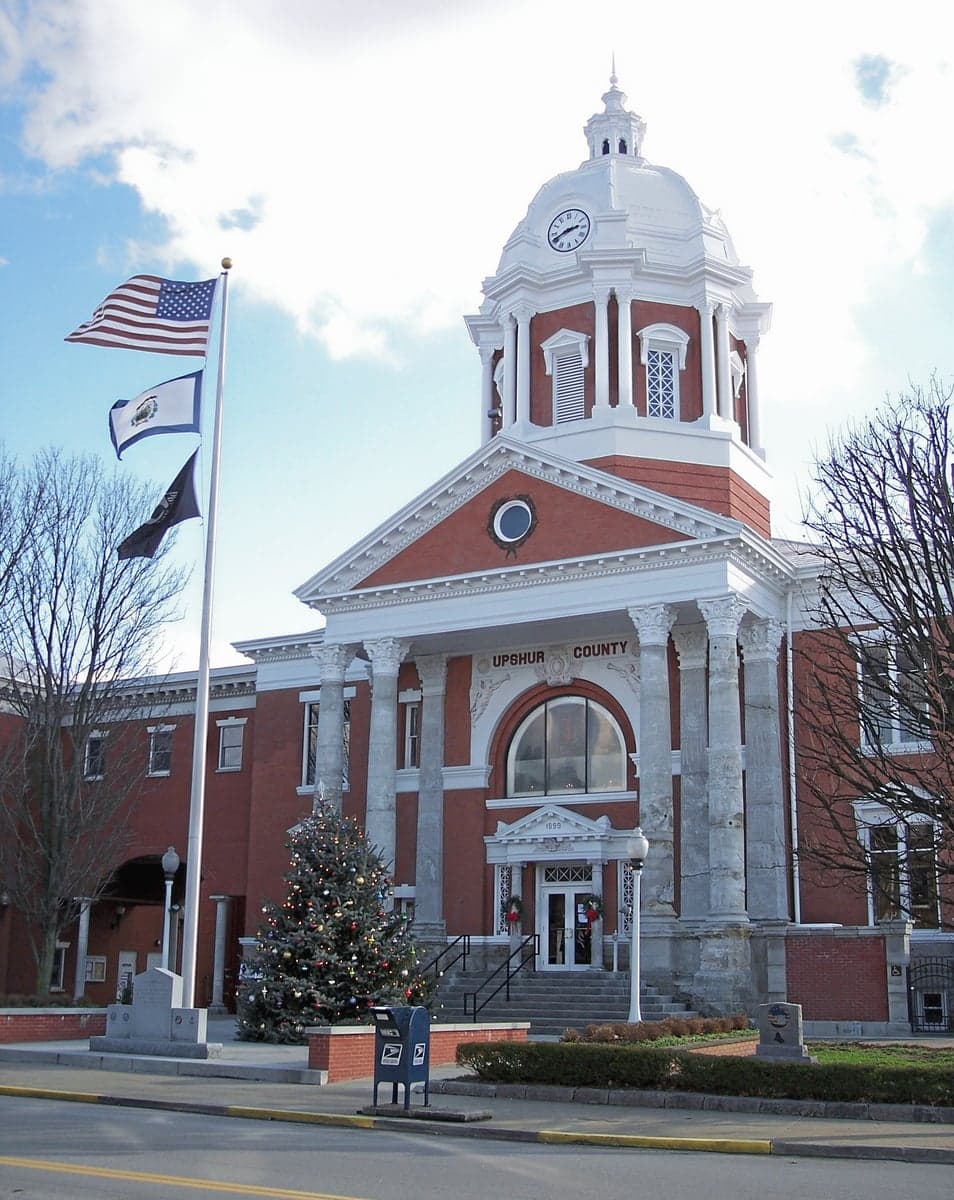
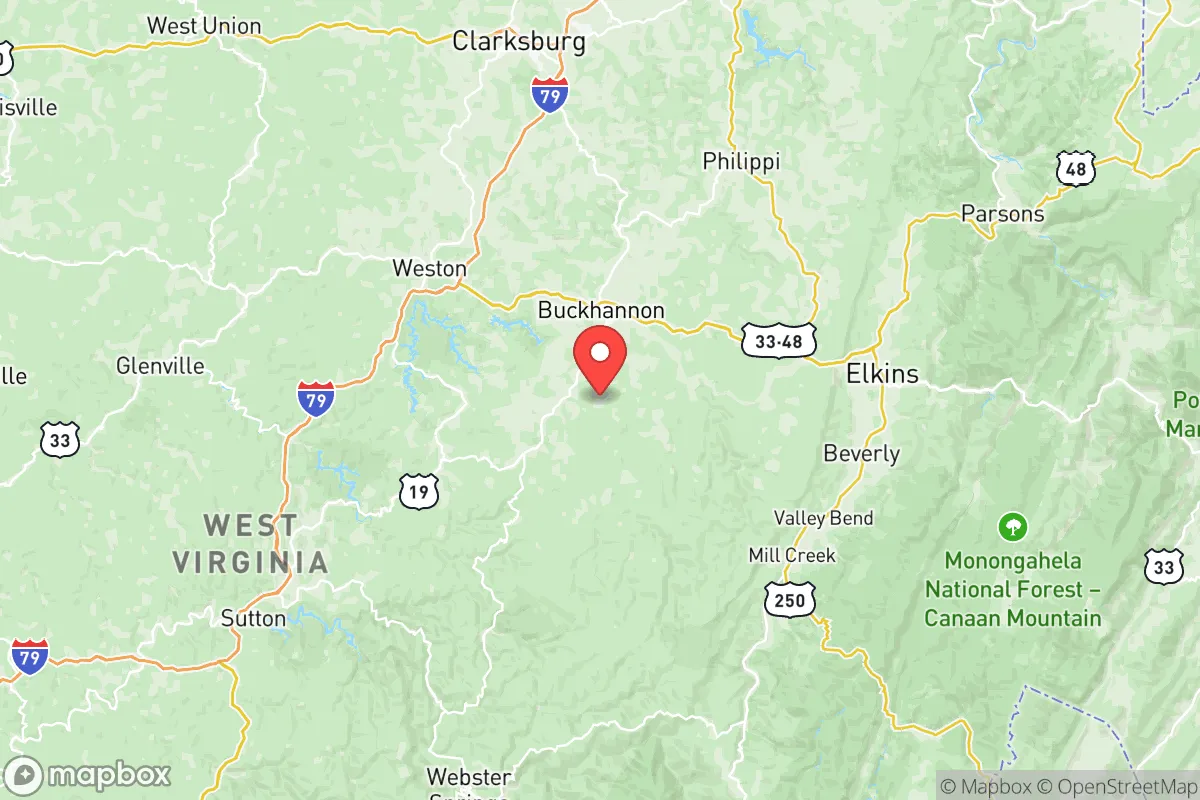
Photo: Wikipedia
Political ClimatePolitical Climate in Upshur County
Showing district-level results — no local-only data available.
Local Political AnalysisPolitical Analysis of Upshur County
Upshur County, West Virginia, is deeply Republican and has been for a long time. With a Cook Partisan Voting Index of R+20, it’s slightly less Republican than the state as a whole, which sits at R+21, but that’s a meaningless hair-splitting distinction on the ground. In practice, the county has been getting redder with each cycle, especially outside the county seat of Buckhannon. The last time a Democrat carried Upshur County in a presidential race was way back in 1996, and since then, the GOP margin has only widened—Donald Trump took over 78% of the vote here in 2020, a number that likely held or grew in 2024. Local politics follow the same trend: Republicans hold every county commission seat, every magisterial district judge slot, and supermajorities on the board of education.
How it compares to West Virginia
Statewide, West Virginia is R+21, making it one of the most Republican states in the nation. Upshur County’s R+20 means it’s basically a mirror image of the state’s political complexion. But there’s nuance. The real divide in Upshur isn’t between parties—it’s between Buckhannon and everywhere else. Buckhannon, home to West Virginia Wesleyan College and a small but noticeable student population, is the county’s lone blue dot. Precincts around downtown Buckhannon and near the campus can swing 45-50% Democratic in some elections, especially when there’s a moderate Democrat on the ballot. Meanwhile, the rural outlying communities—places like Rock Cave, French Creek, and Tallmansville—vote 85-90% Republican every cycle. The swing precincts are really in the more developed suburban edges of Buckhannon, like the areas along Old Weston Road, where you’ll see a mix of college faculty, hospital workers, and retired union families; those precincts usually break 60-65% Republican but are the first to flip if the GOP candidate stumbles. This town-country split is more pronounced in Upshur than in many other parts of the state, because Buckhannon is the only real population center for miles.
What this means for residents
For conservative residents, Upshur County is extremely comfortable. Your values dominate local school board decisions—prayer at graduation, book selection, and parental notification policies—and the county commission rarely faces serious primary challenges. The Buckhannon City Council is nonpartisan, but even there, conservative voices hold the majority. For liberal residents, life is a little different. You’re definitely in the minority, but Buckhannon provides a bit of a bubble. The college and the arts scene mean you’ll find like-minded people at local coffee shops, the public library, or community events like the West Virginia Strawberry Festival (which is famously non-political). Statewide politics can feel frustrating—your vote for governor or Senate is effectively irrelevant—but local elections are winnable: Democrats have held at-large city council seats and school board positions within the last decade. The real impact is social: political conversations at family gatherings or at the hardware store can get tense if you bring up national politics, but most folks also know that neighbors are neighbors, and in a small county like this, you help each other out regardless of how you vote. The biggest practical effect is probably taxes: with a conservative commission, county levies stay low, but services like road maintenance and public transit are also minimal compared to more urban areas.
Culturally, Upshur County is defined by a strong rural independence and a certain wariness of outside influence—whether from Charleston or Washington. Gun rights are a given; the county has a Second Amendment sanctuary resolution on the books. Religious conservatism is more visible here than in some other parts of the state, with dozens of independent Baptist and Methodist churches dotting the country roads. But it’s not all one note: Buckhannon’s small but visible LGBTQ community has held Pride events for several years, and the community response has been mostly live-and-let-live, with occasional pushback from a vocal minority. The biggest policy distinction from the rest of West Virginia? Upshur County is one of the few counties in the state that has consistently rejected school consolidation proposals, keeping small K-8 schools alive in places like French Creek and Hodgesville, even when state officials pushed for mergers. That local control—the idea that decisions should be made at the county level, not in Charleston—is what ties the politics here together, regardless of party. The trajectory is pretty clear: Upshur will keep trending red, but the town-country split will likely widen, and the heated national fights will affect school board and city council races more than they used to. For newcomers, the key is understanding that unless you’re living in the Buckhannon city limits, you’re living in an overwhelmingly conservative area, and the political climate reflects that directly in your daily life—from the local paper’s editorial stance to the topics that dominate conversation at the diner.

State Political ClimatePolitical Climate in West Virginia
State Political AnalysisPolitical Environment in the State
West Virginia is one of the most reliably Republican states in the nation, with a Cook PVI of R+21, but it wasn't always this way. For generations, the state was a Democratic stronghold thanks to its powerful labor unions and coal industry, but a dramatic realignment over the past 20 years has flipped it deep red. Today, the dominant coalition is a mix of working-class cultural conservatives, small-government libertarians, and retirees fleeing high-tax states, creating an environment where Democrats rarely win statewide office and the primary election is often the real contest. This shift is reflected everywhere from the statehouse in Charleston to the county commissions in places like Morgantown, where the old union vote has been replaced by a solidly Republican majority.
Urban vs. rural divide
The political geography of West Virginia is striking, with a clear urban-rural split that's even more pronounced than in many other states. The only truly blue stronghold is Morgantown, home to West Virginia University, where the student population and academic workforce keep Monongalia County competitive for Democrats in down-ballot races. Charleston and Huntington, the state's other major population centers, are more purple but are trending redder—Kanawha County (Charleston) voted for Trump by 21 points in 2024, while Cabell County (Huntington) went for Trump by 36 points. Meanwhile, rural counties like McDowell and Mingo in the southern coalfields vote Republican by margins exceeding 70 percent, a stark reversal from the days when they were solidly Democratic. This means a new resident in Morgantown might encounter a politically mixed social circle, while someone in Lewisburg or Shepherdstown will find a deeply conservative community.
Policy environment
West Virginia's policy environment is aggressively pro-business and socially conservative, with a low-tax, low-regulation posture that appeals to many relocators. There is no state income tax on Social Security benefits, and the state has been phasing out its personal income tax, with a current top rate of 5.12% and a goal of elimination. Property taxes are among the lowest in the nation, and the state is a "right-to-work" state, meaning union membership is not mandatory. On social issues, the state has some of the strictest abortion laws in the country—triggering a near-total ban after Roe v. Wade fell—and permits concealed carry without a permit. The election laws are straightforward: voter ID is required, early voting is available for 10 days, and same-day voter registration is not permitted. For a conservative relocator, the tax and gun policies are major draws; a liberal relocator will find the social policies restrictive, though charter schools and school choice are expanding.
Recent policy direction
The last few years have seen an acceleration of the state's conservative trajectory, with the legislature and Governor Jim Justice pursuing a full-spectrum libertarian-conservative agenda. In 2023, the state passed a near-total abortion ban with no exceptions for rape or incest, and it enacted a law prohibiting transgender athletes from participating in girls' sports. The Second Amendment was strengthened with the "Constitutional Carry" law, allowing any law-abiding adult to carry a concealed firearm without a permit. On education, the state created a universal school choice program in 2022, allowing families to use public funds for private school tuition, homeschooling, or tutoring. Property rights were bolstered with a law limiting the ability of counties to enforce certain building codes on farmland. On taxation, the state accelerated its income tax cuts, with a trigger mechanism that could bring the top rate below 4% by 2028. For voting, the state tightened its voter ID laws and purged inactive voters from rolls, a move that pleased election integrity advocates but drew criticism from voting rights groups.
Civil unrest & political movements
Political activism in West Virginia is often tied to industry and land use, with the "Keep It in the Ground" movement in places like Fayetteville clashing with pro-coal interests in Beckley. Major protests have been rare, but the 2018 teachers' strike shut down every school in the state for nine days, forcing the GOP-led legislature to approve a 5% pay raise—a rare instance of broad-based labor action crossing party lines. There is a vocal anti-vaccine and anti-mandate movement, particularly strong in rural counties like Grant and Hardy, and the state passed a law barring employer vaccine mandates in 2022. Immigration politics are muted, as West Virginia has one of the lowest foreign-born populations in the US, and there are no sanctuary cities. Secession or nullification rhetoric occasionally surfaces in conservative circles, particularly around federal gun laws, but it remains fringe. The most visible flashpoint any new resident will notice is the ubiquity of "Trump Won" flags and "Fuck Biden" stickers on pickup trucks, particularly in Morgantown's outskirts and along the I-79 corridor.
Projection
Over the next 5-10 years, West Virginia is likely to become even more Republican as the state continues to lose population—particularly younger, more liberal residents—while attracting conservative retirees from high-tax states like New York and California. The in-migration is small but growing, concentrated in communities like Shepherdstown and Berkeley Springs in the Eastern Panhandle, where Washington, D.C., exiles and remote workers are settling. This influx tends to reinforce the state's conservative lean, as these newcomers are often drawn by the low taxes and gun laws. The Democratic Party in the state is at its weakest point in modern history, with no real path to statewide victory unless a moderate populist candidate emerges. The income tax will likely be fully eliminated within a decade, further differentiating West Virginia from neighboring Maryland and Virginia. Expect continued battles over school choice expansion, abortion access, and energy policy, but the overall direction is clear: the state will remain one of the most conservative in the union, with a policy environment that favors individual liberty over government intervention.
For a new resident, the bottom line is that West Virginia is a place where your politics will largely be unremarkable if you're conservative, especially in rural areas. If you're liberal, you'll find your views in the minority, but you'll also find that most people are more interested in hunting, fishing, and helping a neighbor than in political arguments. The practical takeaway is this: the tax savings and gun-friendly laws are real, but so is the limited diversity in services and social options. If you value low taxes, self-reliance, and a slower pace, West Virginia will feel like a perfect fit. If you want progressive social policies or a thriving urban scene, you'll need to look elsewhere.
* Values derived from national, state, county, city and local statistics and may differ in a specific area. Last updated: 2026-06-25T04:31:13.000Z
Narrative content on this page is AI-generated and may contain mistakes. Verify any details that matter before acting on them.
ReloMaps may earn a commission from affiliate links at no extra cost to you.

