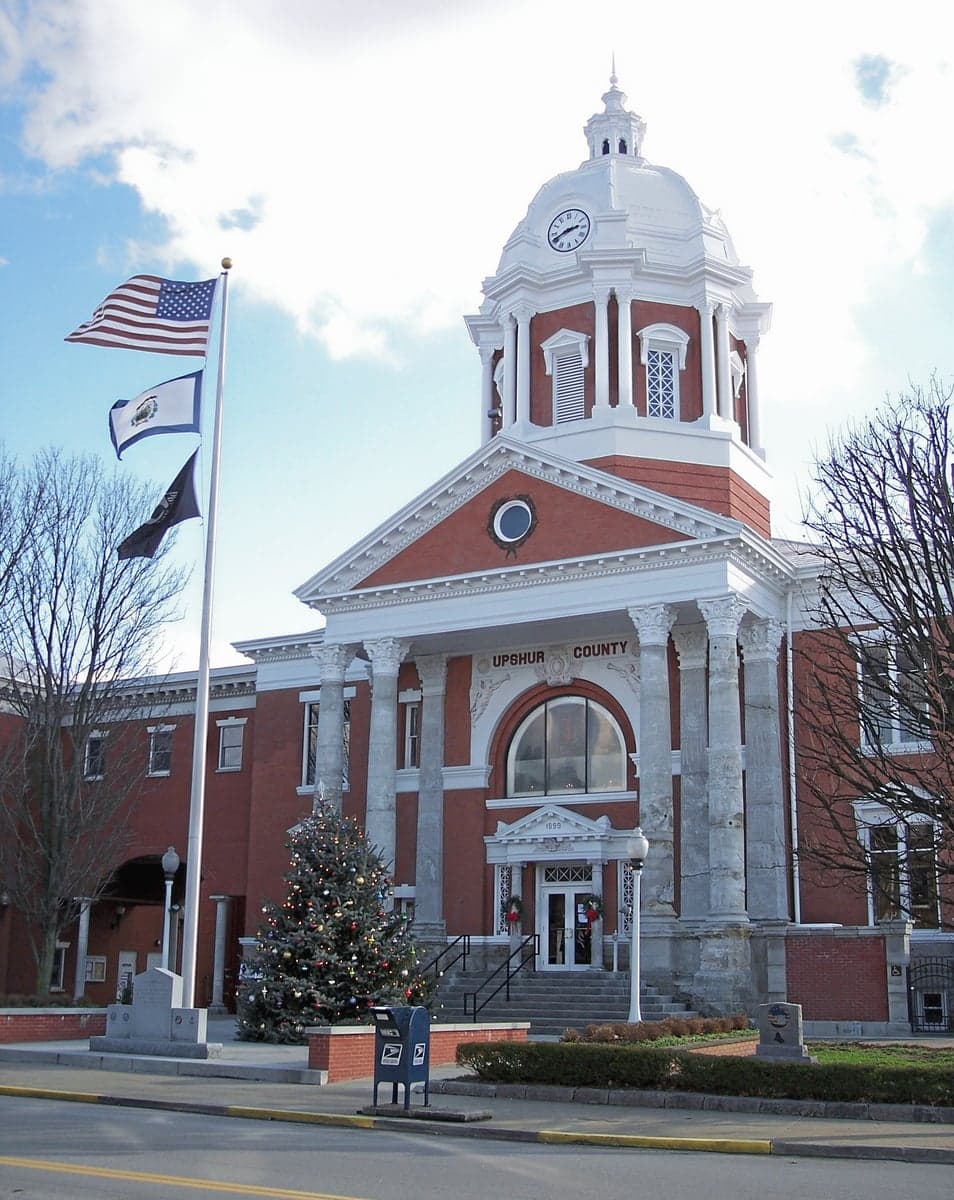
Photo: Wikipedia
Demographics of Upshur County
Affluence Level in Upshur County
A below-average socioeconomic profile. Incomes, home values, and educational attainment trail the U.S., with higher poverty and unemployment.
People of Upshur County
Upshur County, West Virginia is home to 23,758 residents who form one of the state's most homogeneous and deeply rooted populations, with a 92.2% white share that reflects minimal change since the county's 1851 founding. The county seat of Buckhannon anchors a population that is overwhelmingly native-born (99.6% U.S.-born) and predominantly rural, with a distinctive Appalachian cultural identity that persists through family networks, local churches, and community institutions. With a college attainment rate of just 17.4%, Upshur County's workforce remains oriented toward resource extraction, manufacturing, and local services rather than knowledge-industry employment — a demographic profile that shapes both the county's character and its economic trajectory.
Settlement & growth (pre-1960)
The land that became Upshur County was originally part of the vast hunting grounds of the Haudenosaunee (Iroquois) Confederacy, particularly the Seneca and Cayuga nations, who traversed the region for seasonal hunting along the Buckhannon and Little Kanawha rivers. The area saw no permanent Native settlements but was contested ground between the Iroquois and the Shawnee during the 18th century, with the Cherokee also claiming southern portions of what is now West Virginia. European encroachment began in earnest after the French and Indian War (1754–1763), when the British Crown opened trans-Appalachian lands to settlement — though the rugged, heavily forested terrain of central West Virginia delayed intensive colonization compared to the Shenandoah Valley.
The first permanent European settlers arrived in the 1760s and 1770s, overwhelmingly Scots-Irish Presbyterians moving west from Pennsylvania and Virginia's Shenandoah Valley via the Staunton-Parkersburg Turnpike. These pioneer families — the Chenoweths, Tinglers, and Rohlfs among them — established the earliest homesteads along the Buckhannon River at what is now Buckhannon, as well as smaller clusters at French Creek and Rock Cave. They were drawn by the promise of inexpensive land under Virginia's early headright system and by the absence of plantation agriculture: the steep, narrow valleys favored subsistence farming and livestock grazing over cash crops, which attracted a class of independent yeoman farmers rather than wealthy slaveholders. By 1800, the region's white population was almost entirely of Scots-Irish and English descent, with a small number of German families filtering in from Pennsylvania.
The county's formal creation in 1851, carved from parts of Lewis, Barbour, and Randolph counties, coincided with a surge in resource-extraction employment. The discovery of bituminous coal seams along the middle Buckhannon River valley, combined with the expansion of the Northwestern Virginia Railroad (completed to Buckhannon in the 1850s), transformed the economy. Coal mining drew a new wave of settlers: English and Welsh miners from Pennsylvania and Ohio, joined by small numbers of Italian and Polish laborers who arrived in the 1880s and 1890s. These immigrant miners concentrated in the coal camps around Tallmansville, Hinkleville, and Adrian, where company housing and company stores structured daily life. At their peak in the 1910s, Upshur County's mines employed over 1,500 men, making coal the dominant industry until the 1920s downturn.
Following the Civil War, a small African American population — never exceeding 5% — formed in Buckhannon and the mining towns, consisting primarily of freedmen from eastern Virginia who worked on railroad construction or in the mines. The Black population peaked around 1900 at roughly 4% of the county total, then declined steadily through the Great Migration (1915–1970), when families left for industrial jobs in Pittsburgh, Detroit, and Chicago. By 1960, Upshur County's Black population had fallen below 2%, where it has largely remained ever since. No other ethnic group settled in significant numbers during this period, as the county's relative isolation and limited industrial base attracted far fewer immigrants than West Virginia's northern panhandle or the Charleston-Huntington corridor.
The 1930s through the 1950s brought a rural-to-urban shift within the county itself, as the decline of family-scale farming and the consolidation of coal operations pushed younger residents from outlying communities like Kingsville and Truby toward Buckhannon and its expanding manufacturing base. The arrival of Weston State Hospital (in neighboring Lewis County) and the establishment of small factories — including a glass plant and a garment factory — created a modest employment base that kept the county's white, native-born population relatively stable through the mid-20th century. By 1960, Upshur County's population stood at roughly 20,000, and its ethnic composition was already 96% white and 98% U.S.-born — a profile that would change only marginally in the decades to come.
Modern era (post-1965)
The 1965 Hart-Cellar Immigration Act, which dramatically reshaped the ethnic composition of most American counties, had virtually no effect on Upshur County. The county's foreign-born population today stands at just 0.4%, making it one of the least immigrant-receiving counties in the United States. The small number of foreign-born residents who have arrived since 1965 are overwhelmingly European (primarily German and British retirees) or, in a handful of cases, medical professionals recruited by St. Joseph's Hospital in Buckhannon — the county's largest employer. There is no East/Southeast Asian enclave (0.2% of the population), no Indian subcontinent population (0.0%), and no visible Arab or North African presence. The Hispanic population has grown from virtually zero in 1990 to 1.4% today, with most Hispanic residents concentrated in Buckhannon and working in the construction and service sectors — often following seasonal patterns tied to timber and road work. This growth, while small in absolute terms, represents the county's most significant demographic change since the 1960s.
The dominant demographic trend since 1965 has not been immigration but depopulation and out-migration, driven by the collapse of the coal industry in the 1970s and 1980s and the broader deindustrialization of Appalachia. Upshur County's population peaked at 23,839 in 2010 and has hovered near 23,700 since 2020, held steady primarily by a modest inflow of retirees from other parts of West Virginia and by the relative stability of West Virginia Wesleyan College and St. Joseph's Hospital as anchors. Domestic in-migration has come almost exclusively from other Appalachian counties — workers following the Marcellus Shale natural gas boom in northern West Virginia, and families seeking lower housing costs and slower pace of life compared to larger cities like Morgantown or Charleston. These new residents are overwhelmingly white and native-born, reinforcing the county's existing demographic profile rather than diversifying it.
The African American population has remained below 2% since the 1970s, with most Black residents living in Buckhannon and working in education, healthcare, or retail — a shift from the earlier coal-camp concentration. The town of French Creek and the unincorporated community of Sand Run have seen no significant Black population in recent decades. The county's racial homogeneity is one of West Virginia's highest: among the state's 55 counties, Upshur ranks in the top five for white percentage, alongside neighboring Lewis and Barbour counties.
The future
Upshur County's population is projected to remain essentially flat through 2040, with the share of white residents likely staying above 90%. The county's population is aging — median age is 42.3, above the national average — and death rates have exceeded birth rates in seven of the last ten years, meaning natural population decline is ongoing. The only growth catalyst on the horizon is continued expansion of natural gas-related employment in the broader region, which could draw younger families from other parts of West Virginia and perhaps from Ohio and Pennsylvania. The Hispanic population may grow slowly to perhaps 2.5–3% by 2040, as construction and food-service employers continue to recruit, but no larger immigrant group is expected to arrive given the county's limited urban infrastructure, lack of ethnic support networks, and distance from major airports.
Culturally, the county is becoming more self-consciously Appalachian rather than more diverse. The revival of Buckhannon's historic Main Street, investment in the West Virginia Wildlife Center (a major tourism draw), and the continued prominence of local churches and family farms suggest a future in which Upshur County retains its rural, white, native-born character — but with a younger, more wired generation that is connected to national culture via broadband and the growing presence of remote workers. The county's college-educated share may rise slowly as telecommuting brings knowledge workers from outside, but the 17.4% figure is likely to remain well below the national average for another decade.
For someone moving in now, Upshur County offers a community that is remarkably stable in its demographics and culture — a place where 92% of residents share the same racial background, where the foreign-born presence is negligible, and where the pace of change is measured in decades rather than years. The county is not diversifying in any meaningful sense; it is instead consolidating its identity as a white, rural Appalachian enclave with an economy slowly shifting from extraction to healthcare and education. New arrivals who value ethnic and cultural homogeneity, low housing costs, and a deeply rooted sense of place will find Upshur County welcoming. Those seeking diversity or rapid growth will find it one of the least dynamic counties in the nation.

* Values derived from national, state, county, city and local statistics and may differ in a specific area. Last updated: 2026-06-25T04:31:13.000Z
Narrative content on this page is AI-generated and may contain mistakes. Verify any details that matter before acting on them.
ReloMaps may earn a commission from affiliate links at no extra cost to you.

