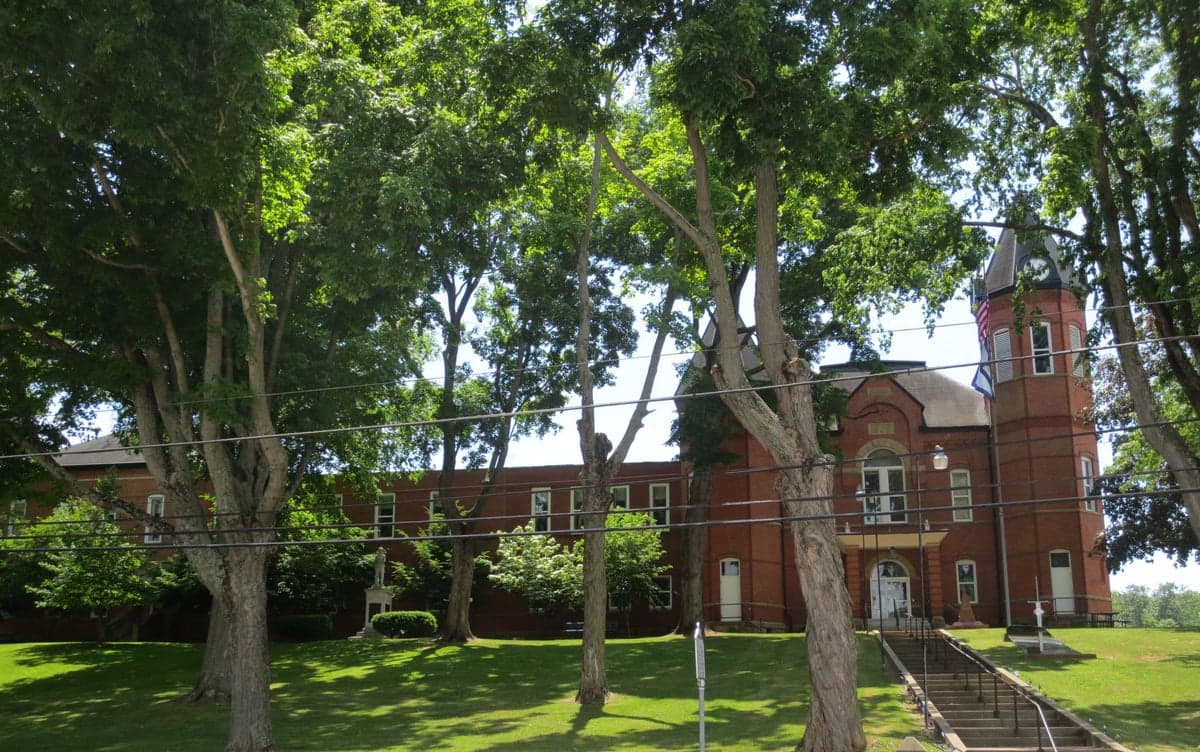
Photo: Wikipedia
Political ClimatePolitical Climate in Putnam County
Showing district-level results — no local-only data available.
Local Political AnalysisPolitical Analysis of Putnam County
Putnam County is one of the most reliably Republican strongholds in West Virginia, with a Cook Partisan Voting Index (PVI) of R+22, meaning it votes about 22 points more Republican than the national average. The county has been trending steadily redder over the past two decades, driven by a combination of out-migration of younger, more moderate voters and an influx of retirees and commuters from the Charleston area who are drawn to lower taxes and a more conservative cultural environment. In the 2024 presidential election, Donald Trump carried Putnam County with over 72% of the vote, a margin that has widened from around 65% in 2016, reflecting a broader statewide shift that has made West Virginia one of the most Republican states in the country.
How it compares
Putnam County is significantly more Republican than West Virginia as a whole, which has a Cook PVI of roughly R+22 as well, but the county's internal dynamics are more polarized than the state average. While the state has pockets of Democratic strength in the northern panhandle and the coal fields of southern West Virginia, Putnam County has no such blue enclaves. The county seat, Winfield, leans Republican but is slightly more moderate than the rest of the county, with some precincts near the Kanawha River occasionally voting within 10 points of the national average. In contrast, the town of Hurricane is a deep-red stronghold, where Republican candidates routinely win by 30 points or more, driven by its large population of commuters and retirees. The unincorporated community of Teays Valley, which straddles the border with Kanawha County, is the most politically mixed area in Putnam, with some precincts showing a more balanced split due to its proximity to Charleston and a higher concentration of white-collar professionals. Overall, Putnam County's Republican lean is about 5-7 points stronger than the state average, making it one of the most conservative counties in a state that is already among the most conservative in the nation.
What this means for residents
For conservative residents, Putnam County offers a deeply affirming political environment where Republican candidates are virtually guaranteed to win every local, state, and federal election. The county commission, school board, and all three state legislative seats are held by Republicans, and there is little organized opposition from Democrats. This means that conservative policy priorities—such as low property taxes, limited zoning regulations, and support for Second Amendment rights—are consistently enacted. For liberal residents, the political reality is more isolating. There is no active Democratic Party organization in the county, and progressive candidates rarely appear on the ballot. Socially liberal residents often find themselves in the minority on issues like gun control, abortion rights, and public education funding, and they may feel pressure to keep their political views private in social or professional settings. However, the county's strong economy and low cost of living mean that even liberal residents can find practical benefits in living here, as long as they are willing to navigate a politically homogeneous environment.
Culturally, Putnam County is more suburban and service-oriented than the rest of West Virginia, with a heavy emphasis on church attendance, family values, and community volunteerism. The county's politics are shaped less by the coal industry and more by the concerns of commuters and retirees, such as road maintenance, school quality, and tax rates. This makes Putnam County distinct from the more rural, resource-dependent parts of the state, where economic anxiety and union ties still influence voting patterns. Looking ahead, the county's political trajectory is likely to remain deeply red, with no signs of a shift toward the center, as the population continues to grow with conservative-leaning newcomers from other parts of the state and country.

State Political ClimatePolitical Climate in West Virginia
State Political AnalysisPolitical Environment in the State
West Virginia has been one of the most reliably Republican states in the nation for over two decades, but that wasn’t always the case. As recently as the 1990s, the state was a Democratic stronghold at the local level, even as it trended conservative in presidential elections. The shift accelerated after 2000, driven by cultural and economic realignment, and by 2024, Donald Trump carried the state by nearly 40 points. Today, the dominant coalition is a mix of rural conservatives, working-class voters who left the Democratic Party over gun rights and energy policy, and a growing number of out-of-state transplants seeking lower taxes and fewer regulations. The state legislature is supermajority Republican, and every statewide office is held by the GOP. The political climate is deeply conservative, but with a populist, anti-establishment streak that sometimes puts state leaders at odds with national party orthodoxy.
Urban vs. rural divide
The political map of West Virginia is a study in contrasts, but not in the way you might expect from a larger state. The only real urban center is Charleston, the capital and largest city, which leans Democratic but is surrounded by deeply red suburbs and exurbs. Kanawha County, home to Charleston, voted for Trump by about 20 points in 2024, but the city itself is more competitive, with a small but active progressive base centered around the state university system and healthcare workers. Morgantown, home to West Virginia University, is the state’s most liberal enclave, with Monongalia County voting Democratic in recent presidential cycles. The student population and faculty create a blue island in a sea of red. Huntington, the second-largest city, is more mixed—working-class and union-heavy, it has trended Republican but still elects some Democrats to local office. The real story is the rural expanse: counties like Mingo, Logan, and McDowell in the southern coalfields voted 70-80% for Trump in 2024. These areas were once solidly Democratic but flipped hard on cultural and energy issues. The Eastern Panhandle—counties like Jefferson and Berkeley—is a fast-growing region influenced by Washington, D.C. exurbs, and it’s more moderate, with some competitive local races. The divide isn’t just urban vs. rural; it’s also between the old industrial south and the newer, more suburban north and east.
Policy environment
West Virginia’s policy environment is aggressively conservative, with a focus on low taxes, limited regulation, and cultural traditionalism. The state has no personal income tax on Social Security benefits and has been phasing down its personal income tax rate—currently a flat 3.99% as of 2025, with a goal of elimination. Property taxes are among the lowest in the nation, capped by the state constitution. The regulatory posture is business-friendly, especially for energy, manufacturing, and outdoor recreation. Education policy has been a flashpoint: the state passed a broad school choice law in 2021, including charter schools and education savings accounts (ESAs) that can be used for private school tuition or homeschooling. The state also enacted a near-total ban on abortion in 2022, with no exceptions for rape or incest, only for medical emergencies. Healthcare is a mixed bag—West Virginia expanded Medicaid under the Affordable Care Act, and the state has a high rate of opioid addiction treatment access, but rural hospital closures remain a problem. Election laws are restrictive: voter ID is required, early voting is limited to 10 days, and no-excuse absentee voting was eliminated in 2023. The state also passed a law in 2024 banning ranked-choice voting and requiring all ballots to be hand-counted in future elections, a move that has drawn both praise and criticism.
Recent policy direction
The last few years have seen a flurry of legislation that signals where the state is headed. On gun rights, West Virginia became a constitutional carry state in 2016, allowing permitless concealed carry, and in 2023 passed a law prohibiting state enforcement of any future federal gun restrictions. On parental and education rights, the 2021 "Parental Bill of Rights" law requires schools to notify parents of any curriculum involving sexuality or gender identity, and a 2023 law banned transgender girls from participating in female sports. Speech and privacy laws have tightened: the state passed a law in 2024 requiring social media platforms to verify the age of users and obtain parental consent for minors, and it banned the use of TikTok on state devices. Medical and bodily autonomy is sharply restricted—abortion is banned, and the state has a 2023 law prohibiting gender-affirming care for minors. Property rights are strong, with no state-level property tax on business inventory and a 2022 law limiting eminent domain for economic development. Taxation is trending downward: the personal income tax rate was cut from 6.5% to 3.99% over three years, and the state eliminated the corporate net worth tax in 2023. Voting and ballot access have become more restrictive, with the hand-counting law and a 2024 law requiring proof of citizenship to register. For a relocator, the practical takeaway is that West Virginia is moving decisively toward a low-tax, low-regulation, culturally conservative model, with a strong emphasis on parental control and gun rights.
Civil unrest & political movements
West Virginia has a history of labor activism, but modern political movements are more focused on cultural and energy issues. The 2018 statewide teachers’ strike, which shut down schools for nine days and won a 5% pay raise, was a rare moment of cross-party unity and remains a touchstone for labor rights. More recently, the state has seen organized opposition to vaccine mandates and school mask requirements, with protests at the state capitol in 2021-2022. The "Coal Country" movement, centered in Beckley and Lewisburg, has pushed back against federal environmental regulations, with some local officials advocating for nullification of EPA rules. Immigration politics are less visible here than in border states—West Virginia has a very small foreign-born population (about 1.5%)—but the state passed a law in 2024 requiring local law enforcement to cooperate with ICE detainers. There is no sanctuary city movement; in fact, Martinsburg in the Eastern Panhandle has seen local ordinances aimed at discouraging undocumented immigrants. Election integrity controversies flared after 2020, with some county commissions in southern West Virginia calling for audits, but no widespread fraud was found. The most visible flashpoint for a new resident would be the cultural divide between the conservative rural areas and the more liberal college towns like Morgantown, where protests over abortion and transgender rights have occurred. Overall, political activism is less intense than in many states, but the coal and energy industries remain a powerful lobbying force.
Projection
Over the next 5-10 years, West Virginia is likely to become even more conservative, but with some interesting wrinkles. In-migration is modest but growing, driven by remote workers and retirees from the Northeast and Mid-Atlantic seeking lower taxes and a slower pace. The Eastern Panhandle, particularly Charles Town and Shepherdstown, is seeing an influx of younger, more moderate residents who work in D.C. or remotely, which could shift local politics in those counties toward the center. However, the state’s population is aging and declining overall—West Virginia lost about 3% of its population between 2020 and 2024—and the rural areas that drive the conservative majority are shrinking. The state’s economy is slowly diversifying beyond coal, with growth in outdoor recreation (skiing in Snowshoe, whitewater rafting in Fayetteville), data centers, and manufacturing. Politically, the state will likely continue to pass culturally conservative laws on education, gender, and guns, while pushing for further tax cuts. The biggest wildcard is the federal government: if the Mountain Valley Pipeline and other energy projects proceed, the state’s economy could get a boost, reinforcing the current political trajectory. If the coal industry continues to decline, the state may face budget pressures that force a rethink of tax cuts. For someone moving in now, expect a decade of continued conservative governance, with a possible moderate shift in the Eastern Panhandle and a persistent blue island in Morgantown.
For a new resident, the bottom line is straightforward: West Virginia offers a deeply conservative political environment with low taxes, strong gun rights, and a focus on cultural traditionalism. If you align with those values, you’ll find a welcoming state with a low cost of living and a strong sense of community. If you’re more liberal, you’ll find a few friendly enclaves in Morgantown and parts of Charleston, but you’ll be in the minority on most state-level issues. The state’s trajectory is clear—more of the same, with a gradual shift toward moderation only in the fastest-growing corners. Practical takeaways: expect to show voter ID, plan for limited early voting, and know that your property taxes will stay low. The political climate is stable, not volatile, and the biggest debates will be over energy, education, and healthcare access. It’s a place where your vote matters less in statewide races but can make a real difference in local school board and county commission elections.
* Values derived from national, state, county, city and local statistics and may differ in a specific area. Last updated: 2026-07-26T05:07:27.000Z
Narrative content on this page is AI-generated and may contain mistakes. Verify any details that matter before acting on them.
ReloMaps may earn a commission from affiliate links at no extra cost to you.

