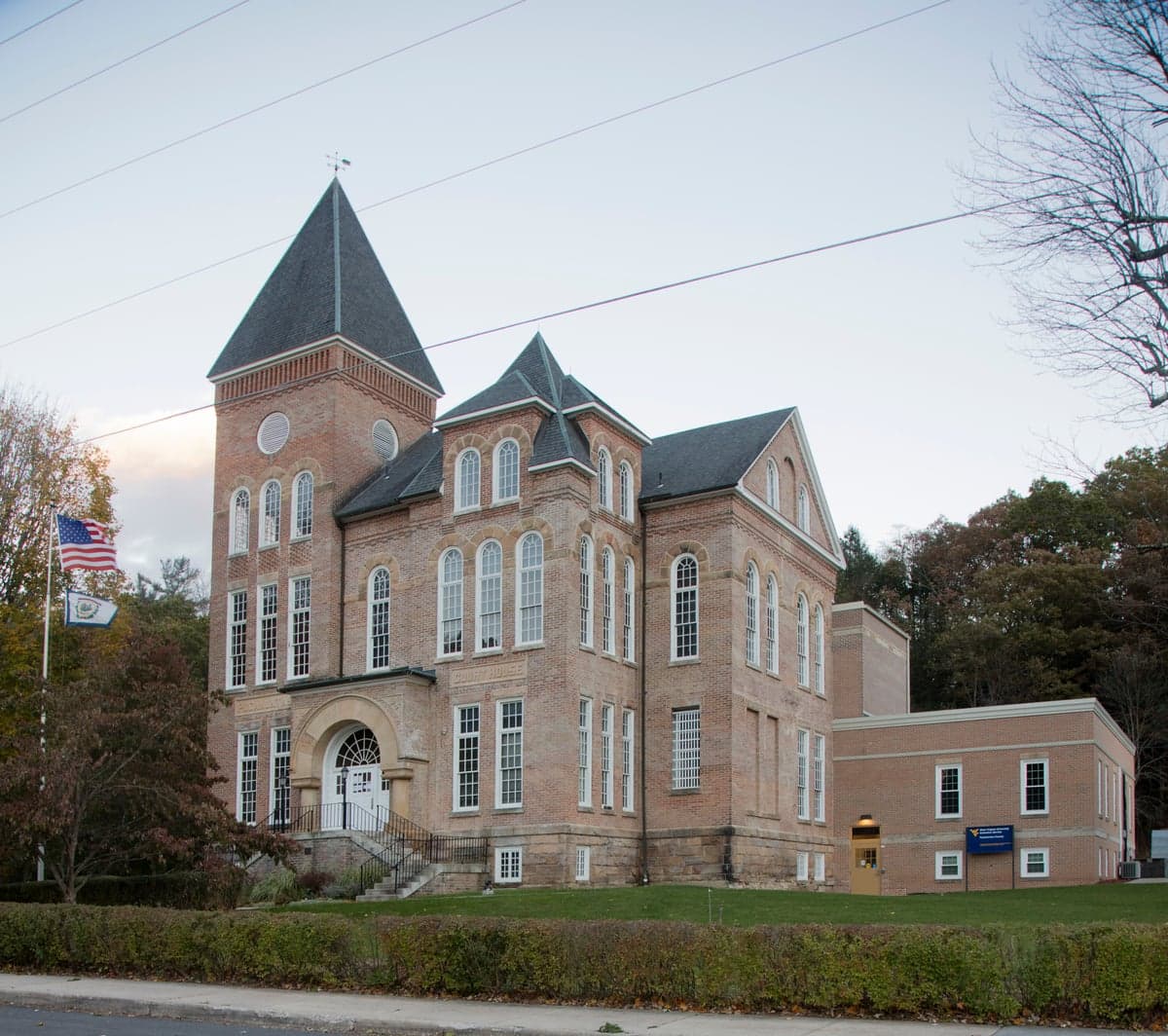
Photo: Wikipedia
Demographics of Pocahontas County
Affluence Level in Pocahontas County
A low-income area with significant economic hardship. Household wealth and educational attainment are well below national averages.
People of Pocahontas County
The people of Pocahontas County, West Virginia today number just 7,855, making it one of the most sparsely populated counties east of the Mississippi. The population is overwhelmingly white (94.5%) and native-born, with a foreign-born share of just 0.1% — one of the lowest in the nation. This is a deeply rooted, rural Appalachian community shaped by centuries of isolation, resource extraction, and out-migration, where a college education rate of 15.8% reflects an economy historically tied to manual labor rather than knowledge industries.
Settlement & growth (pre-1960)
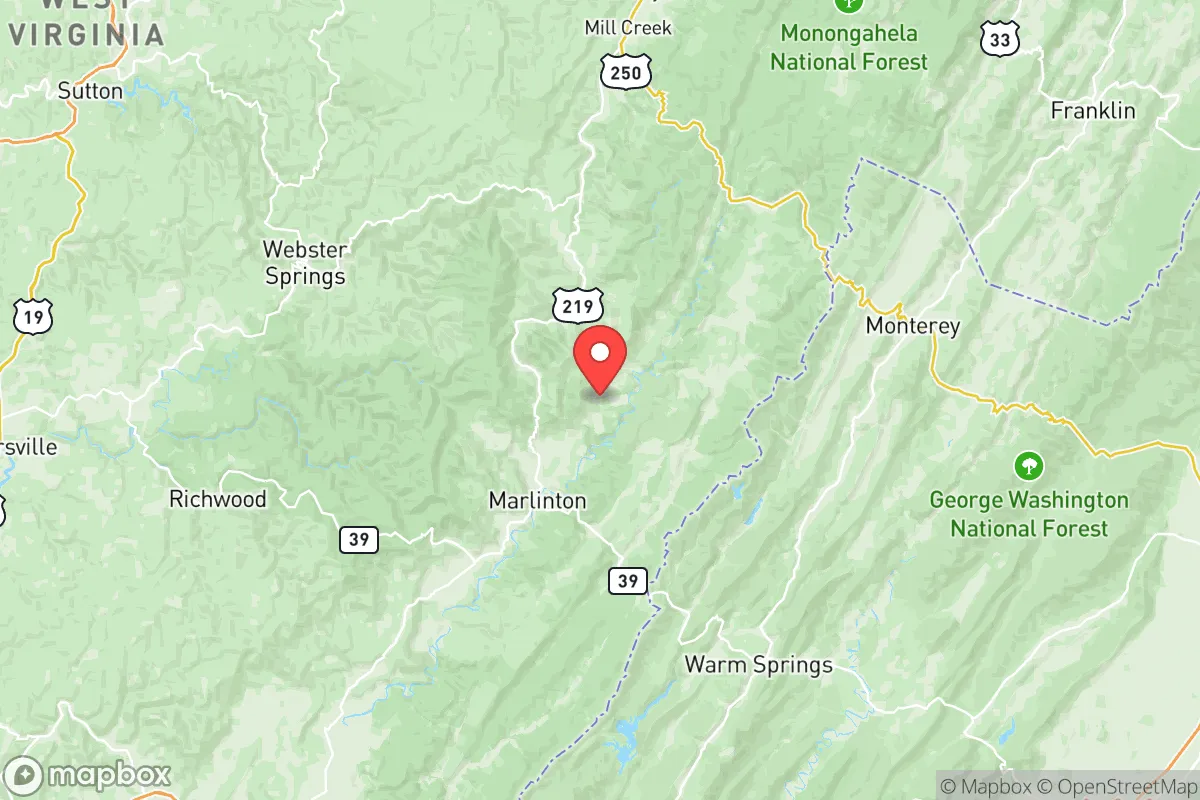
Long before European settlers arrived, the region that is now Pocahontas County was hunting and foraging ground for the Seneca, Shawnee, and Cherokee nations. The dense forests and rugged Allegheny Mountain terrain made it a seasonal resource zone rather than a permanent settlement site. No major Native villages stood within the county's boundaries, but the Seneca Trail — a major north-south war and trade path — ran through what is now the town of Marlinton, the county seat.
European settlement began in earnest after the American Revolution, when Virginia land grants drew Scots-Irish and English pioneers into the Greenbrier Valley. The first permanent settlers arrived around 1769, pushing up the Greenbrier River from the southeast. These were subsistence farmers and hunters, carving homesteads out of steep hollows. The county was formally created in 1801 from parts of Bath, Pendleton, and Greenbrier counties, named after the Powhatan Confederacy's paramount chief — an unusual honor in a region that had seen little direct Native conflict.
The 19th century brought a slow trickle of German-speaking settlers, mostly from Pennsylvania and the Shenandoah Valley, who established small farms in the flatter bottomlands around Hillsboro and Buckeye. These families were Lutheran and Reformed, adding a distinct religious layer to the dominant Scots-Irish Presbyterianism. By 1850, the county's population had reached roughly 4,000, almost entirely white and native-born.
The Civil War split Pocahontas County, as it did much of western Virginia. The county sent men to both Union and Confederate regiments, and the region saw sporadic guerrilla fighting. After the war, the economy shifted from subsistence farming toward timber and, later, railroad construction. The arrival of the Chesapeake & Ohio Railway's Greenbrier Division in the 1890s opened the county's vast hardwood forests to industrial logging. Towns like Cass and Durbin sprang up as company towns, populated by native-born Appalachian loggers and a small number of Italian and Irish laborers brought in to build the railroad spurs. By 1910, the population peaked at 15,000 — nearly double today's figure.
The timber boom collapsed by the 1930s, and the county entered a long demographic decline. The Great Depression hit hard, and the creation of the Monongahela National Forest in the 1920s and 1930s locked up vast tracts of land, limiting future agricultural or industrial expansion. Young people began leaving for factory jobs in Ohio, Michigan, and the Mid-Atlantic. The population fell steadily from 15,000 in 1910 to 8,000 by 1960.
Modern era (post-1965)
The 1965 Hart-Cellar Act had virtually no effect on Pocahontas County. With no urban industrial base, no major university, and no existing immigrant community to anchor chain migration, the foreign-born population has remained below 0.2% for decades. The county's demographic story since 1965 is entirely one of domestic out-migration and natural decline.
From the 1970s through the 1990s, the county lost roughly 1,000 residents per decade. The collapse of the railroad industry and the mechanization of logging eliminated most remaining blue-collar jobs. Young adults continued to leave for college or for work in Charleston, Roanoke, or the Washington, D.C. suburbs. The population aged: by 2000, the median age had climbed to 44, well above the national average.
A modest counter-trend emerged in the 1990s and 2000s: amenity migration. Retirees and second-home buyers from the Mid-Atlantic and Northeast began purchasing land and vacation homes, drawn by the county's low property prices, trout fishing, and proximity to Snowshoe Mountain Resort. The resort, built in the 1970s around Snowshoe village, became the county's largest employer and a year-round tourist destination. This brought a small influx of younger service workers — ski instructors, restaurant staff, hospitality managers — but most were white and native-born, and few stayed permanently. The town of Slatyfork, near Snowshoe, saw the most visible growth, with new vacation rentals and a handful of boutique businesses catering to tourists.
Racial and ethnic diversity has remained negligible. The 2020 Census recorded a population that was 94.5% white, 0.9% Hispanic, 0.4% Black, 0.2% East/Southeast Asian, and 0.1% Indian (subcontinent). The Hispanic share, though tiny, is the county's fastest-growing demographic, driven by a small number of migrant workers in the timber and Christmas tree industries. These workers are overwhelmingly Mexican-born and tend to be seasonal rather than permanent residents.
The future
Pocahontas County's population is projected to continue its slow decline, falling below 7,500 by 2035 under most state forecasts. The county has a death rate roughly double its birth rate, and net in-migration is insufficient to offset natural decrease. The aging of the baby boom generation will accelerate this trend, as the large cohort of retirees who moved to the county in the 1990s and 2000s passes away.
The county is not becoming more diverse. The Hispanic population may grow modestly as the Christmas tree and logging industries continue to rely on seasonal labor, but permanent settlement is unlikely given the lack of a co-ethnic community, affordable housing shortages in resort areas, and limited social services. The East/Southeast Asian and Indian populations are essentially zero and will remain so absent a major economic shock — a new factory, a data center, or a university — none of which is on the horizon.
What growth does occur will concentrate in the Snowshoe corridor — the Snowshoe and Slatyfork area — and in Marlinton, which serves as the county's commercial and government hub. Remote work, accelerated by the pandemic, has brought a small wave of younger telecommuters to the county, particularly to Hillsboro and Marlinton, where historic homes and fiber-optic internet are available. These newcomers are mostly white, college-educated, and politically moderate, creating a quiet cultural tension with the older, more conservative native population.
Culturally, the county is becoming a hybrid of two Americas: a shrinking, aging native Appalachian population rooted in timber and farming traditions, and a small but growing cohort of amenity migrants and remote workers who value the landscape over the local economy. The county's identity as a "mountain getaway" is likely to deepen, while its identity as a working community of loggers and farmers will continue to fade.
For someone moving in now, Pocahontas County offers extreme isolation, low crime, and stunning natural beauty — but also a shrinking tax base, limited healthcare access, and a population that is older, whiter, and less educated than almost anywhere else in the country. It is a place for those seeking solitude and self-reliance, not community growth or diversity.

* Values derived from national, state, county, city and local statistics and may differ in a specific area. Last updated: 2026-11-11T23:11:40.000Z
Narrative content on this page is AI-generated and may contain mistakes. Verify any details that matter before acting on them.
ReloMaps may earn a commission from affiliate links at no extra cost to you.

