Demographics of Mcdowell County
Affluence Level in Mcdowell County
A low-income area with significant economic hardship. Household wealth and educational attainment are well below national averages.
People of Mcdowell County
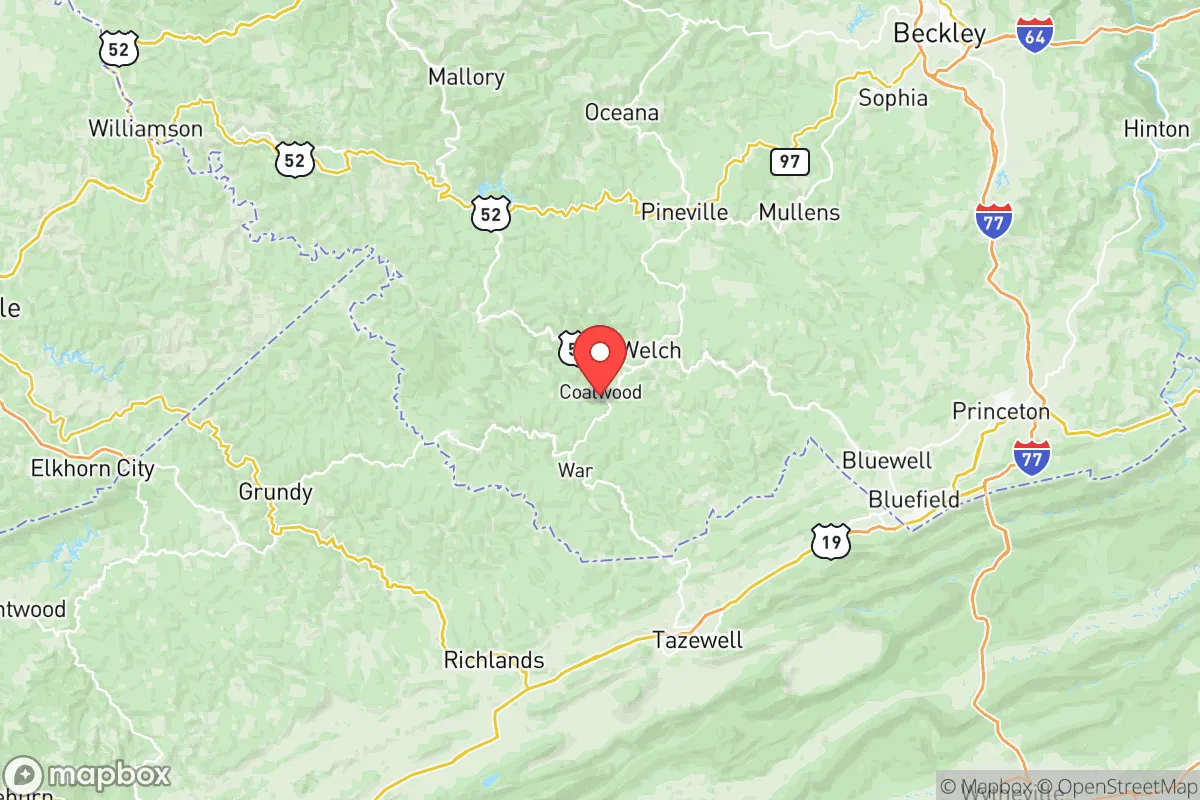
The people of McDowell County, West Virginia, today number roughly 18,400, making it one of the most rural and least densely populated counties in the state. Its population is overwhelmingly white (86.7%) with a significant Black minority (9.0%), reflecting a history deeply rooted in the coal industry that once drew thousands of workers from the American South and Appalachia. With a foreign-born population of just 1.3% and a college attainment rate of only 5.7%, the county's identity is shaped by its working-class origins, economic decline, and a strong sense of place among families who have remained through booms and busts.
Settlement & growth (pre-1960)
Before European settlement, the area now known as McDowell County was part of the vast hunting grounds of the Cherokee and Shawnee nations. These Native peoples used the rugged, forested terrain along the Tug Fork River for seasonal hunting and travel, but no permanent settlements existed due to the mountainous landscape. European exploration was minimal until the mid-1700s, with the region remaining a sparsely visited frontier corridor between Virginia and Kentucky.
The first permanent settlers arrived in the late 18th and early 19th centuries, predominantly Scots-Irish and English pioneers pushing westward through the Appalachian valleys. These early families—names like Hagy, Hatfield, and Blankenship—established subsistence farms in narrow hollows and along creeks like Huff Creek and North Fork. Towns such as Welch, the county seat founded in 1893, grew slowly as agricultural hubs. For most of the 1800s, McDowell remained a remote, thinly populated corner of Virginia, with fewer than 3,000 residents by 1850.
The transformative event was the arrival of the Norfolk & Western Railway in the 1880s and 1890s. McDowell County sat atop one of the richest bituminous coal seams in the world—the Pocahontas No. 3 seam—and the railroad opened it to industrial extraction. Between 1890 and 1920, the county's population exploded from around 7,000 to over 60,000, making it briefly one of the most densely populated rural counties in America. This boom drew two primary waves: white native-born Appalachians from surrounding counties (Raleigh, Wyoming, Mercer) and, crucially, tens of thousands of African American workers from Virginia, North Carolina, and Alabama. These Black migrants came seeking higher wages in the mines, forming substantial communities in coal camps and towns such as Keystone, Northfork, and Coalwood. By 1930, Black residents made up roughly 30% of McDowell's population—one of the highest proportions in Appalachia. Italian and Polish immigrants also arrived in smaller numbers, working alongside native-born miners in camps like Davy and Anawalt, though their presence was less concentrated than in northern West Virginia coal fields.
This era defined McDowell's character: a boom-and-bust coal economy, racial segregation in housing and public life (Keystone had a thriving Black business district, but most camps were segregated by race), and a fiercely independent, union-organized workforce. The United Mine Workers of America gained a stronghold here, and the county became a center of labor activism, including violent strikes in the 1920s and 1930s. Population peaked at 98,887 in 1950, just as mechanization began to reduce mining jobs.
Modern era (post-1965)
The 1965 Hart-Cellar Act, which reshaped U.S. immigration nationally, had virtually no effect on McDowell County. The foreign-born population today is negligible (1.3%), and no new immigrant enclaves formed. Instead, the county's modern demographic story is one of sustained, catastrophic outmigration. Mechanization in the mines, the decline of the coal industry, and the rise of competing energy sources (natural gas, renewables) caused McDowell's population to collapse from nearly 99,000 in 1950 to 18,413 in 2024—a loss of over 80%. Families who had been in the county for three or four generations left for industrial jobs in Ohio, Michigan, and the Carolinas, or for government and service work in Charleston and Roanoke.
The racial composition shifted dramatically during this period. The white population remained the majority, but the Black share fell from around 30% in 1950 to 9.0% today. This decline reflects the departure of Black families who had moved here for mining work and left as jobs vanished, often heading to urban centers like Detroit, Cleveland, or Washington, D.C. The remaining Black community is concentrated in the county's southern towns: Keystone (which remains a historic Black enclave), Northfork, and parts of Welch. The Hispanic population is tiny (1.9%) and dispersed, with no distinct barrio; most are recent arrivals working in the few remaining mines or service jobs. East/Southeast Asian residents account for just 0.1% of the population, and Indian-subcontinent residents are at 0.0%, reflecting no meaningful migration to this remote area.
County status as a federally designated Persistently Poor County since the 1960s has shaped modern life. Outmigration has been heavily selective: younger, educated adults leave, while older, less mobile residents remain. The median age is over 48, well above the national median. Gary, once a thriving company town of 800 miners at its peak, now has fewer than 400 residents. War, another former coal camp, has seen its population drop below 200. The county's few remaining schools struggle with declining enrollment, and healthcare access is limited to the county hospital in Welch and a handful of clinics.
The future
The county's population is projected to continue shrinking for at least the next decade. The remaining resident base is elderly (roughly 22% are over 65), with fewer than 1,400 children under 10, suggesting a natural decline as deaths outpace births. No major new industry is expected to reverse the trend—coal mining employed about 1,200 people as of 2024, down from over 15,000 in the 1950s, and tourism and remote work have made only marginal inroads. The county's extreme rurality, poor connectivity (limited broadband), and low education levels (only 5.7% hold a college degree) make it unattractive to in-migration from outside Appalachia.
Diversity will remain low. The Black population is likely to continue shrinking as older residents pass away and few new Black families move in. The Hispanic share may grow slightly if some workers settle in the region's small service sector, but overall racial/ethnic composition will remain overwhelmingly white and native-born. A modest counter-trend may emerge as retirees or second-home buyers from nearby states buy land in areas like Bradshaw or Roderfield, drawn by low property prices and scenic isolation, but this will not offset the broader decline.
For someone moving in now, McDowell County offers a stark, honest picture: a place where community is deeply rooted but thinning, where the cost of living is extremely low but opportunities are few. It is not growing, diversifying, or gentrifying. It is a county preserving its coal-country heritage and tight-knit character, but demographic data points to a future of continued contraction, with a smaller, older, and whiter population holding on to a vanishing way of life.

* Values derived from national, state, county, city and local statistics and may differ in a specific area. Last updated: 2026-06-29T03:23:13.000Z
Narrative content on this page is AI-generated and may contain mistakes. Verify any details that matter before acting on them.
ReloMaps may earn a commission from affiliate links at no extra cost to you.

